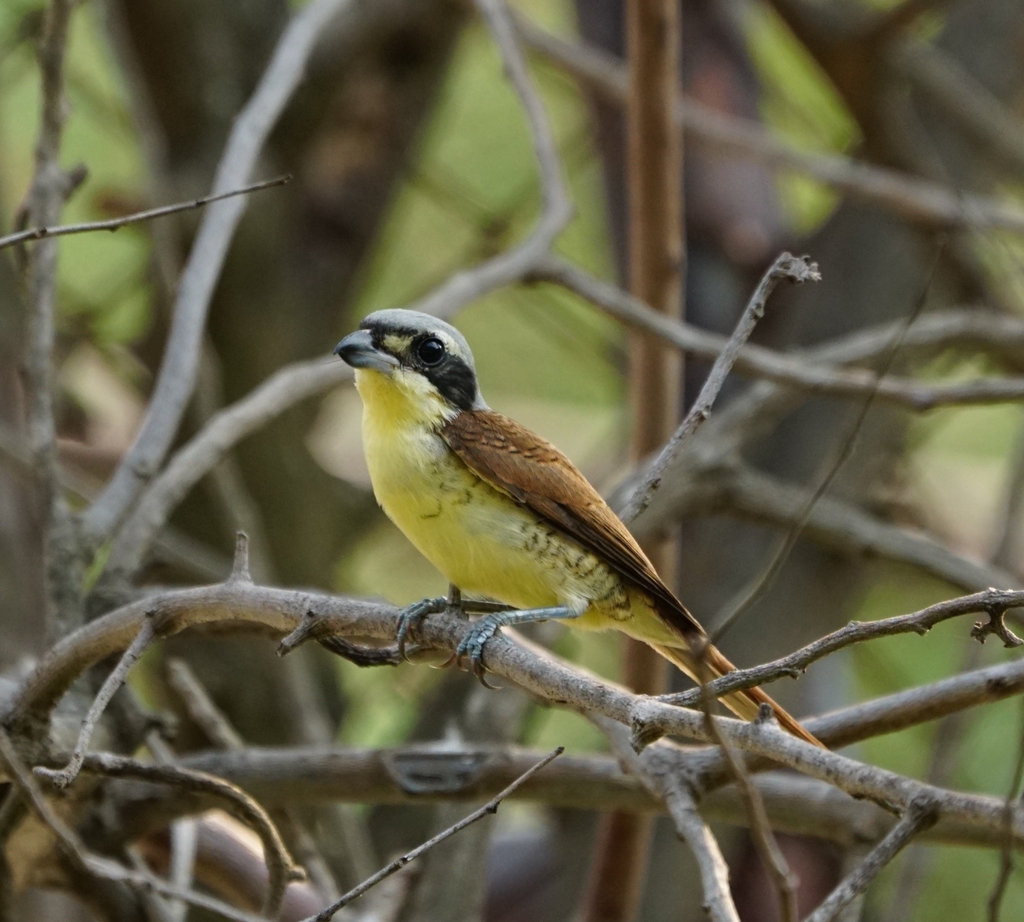
Tiger Shrike
Photo © Focus Saranpat Ouilapan
Photo © Focus Saranpat Ouilapan — CC BY 4.0 — Source: iNaturalist #206406755Identification
The tiger shrike is a small, stocky shrike measuring 17–19 cm long, earning its name from the striking tiger-like barred pattern on its reddish-brown upperparts. Adult males are distinctively marked with a grey crown and nape, bold black forehead and mask, and clean white underparts. Females are considerably duller and browner, with a less prominent mask, narrower white eyebrow stripe, and buff-white flanks showing black barring. Juveniles lack the grey and black head markings altogether, instead displaying dark scale-like markings on the head, back and underparts, with a pale eye-ring that makes their eye appear disproportionately large. All ages show the characteristic thick blue-black bill with black tip, and grey-black legs typical of the genus Lanius.
When identifying tiger shrikes in the field, note their smaller, stockier build compared to similar species. The brown shrike is noticeably larger with a longer tail and thinner bill, while the bull-headed shrike is also more robust and longer-tailed with males showing a white wing-patch. The Burmese shrike is slimmer and longer-tailed with a plain chestnut back and white wing-patch.
Range & Habitat
This species is a migratory breeder found across eastern Asia, with its breeding range extending from Ussuriland in the Russian Far East (around 44°N) through central and eastern China, Korea, and northern and central Honshū in Japan. It favours temperate deciduous and mixed woodlands, forest edges and farmland with scattered trees, occurring mainly below 150 metres in Russia, 800 metres in Japan, and 900 metres in China. The species undertakes a substantial southward migration in August and September, wintering across tropical and subtropical south-east Asia from south-eastern China through eastern Burma, Thailand, Laos and Vietnam to Malaysia and Indonesia, occasionally reaching Java, Bali and Sulawesi, where it inhabits forest clearings, cultivated land, mangroves and gardens below 1,000 metres elevation.
Though widely distributed with a fairly large population and classified as least concern, the tiger shrike has declined noticeably in recent decades, particularly in Japan and Russia, where it was once common in suburban areas including Tokyo suburbs but is now uncommon and local.
Behaviour & Diet
The tiger shrike is a shy, solitary hunter that feeds mainly on insects—particularly grasshoppers, crickets, beetles, bugs, butterflies and moths—supplemented with other arthropods, small birds and lizards. Unlike many shrikes, it typically hunts from inconspicuous perches at the forest edge rather than from prominent exposed positions, also foraging actively among branches and leaves for prey. Its song is a musical warble, and it produces a variety of harsh calls including a loud repeated territorial call from prominent perches, a chattering alarm call, and softer trilling notes, often calling from within protective cover.
During the breeding season from May to July, pairs form during northward migration or soon after arrival on breeding grounds and remain monogamous. Males perform elaborate courtship displays, bowing repeatedly while moving their head from side to side and uttering soft subsong, as well as fast display-flights accompanied by calling. Both sexes construct a cup-shaped nest 1.5 to 5 metres above ground on tree branches, built from stems, twigs, roots and vegetation lined with grasses. Three to six eggs (most commonly five) are laid with variable coloration and dark markings on whitish, pinkish or blue-green backgrounds. The female incubates for 14–16 days, and young fledge after approximately two weeks, remaining near the nest for another fortnight.
Best Time & Places to See It
To encounter tiger shrikes on their breeding grounds, visit eastern Asia from May to June when territorial males are most vocal and active. The Russian Far East, central and eastern China, Korea, and northern Honshū offer the best opportunities during this period. For winter sightings, travel to south-east Asia from October through April, focusing on forest edges, clearings, cultivated areas and mangrove habitats across Thailand, Laos, Vietnam, Malaysia and Indonesia. Be prepared for patient observation, as this species is considerably less conspicuous than most other shrikes and favours sheltered perches within or near cover rather than exposed vantage points.
Photography Tips
Photograph males during breeding season when they perch prominently to deliver territorial calls—early morning often provides the best light and activity. Use a telephoto lens of at least 300–400mm, as tigers shrikes typically remain at middle distances and move restlessly through vegetation. The male's striking contrast between grey head, black mask and white underparts photographs beautifully in good light, while the tiger-like barring on the back requires careful exposure metering to preserve detail. Focus on birds perched at forest edges where lighting is more predictable; avoid pursuing birds deeper into dense cover where harsh shadows will ruin shots. Capture courtship displays during early breeding season if possible, as the male's bowing posture and head movements are distinctive behaviours worth documenting.
Bako National Park
Giant Panda National Park
Gunung Mulu National Park
Hat Noppharat Thara-Mu Ko Phi Phi National Park
Huanglong Scenic and Historic Interest Area
Kaeng Krachan National Park
Khao Laem Ya-Mu Ko Samet National Park
Khao Yai National Park
Laem Phak Bia
Nothing matches these filters.
No community photos yet. Log in to add the first one.
No community observations of this species yet.