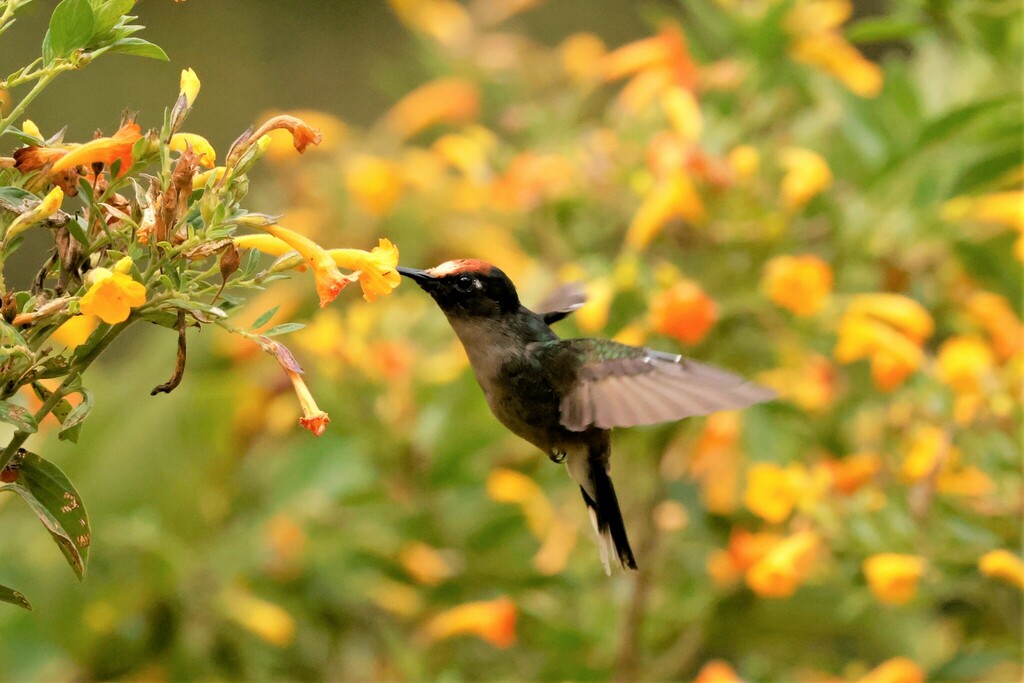
Tolima Blossomcrown
Photo © russnamitz
Photo © russnamitz — CC0 1.0 — Source: iNaturalist photo #353085570Identification
The Tolima blossomcrown is a small hummingbird, measuring just 8.4 cm (3.3 in) in length. Both sexes sport a distinctive straight black bill. Males are particularly striking, featuring a buffy white forehead contrasted with a rufous chestnut hindcrown, mostly shining green upperparts, and a rusty lower back and uppertail coverts. The underparts are grayish buff, while the tail is bronzy green with wide white tips on all but the central feathers, and a characteristic black bar near the tip on most tail feathers. Females and immatures are subtly different, with their entire crown appearing brownish rather than showing the male's contrasting pattern, but otherwise resembling adult males.
Range & Habitat
This species is endemic to Colombia, found exclusively in the upper Magdalena River Valley as it flows through the departments of Cauca, northern Huila, Tolima, and Quindío. The Tolima blossomcrown inhabits the interior and edges of humid primary forest and mature secondary forest, preferring elevations between 1,200 and 2,500 m (3,900 and 8,200 ft). Unfortunately, much of its former habitat has been converted to agriculture, leaving the remaining forest highly fragmented. Despite these challenges, the species does occur in two national parks within its range.
Behaviour & Diet
The Tolima blossomcrown is believed to be sedentary, though any seasonal elevational movements remain unstudied. Like other hummingbirds, it is an active forager, believed to hunt low in the forest understory similar to its relative, the Santa Marta blossomcrown, though its specific foraging strategy and diet have not been documented. The species produces a distinctive long series of repeated tsip notes as its song. Interestingly, many aspects of its biology remain mysterious—its breeding phenology has yet to be studied, leaving much to discover about this elusive species.
Best Time & Places to See It
Finding the Tolima blossomcrown requires visiting Colombia's upper Magdalena River Valley region, particularly within or near the two national parks where the species is known to occur. The best viewing strategy involves searching humid primary and mature secondary forest between 1,200 and 2,500 m elevation in Tolima and surrounding departments. Since the species is sedentary, it should be present year-round, though the optimal season for visiting these cloud forest regions is typically during drier periods. Visitors should search the forest understory, where the bird forages low among vegetation.
Photography Tips
Photographing the Tolima blossomcrown presents challenges befitting its remote habitat and understory lifestyle. The shadowy forest interior where it forages demands fast film speeds and potentially flash supplementation to capture the male's jewel-like shining green upperparts and rusty lower back. Focus on the distinctive features: the contrasting buffy white forehead and rufous chestnut crown on males, and the bronzy green tail with its characteristic white tips and black bars. The species' small size and preference for low perches mean that patience and careful stalking will be rewarded with intimate portraits of this vulnerable Colombian endemic.
Puracé National Natural Park
Puracé, Colombia
+327 birds+2 mammals
Where the Andes thrust upward across southwestern Colombia, Puracé National Natural Park spans nearly 2,631 square kilometers of some of South America's most dramatic montane terrain.…
VIEW NATIONAL PARKGuácharos Cave National Natural Park
Acevedo, Colombia
+359 birds
High in the Andean foothills of southern Huila, where mist-laden slopes rise above 1,600 metres, lies a landscape carved by underground rivers and crowned by karst…
VIEW NATIONAL PARKNo community photos yet. Log in to add the first one.
No community observations of this species yet.