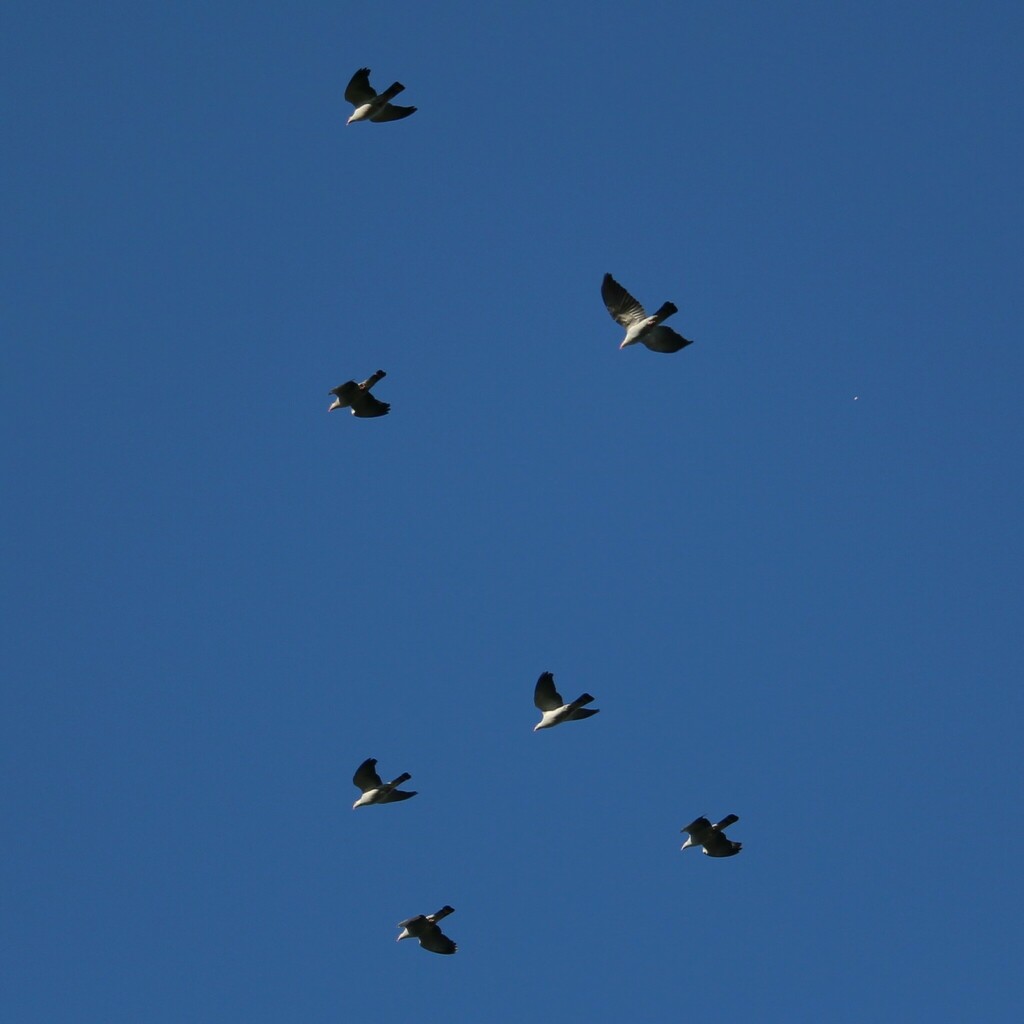
Topknot Pigeon
Photo © Natasha Taylor
Photo © Natasha Taylor — CC BY 4.0 — Source: iNaturalist #140737835Identification
The topknot pigeon is a large pigeon measuring 40–46 centimetres in length, predominantly slate-grey with distinctive features that make it readily identifiable. Its most striking characteristic is the prominent crest: grey from the cere to the forehead, becoming russet-brown on the crown with black sides. The back and wing coverts are darker slate-grey with black quills, while the primaries are black and the remaining body is lighter slate-grey. The chest and hind neck show a streaked appearance from dark bases showing through lighter feathers. The tail is black crossed with a broad grey band. The mandibles are red with brown tips, and the feet and tarsals are purplish-red. The eye is distinctive: yellow-golden with a bright red outer band. Males have larger crests and less chest streaking than females, while juveniles are similar to females but with smaller crests and mottled rather than streaked chests.
The species is also known locally as the "flock pigeon," a reference to its gregarious nature, particularly during fruiting seasons when large congregations gather at productive trees.
Range & Habitat
The topknot pigeon is endemic to eastern Australia, ranging from Cape York Peninsula in Queensland south to the central south coast of New South Wales. These birds are highly nomadic, covering great distances in search of fruiting trees and occasionally appearing far beyond their normal range. They have been recorded in eastern Victoria and, exceptionally, in Tasmania—with historical specimens from 1907 and 1953 representing rare incursions into that state. The species is entirely dependent on rainforest habitat, particularly areas with abundant fruiting trees and palms.
Once occurring in enormous numbers throughout Australian rainforest, populations declined significantly due to forest clearance and historical shooting. However, recent conservation efforts and the availability of new food sources, particularly camphor laurel fruits, have contributed to a resurgence in their numbers.
Behaviour & Diet
The topknot pigeon has a strictly frugivorous diet, feeding exclusively on fruit from various rainforest species, particularly Ficus and other native fruit trees. Unlike many pigeon species, it does not use grit in its crop to process seeds, meaning seeds are defecated intact. This adaptation makes the species an important seed disperser, distributing seeds not only beneath fruiting trees where it feeds but also at roosting sites.
The species produces three distinct vocalizations: 'coo-oo, eee,' 'coo-oo, ooo,' and 'cor-or'—the latter a quiet, croaky, almost guttural call similar to domestic pigeons. During mass flocking and feeding, it produces a short raucous call described as resembling a distant flying fox or domestic pig. Breeding occurs from June to December, timed with fruit ripening. Nests, built of stout sticks from turpentine and eucalyptus trees, can range from flimsy to substantial. A single ovate egg (approximately 43 by 30 mm) is laid, with incubation lasting 17–24 days and both sexes sharing incubation duties.
Best Time & Places to See It
Topknot pigeons are most reliably encountered during the fruiting season when they congregate in large flocks at productive trees. The timing varies throughout their range as different fruit species ripen at different times of year. While they can appear unpredictably, they are most consistent in rainforest areas of Queensland and northern New South Wales where fruiting cycles are predictable.
The species is currently classified as Least Concern by the IUCN, and populations appear to be stable to increasing. Patient observation of fruiting rainforest trees, particularly during peak fruiting periods, offers the best chance of encountering these gregarious birds.
Photography Tips
The topknot pigeon's large size and distinctive plumage make it a rewarding photographic subject. The striking eye with its yellow-golden iris and bright red outer ring is a key detail worth capturing. The russet-brown crown and crest are particularly prominent when the bird is alert, so focus on head detail when possible. Males' larger crests and less-streaked chests offer subtle but photographable sexual dimorphism.
Flocking behavior during fruiting season creates opportunities for group compositions. Early morning or late afternoon light will best showcase the slate-grey plumage and highlight the contrast between the darker back and lighter underparts. Position yourself near actively fruiting trees, particularly native Ficus species, and remain patient—the birds' nomadic nature and tendency to appear suddenly at favored feeding sites reward persistence.
Kroombit Tops National Park
Valentine Plains, Australia
+152 birds+6 mammals
Where eucalypt woodlands rise into sandstone plateaus, Kroombit Tops unfolds across nearly 906 square kilometres of northeastern Queensland's most biodiverse terrain. The park's defining feature is…
VIEW NATIONAL PARKNerang National Park
Gold Coast, Australia
+126 birds+13 mammals
Steep subtropical rainforest clads the hinterland ridges of southeast Queensland's Gold Coast, where Nerang National Park sprawls across 34 square kilometres of protected bushland between the…
VIEW NATIONAL PARKBunya Mountains National Park
Australia
+149 birds+11 mammals
Where subtropical rainforest meets open eucalyptus woodland on the elevated plateau of southeastern Queensland, Bunya Mountains National Park unfolds across 483 square kilometres of some of…
VIEW NATIONAL PARKHerberton Range National Park
Australia
+115 birds+10 mammals
Rainforest-clad ridges and rocky outcrops define this 324-square-kilometre reserve in far north Queensland, where the mountainous terrain of the Herberton Range rises through layered eucalypt woodland…
VIEW NATIONAL PARKDaintree National Park
Dedin, Australia
+362 birds+37 mammals
Daintree National Park is one of the world’s oldest and most biologically diverse tropical rainforests, protecting an extraordinary landscape where ancient forests meet the Great Barrier…
VIEW NATIONAL PARKSpringbrook National Park
Australia
+195 birds+25 mammals
Subtropical rainforest meets open eucalypt woodland across a mountainous terrain where the McPherson Range rises sharply from the Queensland coast, creating a patchwork of microclimates and…
VIEW NATIONAL PARKLamington National Park
Australia
+227 birds+24 mammals
Where subtropical rainforest rises steeply from the Queensland coast, Lamington National Park spreads across 541 square kilometres of one of Australia's most biodiverse mountain landscapes. The…
VIEW NATIONAL PARKSydney Harbour National Park
Sydney, Australia
+203 birds+26 mammals
Where Sydney Harbour's sheltered waters meet the sandstone headlands of New South Wales, a mosaic of coastal heathland, eucalyptus woodland and rocky shores creates one of…
VIEW NATIONAL PARKRoyal National Park
Sydney, Australia
+296 birds+46 mammals
Where sandstone ridges plunge toward the Tasman Sea, Royal National Park unfolds across 343 square kilometres of southeastern Australian coastal wilderness. The park's defining character emerges…
VIEW NATIONAL PARKEndeavour River National Park
Philadelphia, Australia
+203 birds+1 mammals
Where the Endeavour River winds through northeastern Queensland's tropical lowlands, a compact mosaic of rainforest, open woodland, and riverine corridor creates one of Australia's most ecologically…
VIEW NATIONAL PARKMorton National Park
Australia
+253 birds+57 mammals
Across nearly 4,800 square kilometers of New South Wales's Southern Tablelands, rugged sandstone plateaus rise above sheltered valleys where cool-climate eucalypt woodland meets grassy heath and…
VIEW NATIONAL PARKGlass House Mountains National Park
Australia
+151 birds+8 mammals
Conical peaks of volcanic origin rise dramatically from the coastal lowlands of southeastern Queensland, their weathered slopes cloaked in eucalyptus woodland and open sclerophyll forest that…
VIEW NATIONAL PARKBribie Island National Park
Brisbane, Australia
+284 birds+20 mammals
Across tidal flats and shallow waterways north of Brisbane, Bribie Island National Park spreads across nearly four hundred square kilometres of subtropical coastal wilderness—a patchwork of…
VIEW NATIONAL PARKWhitsunday Islands National Park
Whitsundays, Australia
+163 birds+9 mammals
Crystalline waters lap against seventy-four islands where rainforest canopies tumble down to pristine beaches and coral gardens flourish in the shallows. This archipelago off Queensland's coast…
VIEW NATIONAL PARKGreat Sandy National Park
Australia
+306 birds+40 mammals
Where coastal dunes rise inland from the Queensland coastline, Great Sandy National Park encompasses a landscape of remarkable ecological diversity shaped by subtropical humid conditions year-round.…
VIEW NATIONAL PARKGirringun National Park
Australia
+231 birds+10 mammals
Where granite gorges cleave through subtropical woodland in North Queensland, Girringun National Park unfolds across rugged terrain shaped by millions of years of weathering and erosion.…
VIEW NATIONAL PARKWooroonooran National Park
Australia
+240 birds+28 mammals
Where the Great Dividing Range rises sharply inland from Queensland's tropical coast, Wooroonooran National Park encompasses a landscape of steep, forested gorges and cascading waterways carved…
VIEW NATIONAL PARKNoosa National Park
Marcus Beach, Australia
+216 birds+8 mammals
Subtropical eucalypt woodland and open forest meet coastal heathland along the Noosa Peninsula, where the temperate waters of the Tasman current moderate the Queensland climate into…
VIEW NATIONAL PARKBlue Mountains National Park
Australia
+220 birds+43 mammals
Dramatic sandstone cliffs rise in tiers across this mountainous plateau west of Sydney, their rust-coloured faces weathered into amphitheatres and gorges where eucalyptus forest clings to…
VIEW NATIONAL PARKBouddi National Park
Gosford, Australia
+147 birds+17 mammals
Sandstone ridges rise sharply from the Tasman Sea along the central New South Wales coast, their weathered faces etched by millennia of salt spray and storm…
VIEW NATIONAL PARKKu-ring-gai Chase National Park
Sydney, Australia
+216 birds+39 mammals
Where Hawkesbury sandstone cliffs plunge toward sheltered bays and creeks, Ku-ring-gai Chase National Park unfolds across rugged terrain just north of Sydney, a mosaic of eucalyptus…
VIEW NATIONAL PARKBarrington Tops National Park
Australia
+175 birds+47 mammals
Where the New England Plateau rises above the Hunter Valley, temperate rainforest cloaks the highest reaches of Barrington Tops, its dense canopy fed by year-round precipitation…
VIEW NATIONAL PARKDorrigo National Park
Gleniffer, Australia
+172 birds+17 mammals
Where subtropical rainforest transitions into cool temperate woodland, Dorrigo National Park rises across the volcanic tablelands of far northern New South Wales, cloaked in the perpetually…
VIEW NATIONAL PARKOxley Wild Rivers National Park
Australia
+202 birds+45 mammals
Where the New England Tablelands descend toward the coast, river gorges carve through temperate forests in a landscape of dramatic geological contrast. Oxley Wild Rivers National…
VIEW NATIONAL PARKNew England National Park
Australia
+169 birds+35 mammals
Temperate eucalypt woodlands and cool rainforest pockets define this upland reserve where granite peaks rise above the New England Plateau in northeastern New South Wales. Here,…
VIEW NATIONAL PARKBen Boyd National Park
Eden, Australia
+255 birds+47 mammals
Where the temperate forests of the far south coast meet towering sea cliffs, Ben Boyd National Park unveils one of New South Wales' most dramatic coastal…
VIEW NATIONAL PARKNo community photos yet. Log in to add the first one.
No community observations of this species yet.