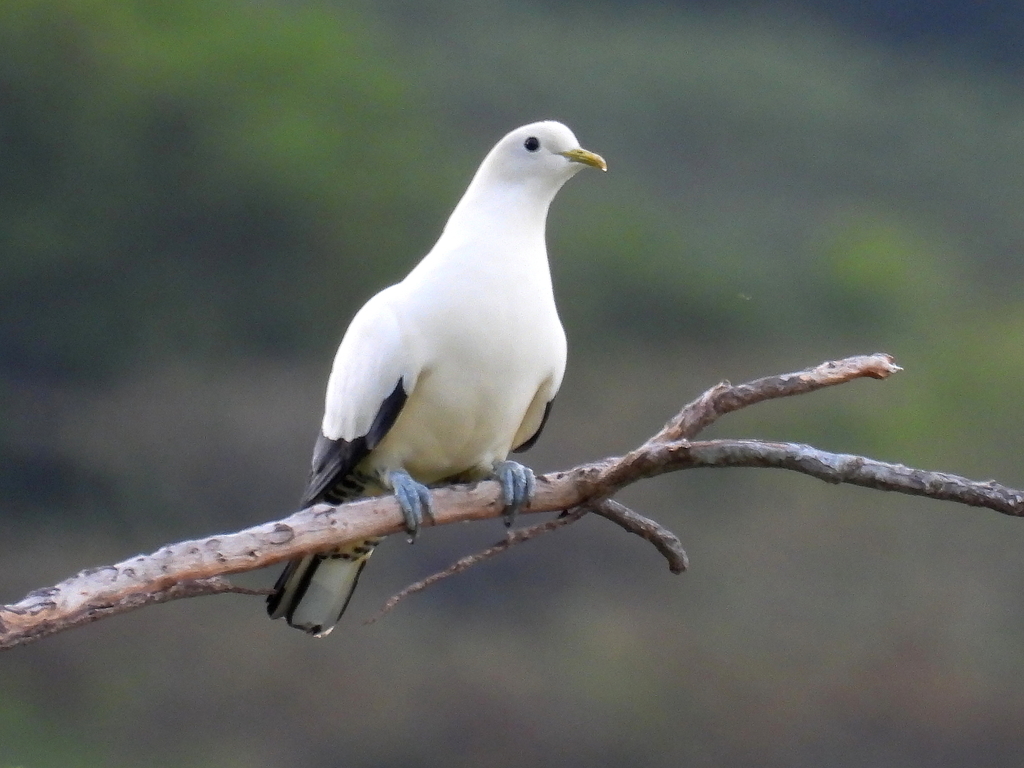
Torresian Imperial Pigeon
Photo © Graham Winterflood
Photo © Graham Winterflood — CC BY-SA 4.0 — Source: iNaturalist photo #104313294Identification
The Torresian imperial pigeon is a large, robust pigeon measuring 38–44 centimetres in length with a wingspan of approximately 45 centimetres. Its most striking feature is its predominantly white or pale cream plumage, which contrasts sharply with black flight feathers, dark tail feathers, and black spots on the undertail coverts. This distinctive pied pattern makes it unmistakable in flight. The head may appear brown or soiled from feeding on fruit, a useful field mark that hints at the bird's dietary specialization.
Range & Habitat
This species is found across a broad region spanning northern Australia, New Guinea, and various Indonesian archipelagos. In Australia, its range includes north-east Western Australia, the northern Northern Territory, north Queensland, and the Torres Strait Islands. Its distribution extends through the Aru Islands, Geelvink Bay islands, D'Entrecasteaux Islands, and the Louisiade Archipelago. The pigeon favours forest, woodland, savanna, mangrove and scrub habitats.
Most populations are resident year-round, though the Queensland population is notably migratory, departing for New Guinea between February and April and returning in July and August. The species has occasionally been recorded as a vagrant in New South Wales.
Behaviour & Diet
The Torresian imperial pigeon is highly specialized for fruit-eating, feeding almost exclusively on arboreal fruits. Remarkably, it can swallow fruits with very large seeds, later regurgitating or excreting the seeds whole depending on their size. This frugivorous diet makes it an important seed disperser throughout its range. The bird's flight is fast and direct, characterized by regular wing beats and occasional sharp flicks typical of pigeons generally.
During breeding season (August to January in Australia), males perform a distinctive display: they fly steeply upward, pause, tip forward, and glide downward. The female constructs a simple untidy stick nest, typically in a coconut palm or mangrove, and lays a single white egg. The egg hatches after 26 to 28 days, and the young fledges after a further three weeks. In north-east Queensland, birds make daily commutes as flocks from breeding islands to mainland rainforests to feed, returning to islands at dusk. The species produces deep, sonorous calls: "mrrrooooo", "roo-ca-hoo", and "up-ooooo".
Best Time & Places to See It
In Australia, the best viewing opportunities occur between August and January when breeding populations concentrate on offshore islands such as the Brook Islands. The population in Weipa, Cape York Peninsula, is particularly thriving in recent decades; flocks can be observed feeding twice daily on Carpentaria Palms in suburban areas from August onwards. The Queensland migratory population returns from July through August, making this an excellent season for observation in coastal north Queensland.
Photography Tips
The pigeon's striking white and black contrast provides excellent photographic opportunities, particularly during flight when the dark remiges and tail feathers stand out against the pale body. Early morning and dusk offer the best light, especially when photographing the daily commutes between islands and feeding grounds. The birds' gregarious nature means you may encounter flocks, offering chances for flock photography. Patience near fruiting trees, particularly palms, can yield feeding behaviour shots. The birds' fast, direct flight requires a fast shutter speed and continuous autofocus to capture sharp images in flight.
Herberton Range National Park
Australia
+115 birds+10 mammals
Rainforest-clad ridges and rocky outcrops define this 324-square-kilometre reserve in far north Queensland, where the mountainous terrain of the Herberton Range rises through layered eucalypt woodland…
VIEW NATIONAL PARKKakadu National Park
Kakadu, Australia
+273 birds+46 mammals
Kakadu National Park is Australia’s largest national park and one of the world’s most remarkable protected areas, covering nearly 20,000 square kilometres in the tropical north…
VIEW NATIONAL PARKDaintree National Park
Dedin, Australia
+362 birds+37 mammals
Daintree National Park is one of the world’s oldest and most biologically diverse tropical rainforests, protecting an extraordinary landscape where ancient forests meet the Great Barrier…
VIEW NATIONAL PARKLamington National Park
Australia
+227 birds+24 mammals
Where subtropical rainforest rises steeply from the Queensland coast, Lamington National Park spreads across 541 square kilometres of one of Australia's most biodiverse mountain landscapes. The…
VIEW NATIONAL PARKAnnan River (Yuku Baja-Muliku) National Park
Australia
+78 birds
Where the Annan River winds through northeastern Queensland's coastal hinterland, a compact national park of roughly 246 square kilometers protects a mosaic of subtropical rainforest, eucalypt…
VIEW NATIONAL PARKEndeavour River National Park
Philadelphia, Australia
+203 birds+1 mammals
Where the Endeavour River winds through northeastern Queensland's tropical lowlands, a compact mosaic of rainforest, open woodland, and riverine corridor creates one of Australia's most ecologically…
VIEW NATIONAL PARKRinyirru National Park
Lakefield, Australia
+258 birds+7 mammals
Where the savanna grasslands of far north Queensland meet seasonal wetlands and eucalypt woodlands, Rinyirru National Park sprawls across more than 12,500 square kilometres of rugged,…
VIEW NATIONAL PARKWhitsunday Islands National Park
Whitsundays, Australia
+163 birds+9 mammals
Crystalline waters lap against seventy-four islands where rainforest canopies tumble down to pristine beaches and coral gardens flourish in the shallows. This archipelago off Queensland's coast…
VIEW NATIONAL PARKLitchfield National Park
Australia
+175 birds+15 mammals
Where weathered sandstone plateaus rise above the savanna woodlands of Australia's Top End, Litchfield National Park unfolds as a landscape of dramatic contrasts shaped by a…
VIEW NATIONAL PARKNitmiluk National Park
Australia
+186 birds+27 mammals
Dramatic sandstone gorges carved by the Katherine River slice through the tropical savanna of Australia's Top End, creating a landscape where escarpments tower above crystalline pools…
VIEW NATIONAL PARKGirringun National Park
Australia
+231 birds+10 mammals
Where granite gorges cleave through subtropical woodland in North Queensland, Girringun National Park unfolds across rugged terrain shaped by millions of years of weathering and erosion.…
VIEW NATIONAL PARKWooroonooran National Park
Australia
+240 birds+28 mammals
Where the Great Dividing Range rises sharply inland from Queensland's tropical coast, Wooroonooran National Park encompasses a landscape of steep, forested gorges and cascading waterways carved…
VIEW NATIONAL PARKNo community photos yet. Log in to add the first one.
No community observations of this species yet.