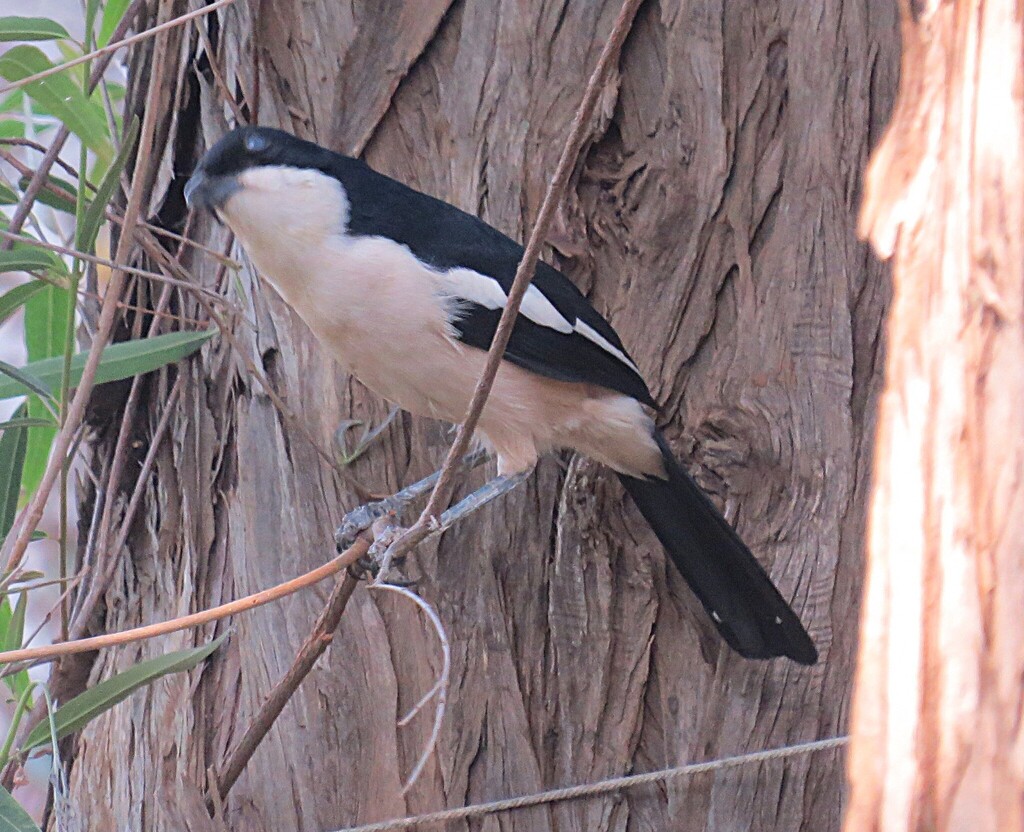
Tropical Boubou
Photo © Gerry van Tonder
Photo © Gerry van Tonder — CC BY 4.0 — Source: iNaturalist #319532720Identification
The Tropical Boubou is a fairly large bushshrike, measuring 23–25 cm in length and typically weighing 50–60 g. Males and females are identical in size and plumage, making field sexing impossible. Adults display glossy blue-black upper parts and tail, with concealed white spots on the rump visible only when wings are spread. The underparts are white, sometimes with a buffy or pinkish tinge on the breast and flanks. Most subspecies feature a distinctive white stripe on the wing coverts, occasionally extending onto the secondary remiges, while outer tail feathers may show white tips. The bill is black, legs bluish grey, and eyes dark reddish brown. Fledglings appear duller with mottled, brownish upper parts and barred plumage; immature birds gradually acquire adult coloration but retain duller wing stripes and underside markings.
Range & Habitat
The Tropical Boubou occurs throughout sub-Saharan Africa and is represented by numerous subspecies and morphs across its range. Recent research indicates this taxon is likely a cryptic species complex rather than a single species. Where sympatric with other Laniarius species, the Tropical Boubou rarely shares the same habitat, occupying distinct ecological niches across its broad distribution.
Behaviour & Diet
This species is heard far more often than seen. Its distinctive calls—bou, hou, or boubou—give the bird its name and may extend into a bubbling bobobobo sequence. Vocalizations are delivered loudly and higher-pitched when announcing territory, or lower and softer when foraging groups maintain contact. The Tropical Boubou engages in elaborate duetting, where pairs or territorial males alternate notes so rapidly they sound like a single bird. Duets typically consist of one to three calls per exchange, though up to seven exchanges have been recorded and may repeat up to 75 times. Males produce low-pitched whistles and harsh croaks, while females deliver higher whistles and harsh tearing or rattling sounds. At least a dozen duet types exist, appearing to convey specific territorial or social information. Remarkably, widowed males can produce both voices of a duet sequence alone, thanks to the avian syrinx's dual-voice capability.
Best Time & Places to See It
The Tropical Boubou is most reliably located by its vocalizations rather than visual sighting. When calling, birds move higher off the ground than during typical foraging and often perch in exposed positions, nodding their heads and bowing their bodies—behaviours that increase visibility. Listening for their characteristic calls, particularly during territorial contests, offers the best opportunity to detect and observe this secretive species in its preferred habitats across sub-Saharan Africa.
Photography Tips
Patience and sound awareness are essential when photographing the Tropical Boubou. Position yourself near vocalizing birds, as their head-nodding and body-bowing during calling provide ideal photographic moments. The glossy blue-black plumage is best captured in good light to reveal its true depth and sheen, while the white wing stripe and concealed rump markings require careful positioning to document. Early morning, when territorial duetting is most active, offers the best opportunities for both locating and photographing this vocal but elusive species.
Bwindi Impenetrable National Park
Lake Mburo National Park
Mabamba Swamp
Murchison Falls National Park
Queen Elizabeth National Park
Aberdare National Park
Amboseli National Park
Arabuko Sokoke Forest Reserve
Arusha National Park
Nothing matches these filters.
No community photos yet. Log in to add the first one.
No community observations of this species yet.