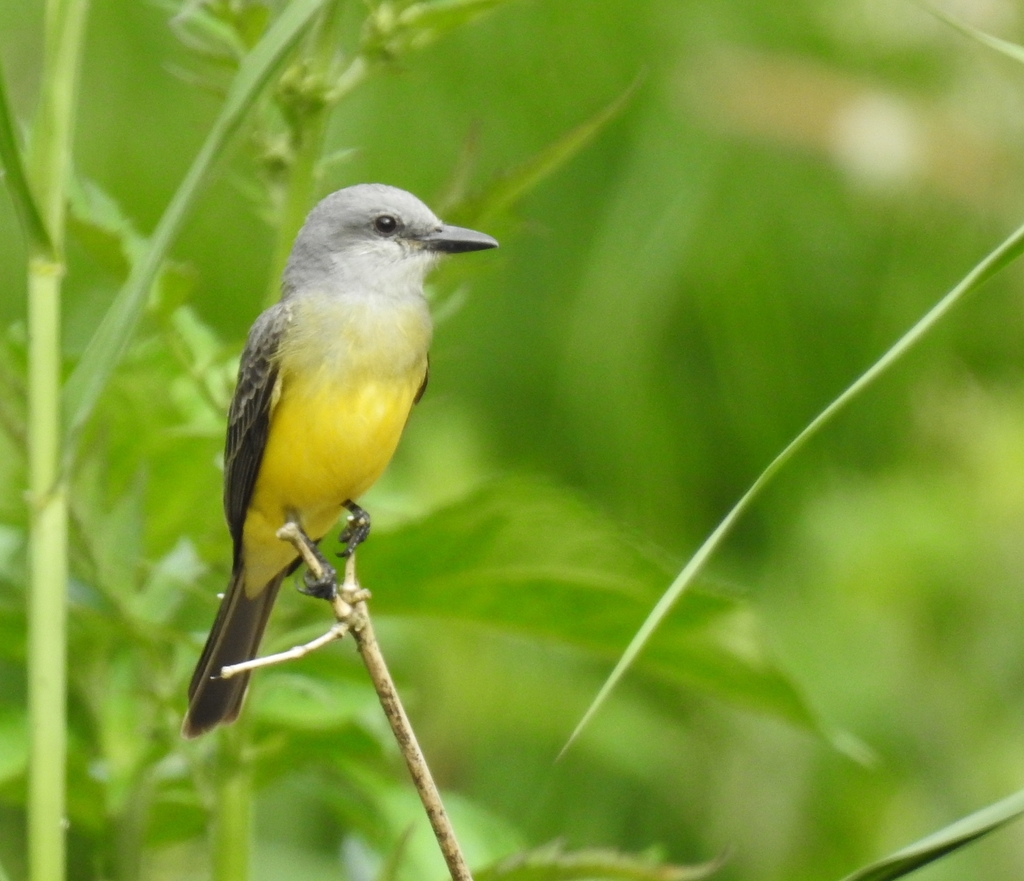
Tropical Kingbird
Photo © Esteban Poveda
Photo © Esteban Poveda — CC BY 4.0 — Source: iNaturalist photo #100825459Identification
The tropical kingbird is a large tyrant flycatcher measuring 22 cm (8.7 in) long with a wingspan of 38–41 cm. Adults are unmistakable: the head is pale gray with a distinctive darker eye mask, an orange crown stripe that gives the bird a striking appearance, and a heavy gray bill. The back is grayish-green, while the wings and forked tail are brown. The throat is pale gray, transitioning to olive on the breast, with bright yellow underparts. The sexes are similar in plumage, though young birds show pale buff edges on their wing coverts.
Range & Habitat
This species has an impressive range spanning from southern Arizona and the lower Rio Grande Valley of Texas through Central America and South America, reaching as far south as central Argentina and eastern Peru, with populations also found on Trinidad and Tobago. Birds from the northernmost and southern breeding areas migrate to warmer parts of the range after breeding, while most populations across their range are permanent residents. They favour semi-open areas with trees and shrubs, thriving in gardens, roadsides, open forest, forest edge, scrub, and agricultural land.
Behaviour & Diet
Tropical kingbirds are monogamous and typically remain in pairs year-round. They are acrobatic hunters, taking up prominent perches high in trees and undertaking long flights to catch insects mid-air through hawking, or hovering to glean food from vegetation. Their diet consists mainly of insects including beetles, bees, wasps, termites, butterflies, moths, dragonflies, and grasshoppers, supplemented with berries and fruits. These birds are fiercely territorial, aggressively defending their domain against intruders—even much larger species such as frigatebirds, toucans, caracaras, and hawks. Their call is a distinctive high-pitched twittering trill, with males delivering a more complex version at dawn.
Best Time & Places to See It
The tropical kingbird is one of the most widespread and conspicuous inhabitants of open habitats throughout its range, making it relatively easy to locate. Look for them perched prominently in trees at forest edges, in gardens, and along roadsides from southern Arizona and Texas southward through Central and South America. The species' increasing population and least-concern status reflect its adaptability to various habitats and human-modified landscapes across an enormous geographic range.
Photography Tips
Position yourself to capture the bird's distinctive features: the orange crown stripe, eye mask, and bright yellow underparts are key identifying marks. Photograph birds on open perches where they like to hunt, as they typically keep to the upper levels of trees. Early morning is excellent for capturing their dramatic aerial hawking behaviour or their striking silhouette against the sky. The contrast between their gray head and yellow belly, combined with the forked tail, makes for striking compositional opportunities.
Alaska Maritime National Wildlife Refuge
Amacayacu National Park
Amazônia National Park
Anavilhanas National Park
Antisana National Park
Araucárias National Park
Arenal Volcano National Park
Arrecifes de Cozumel National Park
Bahuaja Sonene National Park
Nothing matches these filters.
No community photos yet. Log in to add the first one.
No community observations of this species yet.