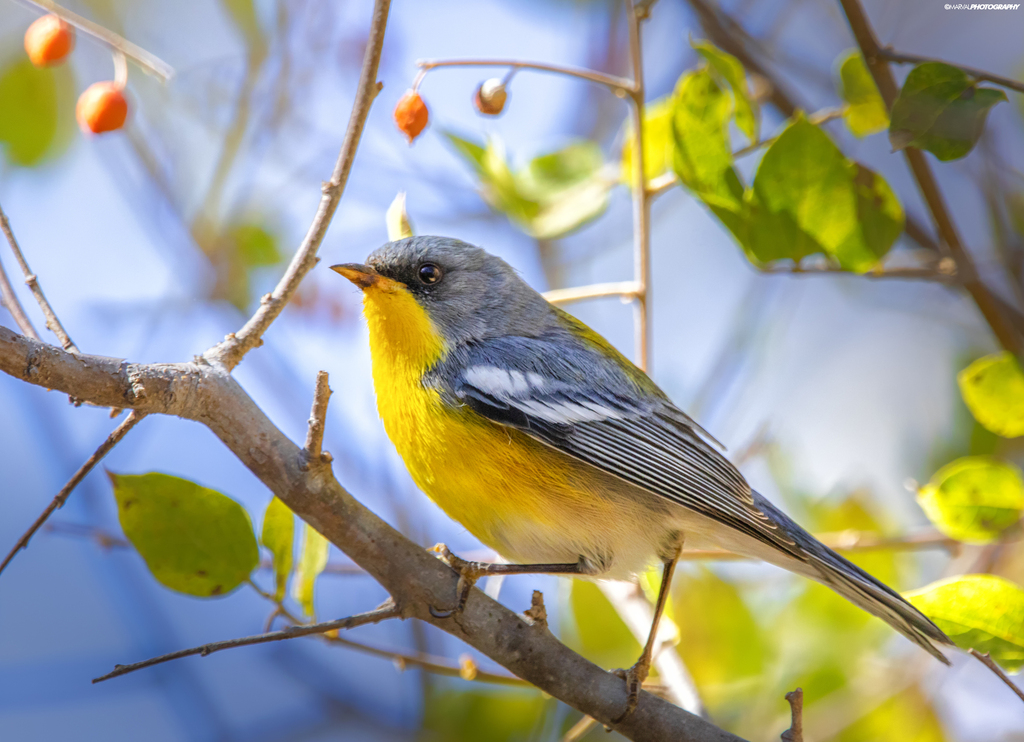
Tropical Parula
Photo © MarvalPhotography19
Photo © MarvalPhotography19 — CC BY 4.0 — Source: iNaturalist photo #470206601Identification
The Tropical Parula is a small warbler, approximately 11 cm long and weighing 6.5–8.0 g. Males are notably colorful, with mostly blue-gray heads, black lores, and a distinctive small black mask. Their upperparts combine blue-gray with an olive mantle, while wings display blue-gray plumage with white-tipped wing bars. The tail is blue-gray with large white spots. The throat and underparts are yellow with a strong orange wash across the lower throat, upper breast, and flanks, while the belly and undertail coverts are white. Females are similar but duller overall, lacking the black mask and showing little to no orange on the underparts. Immature birds resemble adult females with more greenish upperparts and fainter wing bars.
The species comprises nine recognized subspecies that vary considerably in plumage. Some populations show deeper indigo-blue coloring, wider wing bars, or rusty-chestnut flanks, while others exhibit paler yellow breasts with minimal orange. All birds share a dark brown iris, black or brownish upper mandible, yellow lower mandible, and light pinkish-brown legs.
Range & Habitat
The Tropical Parula is found across the Americas from Texas south through Mexico, Central America, and into South America, occurring in every mainland country of the continent (except as a vagrant in Chile) as well as on Trinidad and several Mexican islands. The species is notably absent from the Amazon Basin. Different subspecies occupy distinct geographic ranges, from the Edwards Plateau in Texas and Mexico's mountain ranges to the Andes of Colombia, Ecuador, Peru, and Bolivia, and across much of Brazil to Argentina's Atlantic provinces.
This adaptable warbler inhabits a variety of semi-arid to humid forested landscapes, including woodlands, forest edges and clearings, gallery forest, and secondary growth. It favors somewhat open habitats and generally avoids very humid lowland tropical evergreen forest, occasionally venturing into scrublands.
Behaviour & Diet
The Tropical Parula is an active insectivore, gleaning small arthropods from foliage and branches. Like other warblers, it forages in trees and shrubs, moving restlessly through vegetation in search of prey. The species has been documented hybridizing with the Northern Parula in Texas, with multiple hybrid records increasingly appearing since 2010, confirming the two birds' close evolutionary relationship despite occupying largely separate ranges.
Best Time & Places to See It
For travelers in Texas, the Edwards Plateau and upper Gulf of Mexico coast offer the best opportunity to encounter this species. In Mexico, the Sierra Madre ranges and coastal regions support populations year-round. Central America provides excellent viewing opportunities throughout the region, particularly in woodlands and forest edges. South American travelers should seek the species in Andean regions of Colombia, Ecuador, and Peru, as well as in suitable habitats across Venezuela, the Guianas, Brazil, and into Argentina. The bird's presence in various habitat types makes it relatively accessible across much of its range, though specific timing and local knowledge of habitat preferences will improve sighting success.
Photography Tips
The Tropical Parula's small size and tendency to forage in trees present challenges for photographers. Use fast shutter speeds (1/1000 s or faster) to freeze movement as the bird gleans insects. Position yourself with backlighting to capture the brightness of the yellow underparts and enhance the contrast of wing bars and tail spots. Early morning light is ideal for rendering the blue-gray and olive tones of the upperparts. A telephoto lens of at least 300–400 mm is recommended given the bird's size and often elevated foraging height.
Focus on capturing the diagnostic features: the black lores and mask in males, the distinctive white wing bars, and the bright yellow throat and orange-washed underparts. In the field, patience is essential—wait quietly near productive feeding areas rather than attempting to pursue this active, constantly-moving warbler through dense vegetation.
Antisana National Park
Araucárias National Park
Arenal Volcano National Park
Bahuaja Sonene National Park
Baritú National Park
Baru Volcano National Park
Big Bend National Park
Brasília National Park
Braulio Carrillo National Park
Nothing matches these filters.
No community photos yet. Log in to add the first one.
No community observations of this species yet.