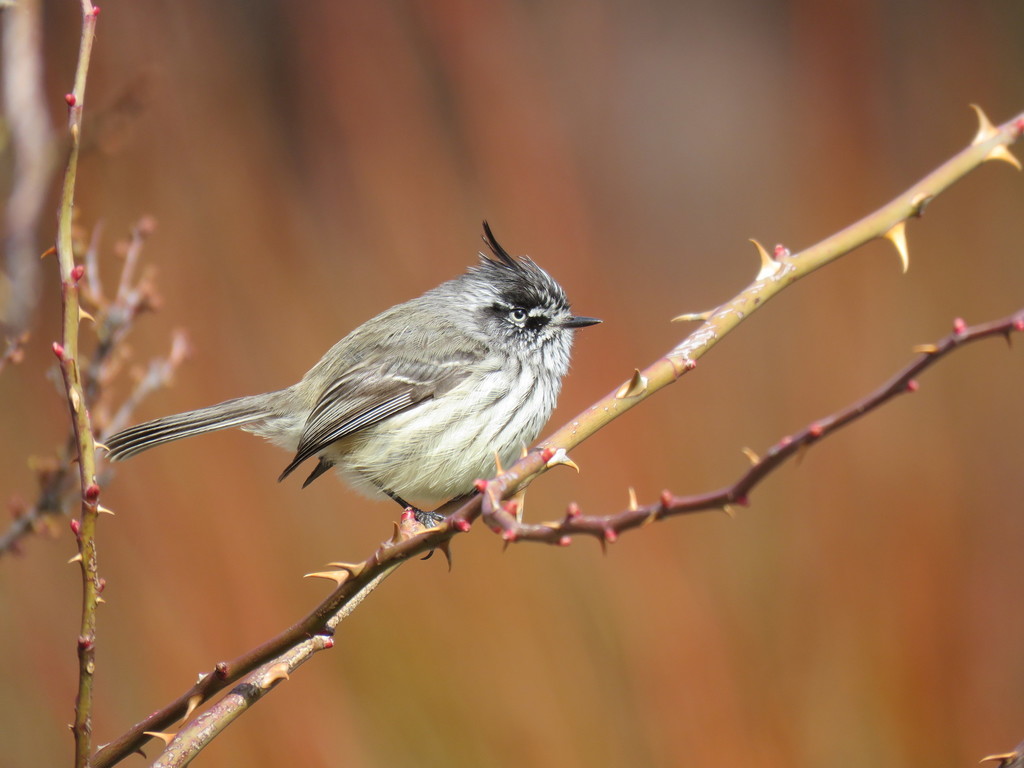
Tufted Tit-Tyrant
Photo © Nicolas Olejnik
Photo © Nicolas Olejnik — CC BY 4.0 — Source: iNaturalist photo #157364106Identification
The Tufted Tit-Tyrant is a diminutive flycatcher, measuring just 9.5–11 centimeters in length and weighing around 6 grams. Its most striking feature is a long, conspicuous black crest that is often parted, creating the illusion of two separate crests. The head is predominantly black with distinctive white supraloral and postocular stripes, while the eye itself is creamy white to pale yellow. The back is dull grayish-brown, contrasting sharply with a white throat and breast heavily streaked with dark gray or black markings. The belly is pale yellow, and the wings display two narrow white wingbars with white outer tail feathers. Males and females are similar, though females tend to be smaller with less prominent crests. Juveniles are duller overall with shorter crests and buffy rather than white wingbars.
The three subspecies show subtle plumage variations. A. p. aequatorialis (northern) is browner above with broader breast streaks and more distinct wingbars. A. p. patagonicus (southern) is notably paler gray overall, particularly on the crown, with a paler yellow to whitish belly. These differences are best appreciated in direct comparison.
Range & Habitat
This species has an extensive range across western South America, stretching from southern Colombia southward along the Andes mountains to Tierra del Fuego. It has been recorded in Colombia, Ecuador, Peru, Bolivia, Argentina, and Chile. Despite its preference for upper montane forests and shrublands, the Tufted Tit-Tyrant is a true habitat generalist, capable of thriving across a wide range of ecosystems within its range, which contributes to its stable conservation status.
Behaviour & Diet
This vocal species possesses a broad repertoire of songs, including a loud, high-pitched song and a rapid chuit-chuit-chuit-chuit-chuit-chidi-didi call. When foraging in pairs, birds maintain contact using a distinctive perr-reet call, and they communicate with a pluit-pluit contact call and occasional weak trills. The Tufted Tit-Tyrant feeds primarily on insects captured through perch gleaning from small shrubs, typically hunting in pairs. Territorially, it defends its space only against other tit-tyrants. Except for southernmost populations, the species is non-migratory, remaining year-round in its territory.
Best Time & Places to See It
The Tufted Tit-Tyrant can be encountered throughout the year across much of its range thanks to its non-migratory habits. Its habitat preferences for montane forests and shrublands make it most reliable at higher elevations along the Andes. The species' vocal nature and active foraging behavior make it relatively conspicuous despite its small size. Breeding seasons vary by geographical location, so timing may differ across the extensive north-to-south range.
Photography Tips
Photographing this diminutive flycatcher requires patience and a good telephoto lens due to its small size and preference for foraging among shrubs. The distinctive crest is the key identification feature and should be a priority to capture clearly. Look for birds foraging in pairs, as they are more vocal and active during these interactions, providing better photo opportunities. Early morning hours typically offer the best light and most active behavior. The contrasting black head, white facial stripes, and streaked breast provide excellent compositional opportunities when the bird is well-lit.
Alerce Costero National Park
Antisana National Park
Cabo de Hornos National Park
Cajas National Park
Cerro Castillo National Park
Chiloé National Park
Corcovado National Park
Cotopaxi National Park
Huascarán National Park
Nothing matches these filters.
No community photos yet. Log in to add the first one.
No community observations of this species yet.