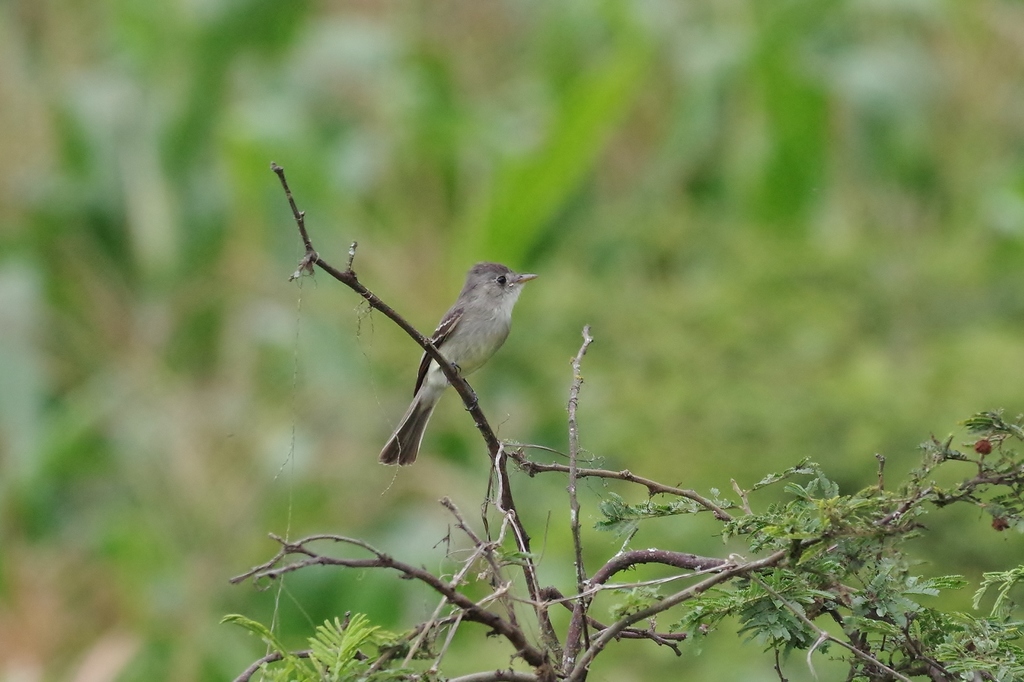
Tumbes Pewee
Photo © Thibaud Aronson
Photo © Thibaud Aronson — CC BY-SA 4.0 — Source: iNaturalist #35000651Identification
The Western Tropical Pewee is a small tyrant flycatcher, measuring 13–14 cm in length and weighing around 9.3 g. Both sexes share identical plumage: a dark olive-gray crown topped with a slight crest, white lores, and a thin white eye-ring set against a pale grayish olive face. The back is olive-gray, while the rump and upper tail coverts display brownish olive-gray tones with hidden white feather tufts on either side. The wings are dusky with white to brownish-gray edges on the secondary feathers, and two thin whitish wing bars formed by the median and greater coverts. The tail is olive-gray, the chin and throat white, the breast and upper belly pale grayish olive, and the lower belly whitish.
Range & Habitat
This species is found from northwestern Ecuador (northern Manabí Province) south through northwestern and west-central Peru to Huancavelica Department, with records also reported in Esmeraldas Province in far northeastern Ecuador and suspected occurrence in southwestern Colombia. It inhabits semi-open landscapes including deciduous and semi-humid woodlands, Podocarpus forests, forest edges and clearings, and occasionally mangroves. Elevations range mostly below 1,500 m in Ecuador, though reaching 1,900 m there and up to 2,800 m in Peru.
Behaviour & Diet
The Western Tropical Pewee is believed to be a year-round resident. It feeds exclusively on insects, typically foraging singly or in pairs from exposed or semi-open perches at mid-story height on forest edges. The bird employs a characteristic hawking technique, sallying out to capture prey in mid-air before returning to the same perch, where it shivers its tail upon landing. It rarely participates in mixed-species feeding flocks. The breeding season encompasses December to March in Ecuador and at least May to July in Peru, with nests reportedly constructed at considerable heights in the canopy.
Best Time & Places to See It
The Western Tropical Pewee is considered fairly common in Peru and occurs in numerous national parks and protected areas throughout its range. Since it is a year-round resident, it can be encountered at any season. Early mornings and late afternoons offer the best opportunities for observing this species, as it vocalizes more frequently during these periods. Look for it in semi-open woodlands and forest edges where it perches openly in the mid-story, making it relatively accessible for patient birdwatchers.
Photography Tips
Position yourself where you can observe exposed perches on forest edges and semi-open woodlands. The Western Tropical Pewee's habit of returning repeatedly to the same perch after hawking sallies makes it predictable and rewarding for photography. Photograph in early morning or late afternoon light when the bird is most vocal and active. Focus on capturing the distinctive features: the slight crest, white eye-ring, thin wing bars, and characteristic tail-shivers upon landing. Its relatively small size and preference for mid-story perches require patience and careful positioning to achieve sharp, well-composed images.
No community photos yet. Log in to add the first one.
No community observations of this species yet.