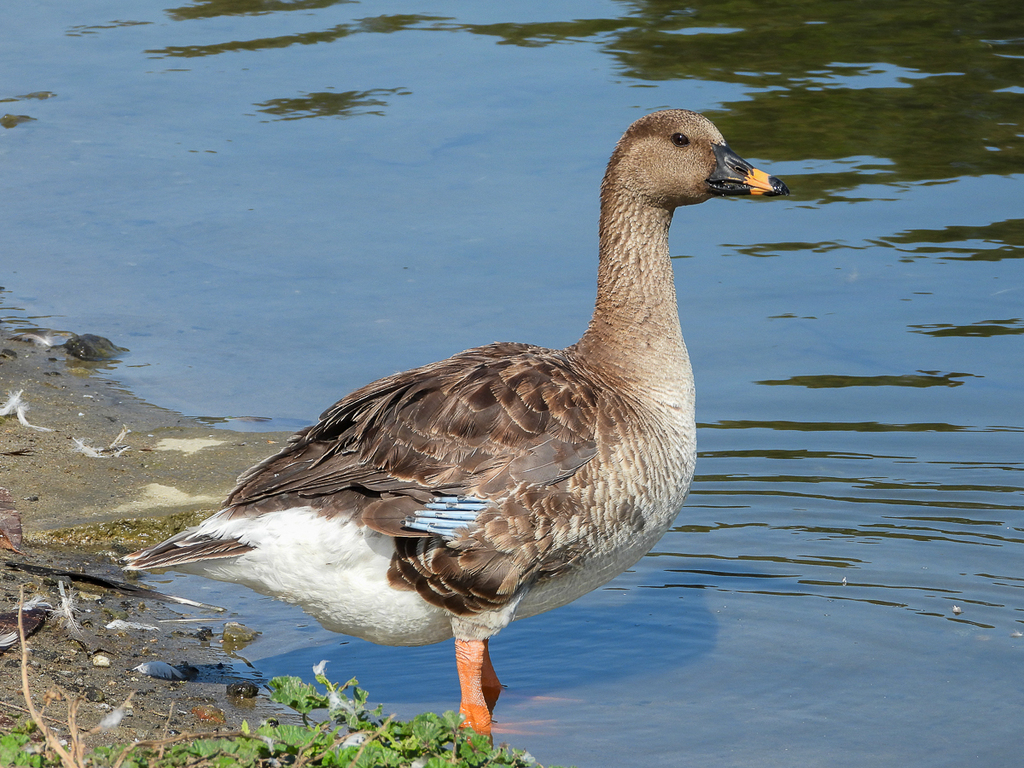
Tundra Bean Goose
Photo © James M. Maley
Photo © James M. Maley — CC BY 4.0 — Source: iNaturalist photo #300925433Identification
The tundra bean goose is a medium-sized goose measuring 68 to 90 cm in length, with a wingspan of 140 to 174 cm. The most distinctive feature is its bill, which is black at the base and tip with a bright orange band across the middle; the legs and feet are similarly bright orange. The upper wing-coverts are dark brown with narrow white fringes to the feathers, distinguishing it from the white-fronted and lesser white-fronted geese. The tundra bean goose produces a loud, honking call that is higher-pitched in smaller individuals.
Two subspecies exist: the smaller A. s. rossicus from the northern Russian tundra, which has a short, stubby bill with a narrow orange band, and the larger A. s. serrirostris from the East Siberian tundra, which has a longer, stouter bill. The closely related pink-footed goose differs noticeably in having a short, bright pink bill and pink feet, along with bluish-grey upper wing-coverts.
Range & Habitat
The tundra bean goose breeds in northern Siberia, with the nominate subspecies ranging across the northern Russian tundra east to the Taimyr Peninsula, while the larger subspecies inhabits the East Siberian tundra. This species is highly migratory, moving south across Asia during winter months. Unlike many goose species, the tundra bean goose has no regular wintering sites and instead appears in small groups scattered among other grey goose species across its wintering range.
Behaviour & Diet
As a migratory species, the tundra bean goose exhibits the typical seasonal movements of high-Arctic breeding geese, traveling between its breeding grounds in Siberia and wintering grounds further south in Asia. The species often occurs in mixed flocks with other goose species during winter, suggesting flexible social behaviour and habitat use. Like other bean geese, it is likely an herbivorous grazer, though specific dietary details are not extensively documented in available sources.
Best Time & Places to See It
The tundra bean goose has no regular wintering sites, making it an unpredictable visitor across most of its range. However, among the most reliable localities are WWT Slimbridge in Gloucestershire and Holkham Marshes in Norfolk, both in England, where small groups are occasionally encountered alongside other grey goose species. Winter months are the most likely time to encounter this species outside its breeding range, though sightings remain irregular and require patience and luck.
Photography Tips
Photographing the tundra bean goose is challenging due to its unpredictable presence and tendency to appear in small numbers within mixed flocks. Focus on capturing the distinctive orange bill and legs, which are the key identifying features separating this species from similar geese. When visiting known localities like Slimbridge or Holkham Marshes, scan mixed goose flocks carefully during winter months. Patient observation and familiarity with the subtle differences from related species will improve your chances of both identifying and photographing this elusive Siberian breeder.
Harz National Park
Harz (LK Goslar), Germany
+141 birds+38 mammals
Where granite peaks rise above beech and spruce forests, the Harz unfolds as one of Germany's most biodiverse upland landscapes. Straddling the border between Lower Saxony…
VIEW NATIONAL PARKLower Saxon Wadden Sea National Park
Norderney, Germany
+193 birds+12 mammals
Where the North Sea meets the German coast, a vast expanse of tidal mudflats, salt marshes, and shallow waters creates one of Europe's most dynamic estuarine…
VIEW NATIONAL PARKHamburgisches Wattenmeer National Park
Hamburg, Germany
+206 birds+6 mammals
Where the North Sea exhales across the Elbe estuary, the tidal mudflats of Hamburgisches Wattenmeer National Park emerge twice daily in a landscape of extraordinary ecological…
VIEW NATIONAL PARKLower Oder Valley National Park
Schwedt/Oder, Germany
+216 birds+21 mammals
Where the Oder River winds through northeastern Brandenburg, the Lower Oder Valley National Park protects one of Central Europe's most vital wetland systems. This sprawling mosaic…
VIEW NATIONAL PARKVorpommersche Boddenlandschaft National Park
Küstengewässer einschließlich Anteil am Festlandso, Germany
+230 birds+19 mammals
Where the Baltic coast dissolves into a labyrinth of shallow lagoons and coastal wetlands, Vorpommersche Boddenlandschaft National Park protects one of northern Europe's most dynamic and…
VIEW NATIONAL PARKSchleswig-Holsteinisches Wattenmeer National Park
Germany
+378 birds+49 mammals
Where the North Sea ebbs and flows across a vast expanse of exposed mud and sand, the Schleswig-Holsteinisches Wattenmeer National Park reveals one of Europe's most…
VIEW NATIONAL PARKBavarian Forest National Park
Germany
+127 birds+18 mammals
Where ancient spruce and fir forests rise across the Bohemian plateau, the Bavarian Forest National Park unfolds as one of central Europe's most intact temperate woodland…
VIEW NATIONAL PARKDoñana National Park
Hinojos, Spain
+300 birds+13 mammals
Where the Guadalquivir River delta spreads into the Atlantic, vast marshes, cork woodlands, and coastal dunes converge to create one of southwestern Europe's most biodiverse wetland…
VIEW NATIONAL PARKSouth Downs National Park
Chichester, United Kingdom
+298 birds+45 mammals
Chalk downland ridges rise and fall across the South Downs, their open grasslands and beech hangers creating a mosaic of habitats that has shaped human settlement…
VIEW NATIONAL PARKPatvinsuo National Park
Lieksa, Finland
+134 birds+1 mammals
Across eastern Finland's borderlands, where boreal forest meets waterlogged terrain, Patvinsuo National Park sprawls across roughly 185 square kilometers of one of northern Europe's most intact…
VIEW NATIONAL PARKHortobágy National Park
Hortobágy, Hungary
+260 birds+17 mammals
Across the North Great Plain of Hungary stretches one of Europe's most expansive semi-natural grassland systems, where horizon-wide vistas of steppe and wetland create a landscape…
VIEW NATIONAL PARKDuna-Ipoly National Park
Dömös, Hungary
+208 birds+19 mammals
Where the Danube curves through central Hungary, the limestone hills and forested valleys of Duna-Ipoly National Park create a landscape that feels caught between seasons and…
VIEW NATIONAL PARKFertő–hanság National Park
Fertőszéplak, Hungary
+246 birds+11 mammals
Where the Austro-Hungarian plains meet the foothills of Western Transdanubia, nearly 900 square kilometres of wetland, reed bed, and mixed woodland form one of Central Europe's…
VIEW NATIONAL PARKCamargue Regional Nature Park
Saintes-Maries-de-la-Mer, France
+378 birds+48 mammals
Where the Rhône Delta sprawls into the Mediterranean, a landscape of stark and haunting beauty emerges—vast salt marshes punctuated by shallow lagoons, reed beds, and scrubland…
VIEW NATURAL PARKSoomaa National Park
Viljandi County, Estonia
+172 birds+20 mammals
Across the boglands of south-central Estonia, where water dominates more than half the landscape, lies one of northern Europe's most hydrologically dynamic national parks. The terrain…
VIEW NATIONAL PARKLahemaa National Park
Lääne-Viru County, Estonia
+237 birds+25 mammals
Where the Baltic coast meets temperate forest in northwestern Estonia, Lahemaa National Park sprawls across more than 1,300 square kilometers of deeply character-filled terrain. Coastal wetlands…
VIEW NATIONAL PARKSt. Paul Island
Saint Paul, United States
+255 birds+8 mammals
Windswept tundra rolls across this remote Pribilof island, where volcanic basalt cliffs plunge into the Bering Sea and fog rolls in thick enough to erase the…
VIEW PROTECTED LANDSCAPEWielkopolska National Park
Trzebaw, Poland
+141 birds+8 mammals
Across the glacial plains of Greater Poland, where ice-age geology shaped a landscape of shallow lakes and mixed forest, Wielkopolska National Park stretches across nearly 190…
VIEW NATIONAL PARKWolin National Park
Kamień County, Poland
+232 birds+21 mammals
Where the Baltic shoreline meets vast wetland complexes and Pleistocene woodlands, Wolin National Park unfolds across nearly 440 square kilometres of northwestern Poland's most biodiverse terrain.…
VIEW NATIONAL PARKSłowiński National Park
Smołdzino, Poland
+217 birds+16 mammals
Where the Baltic shoreline surrenders to vast inland dunes and freshwater lagoons, Słowiński National Park spans nearly 610 square kilometres of one of Europe's most dynamic…
VIEW NATIONAL PARKPieniny National Park
Sromowce Niżne, Poland
+112 birds+4 mammals
Where limestone cliffs rise steeply from the Dunajec River Gorge, Pieniny National Park unfolds across 48 square kilometres of some of Poland's most dramatic terrain. The…
VIEW NATIONAL PARKUjście Warty National Park
Gorzów County, Poland
+212 birds+9 mammals
Where the Warta River spreads into its delta before joining the Oder, wetland and woodland merge into one of central Europe's most vital ecological crossroads. Ujście…
VIEW NATIONAL PARKBiebrza National Park
Goniądz, Poland
+242 birds+33 mammals
Where the Narew River sprawls across northeastern Poland's flatlands, Biebrza National Park unfolds as one of Europe's largest and most ecologically vital wetland complexes. Encompassing roughly…
VIEW NATIONAL PARKBiałowieża National Park
Bialowieza, Poland
+177 birds+23 mammals
Straddling the border between Poland and Belarus, this primordial forest landscape encompasses one of Europe's last remaining expanses of old-growth woodland, where ancient trees rise through…
VIEW NATIONAL PARKNortheast China Tiger and Leopard National Park
Mu Dan Jiang Shi, China
+202 birds+19 mammals
Across the temperate forests of northeastern China, where winters grip the landscape in subzero silence and summers remain cool and brief, the Mudanjiang region supports a…
VIEW NATIONAL PARKYancheng National Nature Reserve
Yancheng, China
+208 birds+4 mammals
Where the East China Sea's tidal rhythms sculpt the Jiangsu coast, Yancheng National Nature Reserve sprawls across one of Asia's most dynamic wetland complexes. This vast…
VIEW NATURE RESERVEPoyang Lake National Nature Reserve
Shangrao, China
+270 birds+7 mammals
Where the Yangtze River's massive floodplain spreads across central China, Poyang Lake National Nature Reserve encompasses one of the continent's most dynamic and water-rich wetland systems.…
VIEW NATURE RESERVEAlaska Maritime National Wildlife Refuge
Alaska, United States
+391 birds+58 mammals
Where the North Pacific collides with Alaska's rugged coastline, a sprawling archipelago of islands, rocky outcrops, and coastal headlands forms one of North America's most remote…
VIEW WILDLIFE SANCTUARYHolkham National Nature Reserve
North Norfolk, United Kingdom
+235 birds+11 mammals
Where Norfolk's coastal flatlands meet the North Sea, Holkham National Nature Reserve unfolds across nearly 4,000 hectares of some of England's most dynamic and least predictable…
VIEW NATURE RESERVENewport Wetlands National Nature Reserve
Goldcliff, United Kingdom
+153 birds+7 mammals
Across the Severn Estuary's southern reaches, where the Gwent Levels meet tidal mud and reedbed in a mosaic of wet grassland and shallow pools, lies one…
VIEW NATURE RESERVEPurbeck Heaths National Nature Reserve
Norden, United Kingdom
+143 birds+8 mammals
Across the gently undulating plateau of Dorset's heathlands, Purbeck's ancient landscape unfolds as a mosaic of heather, gorse, and scattered pines—a habitat shaped by millennia of…
VIEW NATURE RESERVERibble Estuary National Nature Reserve
Southport, United Kingdom
+197 birds+17 mammals
Where the Ribble flows into the Irish Sea, a landscape of mudflats, salt marshes and shallow pools creates one of northwest England's most dynamic estuarine ecosystems.…
VIEW NATURE RESERVENo community photos yet. Log in to add the first one.
No community observations of this species yet.