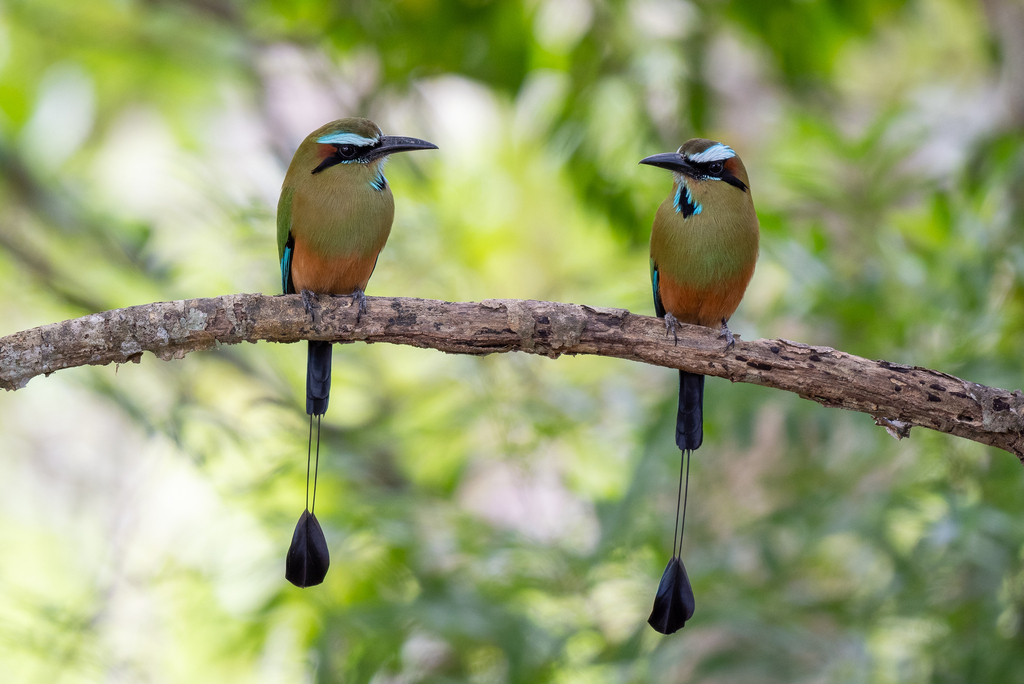
Turquoise-browed Motmot
Photo © Forest Botial-Jarvis
Photo © Forest Botial-Jarvis — CC BY 4.0 — Source: iNaturalist photo #355235007Identification
The turquoise-browed motmot is a striking, medium-sized bird measuring 34 cm (13 in) in length and weighing approximately 65 g (2.3 oz). Its plumage is predominantly grey-blue with a distinctive rufous back and belly. The most eye-catching features are the bright blue stripe above each eye and a blue-bordered black patch on the throat. The flight feathers and upper tail surface are deep blue, and the tail is notably longer and more elaborate than in other motmots, with characteristic racket-shaped tips formed by bare feather shafts called wires. Contrary to popular belief, these distinctive tail tips are not deliberately plucked by the bird; instead, the barbs are naturally weakly attached and fall away through routine abrasion and preening.
Range & Habitat
This species is endemic to Central America, ranging from southeastern Mexico (primarily the Yucatán Peninsula) south to Costa Rica, where it remains common and not threatened. The turquoise-browed motmot favours fairly open habitats including forest edges, gallery forests, and scrubland. It shows a marked preference for areas with high tree diversity and richness, combined with a low, open canopy and dense understory vegetation. Notably, it prefers drier forest environments, contrasting sharply with Lesson's motmot, which inhabits the same regions but favours moist forests. This ecological separation has made the turquoise-browed motmot valuable to ecologists as a bioindicator of aridification trends driven by anthropogenic climate change.
Behaviour & Diet
The turquoise-browed motmot is primarily an insectivore, though it also takes small reptiles. It hunts using a characteristic sit-and-wait strategy, often perching on exposed substrates such as utility lines and fence posts to scan for prey. Its broad, flattened, and serrated bill is perfectly adapted for capturing and consuming its quarry. Both males and females display the elaborate racket-tipped tail, though research has revealed these ornaments serve different evolutionary purposes: in males, longer tails correlate with higher mating and reproductive success, while in females, tail length does not influence breeding outcomes. Both sexes perform a distinctive wag-display, swinging the tail pendulously, often accompanied by croaking vocalizations. This behaviour serves as a pursuit-deterrent signal when predators are present, and briefly during the breeding season when feeding young—the only times the tail-wagging occurs without vocalizations or predator presence.
Best Time & Places to See It
The turquoise-browed motmot is most active during its breeding season, when nesting activity begins in March to avoid peak heat. Eggs are laid at 48-hour intervals, with incubation lasting 16–20 days depending on location. Birds nest in long tunnel burrows excavated in earth banks, quarries, or freshwater wells; where these are unavailable, they utilize inaccessible limestone crevices in cenotes or caves. The species is fairly common throughout its range and can often be approached closely before flushing, earning it local names referencing this tameness. Look for it in open woodland habitats, scanning exposed perches and the edges of clearings.
Photography Tips
The turquoise-browed motmot's brilliant blue and rufous plumage makes it a rewarding photography subject, particularly when perched on utility lines or fence posts where it hunts. The striking facial markings and elaborate tail are best captured in good light. During the breeding season in March and thereafter, patience near nesting sites—especially cenote margins where the species has cultural significance—may yield photographs of tail-wagging displays and feeding behaviour. The bird's habit of allowing close human approach is advantageous, though a respectful distance from active nests should always be maintained. Early morning light best reveals the vibrant blue tones of the plumage and tail feathers.
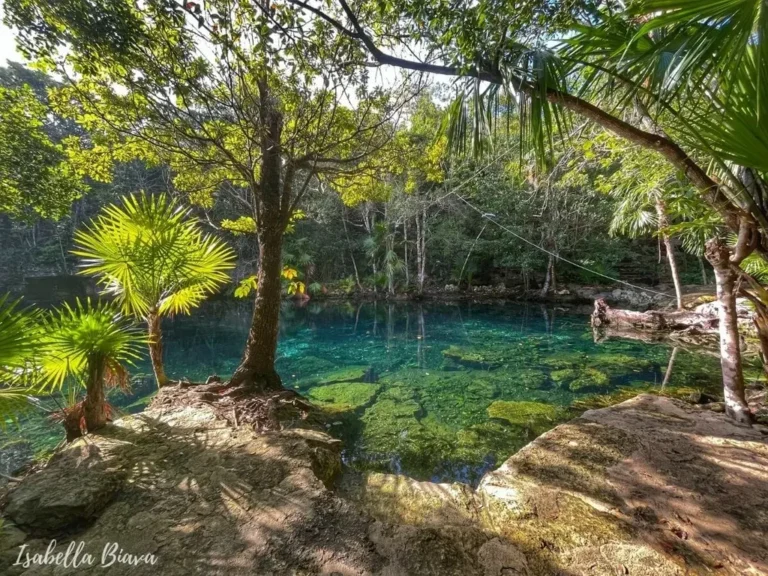
Private Cenote Adventure: A Journey Through the Triple Maya Underworld
Nothing matches these filters.
Arenal Volcano National Park
Carara National Park
Curú National Wildlife Refuge
Dzibilchantún National Park
Guanacaste National Park
Laguna del Tigre National Park
Marino Las Baulas National Park
Palo Verde National Park
Ría Lagartos Biosphere Reserve
Nothing matches these filters.
No community photos yet. Log in to add the first one.
No community observations of this species yet.