Turquoise Parrot
Photo © themaskedlapwing
Photo © themaskedlapwing — CC0 1.0 — Source: iNaturalist #276507941Identification
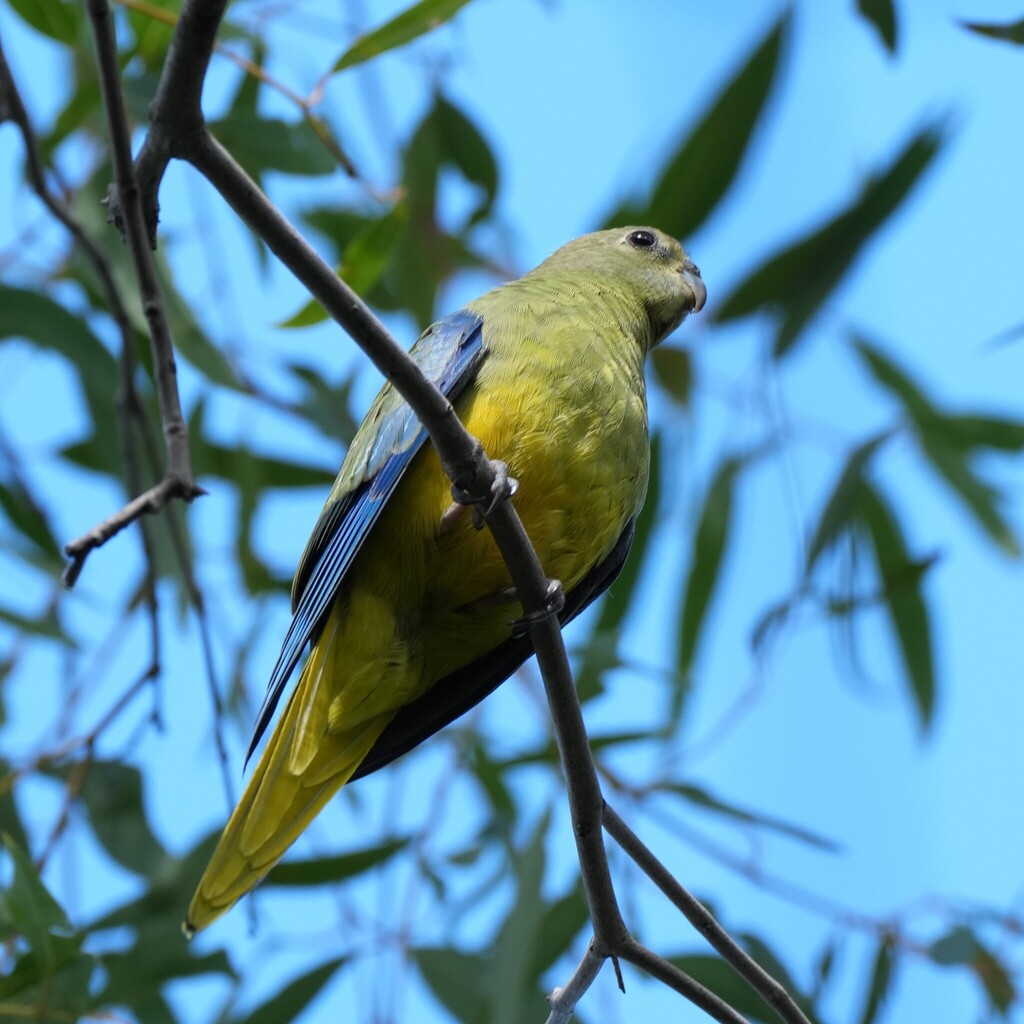
The turquoise parrot is a small and lightly built parrot, measuring around 20 cm in length and weighing only 40 grams. It exhibits striking sexual dimorphism, making it straightforward to distinguish males from females. Males are predominantly green above with yellowish underparts, but the standout feature is the bright turquoise-blue face, which is darkest on the crown and paler on the lores, cheeks and ear coverts. Their wings are predominantly blue with a distinctive red shoulder patch. Females are generally duller and paler overall, with a more uniform and paler blue face featuring highly contrasting cream bare skin around the eye. They lack the red shoulder band entirely, and their blue shoulder markings are darker and less distinct. The female's throat and chest are pale green with a yellow belly, and when flying, a broad white bar is visible on the underwing.
Juvenile birds of both sexes have less extensive blue on their faces, with coloration not extending past the eye. Both young birds display a white wing-stripe, which disappears with maturity in males. The immature male has a red patch on the wing and may also display an orange wash on the belly.
Range & Habitat
The turquoise parrot is native to eastern Australia, occurring from south-eastern Queensland through New South Wales and into north-eastern Victoria. In Queensland, its range extends from around Cooloola, Blackbutt and Chinchilla, westwards to the vicinity of St George. Historically, before 1945, it was recorded further north at the Suttor River and Mackay. The species is found in the foothills of the Great Dividing Range and surrounding areas.
It inhabits grasslands and open woodlands dominated by Eucalyptus and Callitris trees. Much of this habitat has been altered over time, and potential nesting sites have been lost, which has significantly impacted populations. The species is predominantly sedentary but can be locally nomadic. Populations appear to be recovering from a crash that occurred in the early 20th century.
Behaviour & Diet
The turquoise parrot feeds mainly on grasses and seeds, with occasional supplements of flowers, fruit and scale insects. This dietary preference reflects its adaptation to grassland and open woodland environments. The species nests in hollows of gum trees, making the availability of suitable nesting cavities crucial for breeding success.
Best Time & Places to See It
As a predominantly sedentary species, the turquoise parrot can be found year-round throughout its range in eastern Australia. For the best chance of viewing this charming parrot, focus on the grasslands and open eucalyptus woodlands of central and eastern New South Wales, or the foothills regions of south-eastern Queensland and north-eastern Victoria. The species' recovery from historical population crashes means sightings are becoming increasingly reliable in suitable habitat.
Photography Tips
The brilliant turquoise face and contrasting coloration of male turquoise parrots make them superb photographic subjects. Their small size and preference for open grassland and woodland habitats offer good visibility and light for photography. The sexual dimorphism is pronounced enough to allow interesting comparative shots. Look for males perched in low vegetation or feeding on grass seeds, where their vivid blue and red markings will be well-lit and clearly visible against natural backgrounds.
Greater Bendigo National Park
Whipstick, Australia
+202 birds+8 mammals
Across the red volcanic plains of inland Victoria, Greater Bendigo National Park sprawls across more than 1,000 square kilometres of eucalyptus woodland, open grassland, and scattered…
VIEW NATIONAL PARKChiltern-Mt Pilot National Park
Australia
+229 birds+12 mammals
Granite ridges and eucalyptus woodlands define this 869-square-kilometre park straddling the border between Victoria and New South Wales, where rugged terrain rises sharply from gentler foothill…
VIEW NATIONAL PARKLamington National Park
Australia
+227 birds+24 mammals
Where subtropical rainforest rises steeply from the Queensland coast, Lamington National Park spreads across 541 square kilometres of one of Australia's most biodiverse mountain landscapes. The…
VIEW NATIONAL PARKRoyal National Park
Sydney, Australia
+296 birds+46 mammals
Where sandstone ridges plunge toward the Tasman Sea, Royal National Park unfolds across 343 square kilometres of southeastern Australian coastal wilderness. The park's defining character emerges…
VIEW NATIONAL PARKSundown National Park
Australia
+211 birds+9 mammals
Granite ridges and eucalypt woodlands define this 305-square-kilometre expanse of southeastern Queensland, where the landscape descends from sandstone plateaus into open forests and grassy clearings that…
VIEW NATIONAL PARKBald Rock National Park
Australia
+122 birds+15 mammals
Granite peaks and weathered stone dominate the landscape of this 202-square-kilometre national park in inland New South Wales, where rugged tors and rocky outcrops rise dramatically…
VIEW NATIONAL PARKGirraween National Park
Australia
+193 birds+21 mammals
Granite boulders rise like the bones of the earth across these 278 square kilometres of southeastern Queensland, where the Great Dividing Range descends towards the coastal…
VIEW NATIONAL PARKMorton National Park
Australia
+253 birds+57 mammals
Across nearly 4,800 square kilometers of New South Wales's Southern Tablelands, rugged sandstone plateaus rise above sheltered valleys where cool-climate eucalypt woodland meets grassy heath and…
VIEW NATIONAL PARKHeathcote National Park
Sydney, Australia
+119 birds+16 mammals
Sandstone ridges and eucalypt woodlands rise from the Cumberland Plain southwest of Sydney, where Heathcote National Park unfolds across 82 square kilometres of bushland shaped by…
VIEW NATIONAL PARKNoosa National Park
Marcus Beach, Australia
+216 birds+8 mammals
Subtropical eucalypt woodland and open forest meet coastal heathland along the Noosa Peninsula, where the temperate waters of the Tasman current moderate the Queensland climate into…
VIEW NATIONAL PARKBlue Mountains National Park
Australia
+220 birds+43 mammals
Dramatic sandstone cliffs rise in tiers across this mountainous plateau west of Sydney, their rust-coloured faces weathered into amphitheatres and gorges where eucalyptus forest clings to…
VIEW NATIONAL PARKKosciuszko National Park
Australia
+211 birds+52 mammals
Where the Great Dividing Range reaches its highest peaks in southeastern Australia, Kosciuszko National Park encompasses a landscape of windswept plateaus, rocky ridges, and deep river…
VIEW NATIONAL PARKWarrumbungle National Park
Coonabarabran, Australia
+183 birds+22 mammals
Volcanic peaks and weathered ridges rise abruptly from the inland tablelands of central New South Wales, their exposed rock faces glowing ochre and rust in the…
VIEW NATIONAL PARKOxley Wild Rivers National Park
Australia
+202 birds+45 mammals
Where the New England Tablelands descend toward the coast, river gorges carve through temperate forests in a landscape of dramatic geological contrast. Oxley Wild Rivers National…
VIEW NATIONAL PARKNo community photos yet. Log in to add the first one.
No community observations of this species yet.