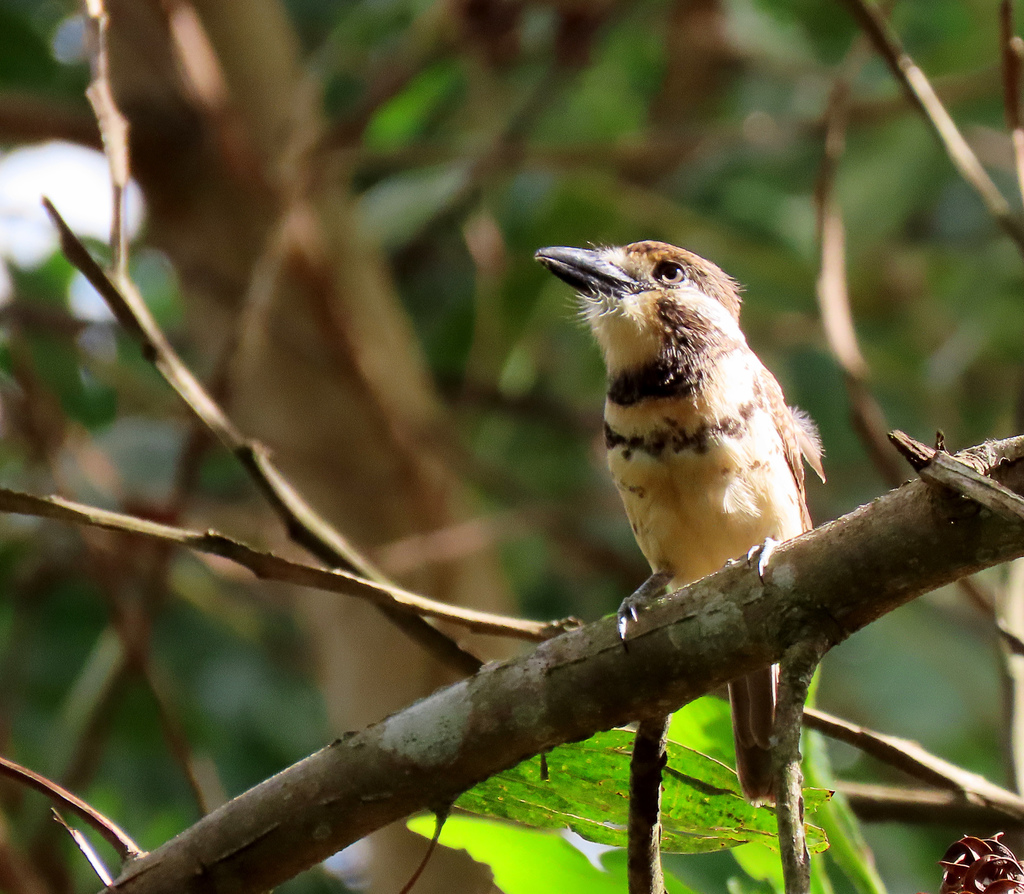
Two-banded Puffbird
Photo © batsoul
Photo © batsoul — CC BY 4.0 — Source: iNaturalist #40818635Identification
The two-banded puffbird is a compact, distinctive bird named for the two black bands that cross its chest. Adults of the nominate subspecies display a dark brown crown with pale brown spots, a buffy patch running from the bill to the eye, and striking white and black patches on the cheek. A narrow whitish collar marks the nape, while the upperparts are dull brown with whitish mottling. The long, dark brown tail features thin pale edges. The chin is whitish, and the throat and upper breast are reddish buff—colors that extend across the belly with black spotting along the upper edge. The flanks are whitish with large black spots. The subspecies H. b. stoicus, found on Margarita Island, is slightly browner and paler overall, with a less dramatically marked face and buff-tipped feathers on the upper breastband.
Range & Habitat
The two-banded puffbird is found exclusively in Colombia and Venezuela. The nominate subspecies inhabits the llanos of northeastern Colombia and extends into northern Venezuela, ranging almost to Lake Maracaibo in the west and east toward the Guyana border, with a slight extension south into Amazonas and Bolívar states. H. b. stoicus occurs only on Margarita Island off the central Venezuelan coast. This species shows a strong preference for open and semi-open landscapes, including llanos savanna, thickets, abandoned farms, and the edges of deciduous woodland on the mainland. On Margarita Island, it inhabits bushland and woods from plains into the foothills. The species remains almost exclusively below 500 metres elevation. Notably, the two-banded puffbird exhibits no documented seasonal migrations, though it sometimes abandons an area where it was previously common for several years before returning.
Behaviour & Diet
The two-banded puffbird employs a hunting strategy known as still-hunting, perching quietly either at height in open areas or in the shade lower down before sallying out to capture prey. Its diet remains incompletely documented but is known to include insects. During breeding season, which appears to include May and June, pairs excavate burrows in arboreal termitaria for nesting, though specific details about clutch size and breeding success remain scarce. The bird's vocalizations are distinctive and memorable: its song consists of a rhythmic repeated "tak-ta-tóo," while its call is a surprisingly loud croaking note that is sometimes delivered in flight.
Best Time & Places to See It
The two-banded puffbird is generally common throughout its mainland range in northeastern Colombia and northern Venezuela, making it a reliable species for birders visiting the llanos region. The nominate subspecies can be encountered in open savanna, scrubland, and woodland edges at low elevations. The more localized H. b. stoicus on Margarita Island offers an alternative destination, though less information is available about its current status there. The breeding season in May and June may present opportunities to locate birds near termitaria burrows. Visitors should note that this species sometimes vacates areas for extended periods, so local knowledge about recent sightings can be invaluable.
Photography Tips
The two-banded puffbird's distinctive plumage—particularly the striking facial pattern and diagnostic chest bands—offers rewarding photographic subjects. Since the species still-hunts from open or semi-shaded perches, patient positioning near suitable habitat may yield opportunities for clean shots. The bird's small to medium size and preference for perching make it relatively approachable compared to more elusive forest species. Photographing birds in their llanos habitat during morning or late afternoon light will best showcase the subtle pale spotting on the crown and the contrasting chest bands. The relatively open nature of savanna and scrubland habitats, compared to dense forest, generally provides better light and fewer obstructions for photography.
No community photos yet. Log in to add the first one.
No community observations of this species yet.