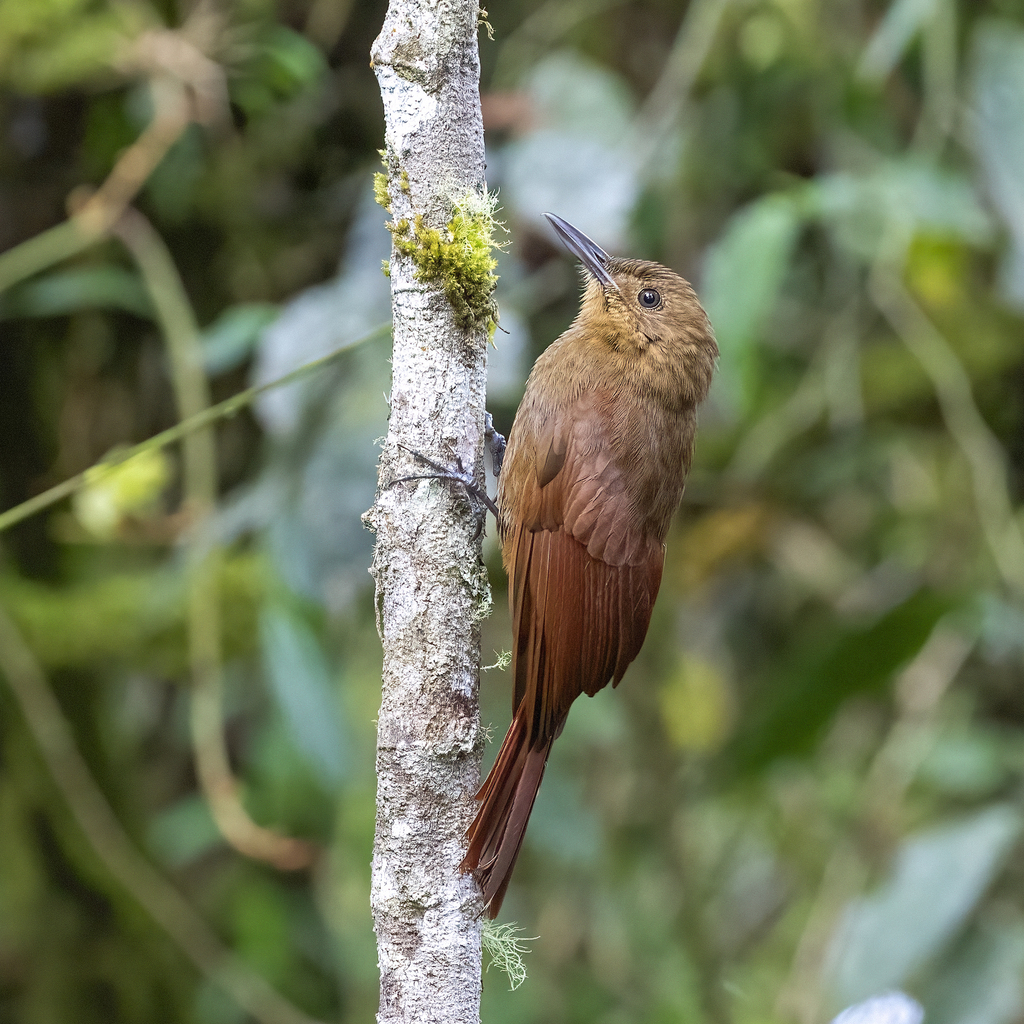
Tyrannine Woodcreeper
Photo © Dan Vickers
Photo © Dan Vickers — CC BY 4.0 — Source: iNaturalist #259388449Identification
The tyrannine woodcreeper is a relatively large and heavy member of its genus, measuring 23 to 26.5 cm (9–10 inches) in length and weighing 40 to 64 grams. The nominate subspecies displays warm brown plumage with a paler throat, faint buff streaks on the forecrown and behind the eye, and rufescent wings and tail. The eastern subspecies D. t. hellmayri is more olive-brown with less prominent rufescent coloring on the wings and tail. Both sexes share identical plumage, though males tend to be heavier. The bird's large, distinctively heavy bill ranges from brownish-gray to black on the upper mandible, with a brownish to bluish-gray lower mandible. The iris is brown to bluish-gray, and the legs and feet are gray to blackish.
Range & Habitat
The tyrannine woodcreeper is found in montane forests across five countries: Colombia, Ecuador, Peru, Bolivia, and Venezuela. The nominate subspecies occurs in Colombia's Western and Central Andes and along both slopes of the Andes southward through Ecuador and Peru into Bolivia. The subspecies D. t. hellmayri inhabits the eastern slope of Colombia's Eastern Andes and adjacent western Venezuela. The species is a year-round resident throughout its range, favoring the interior of primary humid temperate and subtropical montane forests, though it also occurs at forest edges and in mature secondary growth. It is rarely found in open clearings. Elevational range varies by region: in Venezuela between 1,800–2,300 m; in Colombia mostly 1,500–3,000 m with records as low as 720 m in the southwest; in Ecuador 1,400–3,100 m with greatest abundance between 1,800–2,700 m; and in central Peru between 1,310–2,225 m.
Behaviour & Diet
The tyrannine woodcreeper typically forages singly or joins mixed-species feeding flocks, searching for food between 2 and 15 meters above the ground. Its diet consists primarily of insects, which it captures through a distinctive foraging technique: it hitches itself up tree trunks and along branches, then makes brief sallies to snatch prey from the air, rarely taking food directly from surfaces. It seldom follows army ant swarms. Little is documented about its breeding biology, though its solitary nature suggests it does not form lasting pair bonds. Nesting occurs in tree cavities lined with soft material; one documented nest contained a single egg, with fledging occurring at least 29 days after hatching. The incubation period and parental care details remain unknown. The species typically sings from the subcanopy of ridgetop trees, producing a distinctive long stuttered rattle that gradually increases in pitch and volume before trailing off. Its calls include sharp abrupt notes ('di-di-di-di-dik!') and a hollow whistled 'que-up'.
Best Time & Places to See It
The tyrannine woodcreeper is rare to uncommon throughout its range and occupies only a narrow elevational band, making it a challenging species to encounter. Its preference for primary forest interior and sensitivity to human disturbance further limit sightings. A few protected areas within its range offer the best opportunities for observation, particularly in montane forest regions of Colombia, Ecuador, and Peru at mid-elevation zones. Year-round residency means the species is potentially observable in any season, though finding it requires patience and knowledge of its preferred habitat and foraging behavior. Local guides familiar with cloud forest birds will significantly increase chances of detection.
Photography Tips
Photographing this elusive woodcreeper demands patience and familiarity with its behavior. The bird typically forages in the 2–15 meter range, often in dappled subcanopy light typical of montane forests. Position yourself quietly along forest trails or ridgetops where it sings from exposed subcanopy perches—these moments offer the best photographic opportunities. Its large, distinctive bill and subtle plumage details are best captured with good lighting; early morning often provides clearer conditions in cloud forest habitats. The bird's habit of making brief sallies after prey creates dynamic shooting opportunities, though its quick movements and preference for forest interior make a fast shutter speed and responsive autofocus essential. Avoid sudden movements, as this species appears highly sensitive to disturbance.
Antisana National Park
Cordillera Azul National Park
El Tamá National Park
Guácharos Cave National Natural Park
Llanganates National Park
Manu National Park
Natural Chingaza National Park
Natural Farallones de Cali National Park
Natural Munchique National Park
Nothing matches these filters.
No community photos yet. Log in to add the first one.
No community observations of this species yet.