Identification
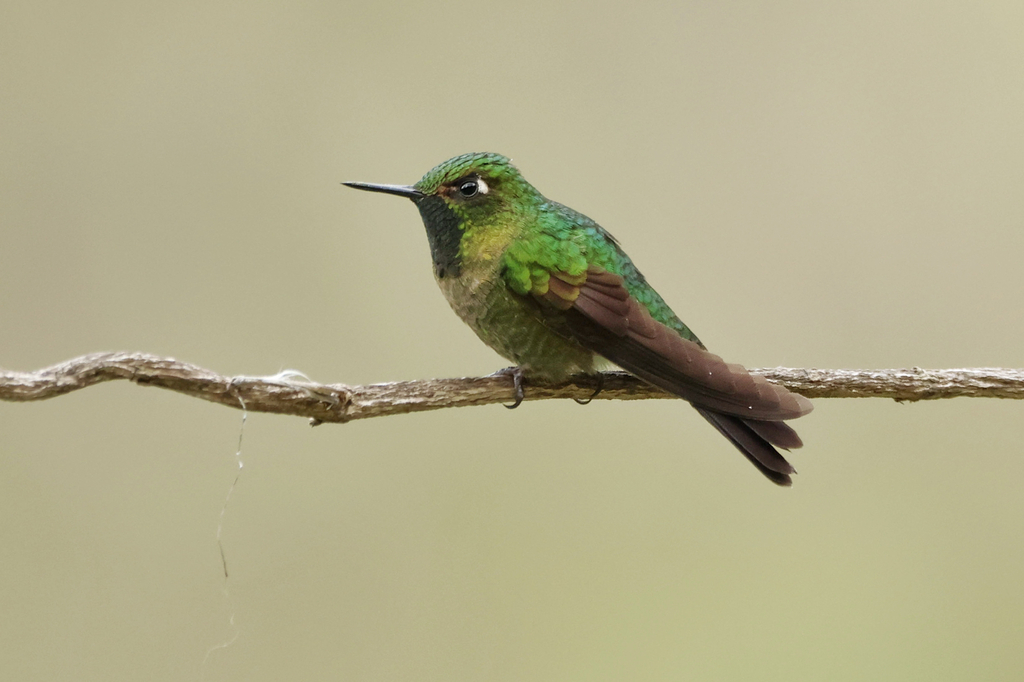
The Tyrian metaltail is a small hummingbird, measuring just 9–10 cm long and weighing 2.7–5.1 g, making it easily overlooked in its montane habitat. Both sexes share a short, straight black bill and iridescent plumage that varies markedly between subspecies. Males of the nominate subspecies display bottle-green upperparts, gray underparts with pale feather fringes, and a striking emerald-green throat contrasting with a slightly forked, glistening bronze tail. Females are bottle-green above with ochre-orange throats spotted in olive-green, whitish bellies with green spotting, and whitish-tipped outer tail feathers. Other subspecies show dramatic variations: some males appear nearly black, while tail colors range from violet and purple-blue to coppery red and golden red depending on the population.
Range & Habitat
This species is distributed across the northern Andes from Venezuela south through Colombia, Ecuador, Peru, and into Bolivia, with seven recognized subspecies occupying specific mountain ranges and slopes. Seven distinct subspecies occupy different regions, from Venezuela's coastal ranges and Andes to the remote cloud forests and high-elevation slopes of the Peruvian and Bolivian Andes. The Tyrian metaltail inhabits humid montane environments between 1,500–4,200 m elevation, favoring cloudforest, secondary forest, mossy treeline scrub, elfin forest, and brushy páramo edges. Most birds concentrate between 2,500–3,300 m, though Venezuelan populations occur lower at around 1,000 m.
Behaviour & Diet
These hummingbirds undertake significant elevational migrations seasonally, occasionally descending to 600 m in Venezuela. Males are territorial, foraging in the canopy of bushes and medium-sized trees for nectar from diverse flowering plants. They feed by hovering at flowers and inserting their bills into the corolla, and they supplement this diet by occasionally piercing the flower base to rob nectar and by hawking small insects in flight. Tyrian metaltails breed in their second year. Females build open-cup nests from moss, lichens, liverwort, and plant material, often placed in rocky niches or suspended from roots on banks, typically laying two eggs. The species is not particularly vocal, producing weak, high-pitched lisping songs and more frequent chattering and squeaky trills during chases, along with brief rattles and sharp 'tsit' calls.
Best Time & Places to See It
The Tyrian metaltail is common throughout its extensive range and locally very abundant, making it a reliable species for most visiting birdwatchers in the higher Andes. Timing your visit should account for the species' elevational movements, with birds descending seasonally to lower elevations. The species occurs in many protected areas across its range and appears less sensitive to habitat disturbance than other Metallura species, so it can be found in both pristine cloud forests and modified landscapes with flowering shrubs.
Photography Tips
Photograph this diminutive hummingbird in early morning and late afternoon light when it is most active at flowering plants. The male's iridescent throat and bronze tail require careful positioning to capture their brilliant metallic colors, which shift dramatically with angle. Focus on territorial males defending flowering bushes and trees in the mid-story canopy, as they often perch and return predictably to the same feeding sites. The species' tendency to hover while feeding and its frequent defensive chases offer multiple photographic opportunities. Slower shutter speeds may be necessary to freeze wing motion in lower light conditions typical of cloud forest habitat.
Antisana National Park
Cajas National Park
Cotopaxi National Park
El Tamá National Park
Guácharos Cave National Natural Park
Huascarán National Park
Llanganates National Park
Manu National Park
Natural Chingaza National Park
Nothing matches these filters.
No community photos yet. Log in to add the first one.
No community observations of this species yet.