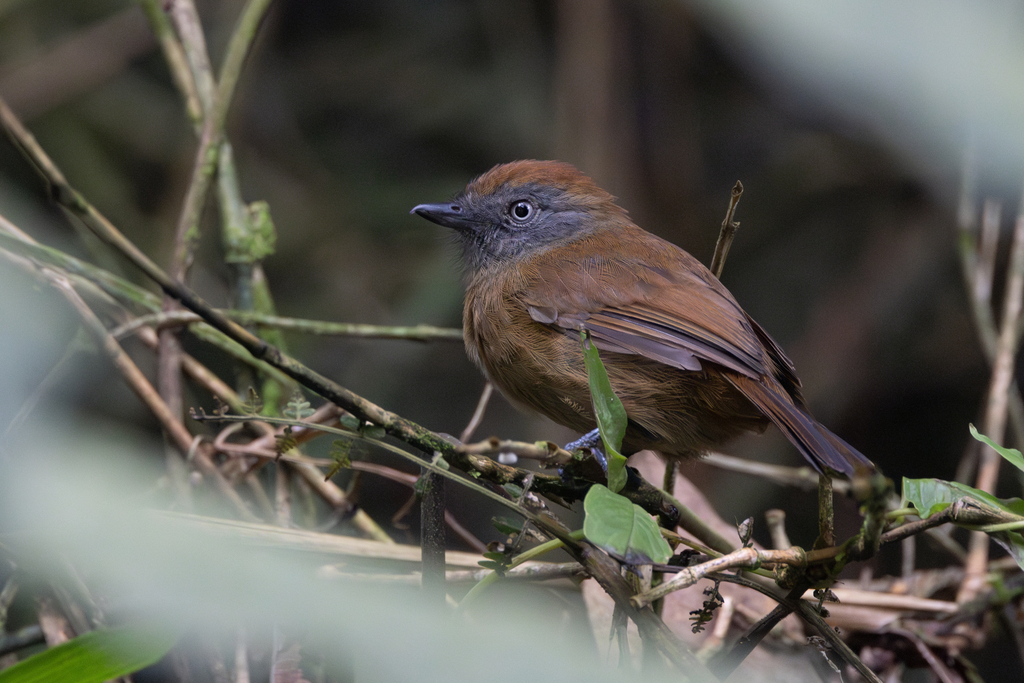
Uniform Antshrike
Photo © Ryan F. Mandelbaum
Photo © Ryan F. Mandelbaum — CC BY 4.0 — Source: iNaturalist photo #361078862Identification
The Uniform Antshrike is a small but sturdy member of the antbird family, measuring 14.5 to 17 cm in length. Like other Thamnophilus species, it possesses the family's characteristic stout, hooked bill. This species shows striking sexual dimorphism. Males are predominantly deep gray to blackish gray, occasionally displaying white tips on their outer tail feathers. Females present a distinctly different plumage: a rufous crown, gray face, rufous-brown upperparts, and pale rufous-brown underparts. Immature birds resemble adult females. Both sexes share a distinctive gray-white to whitish iris, black bill, and gray or blue-gray legs. Subspecific variation exists, with T. u. grandior males more frequently showing white tail tips, and T. u. caudatus females appearing darker and more rufous overall.
Range & Habitat
The Uniform Antshrike has a disjunct distribution across the Andes of Colombia, Ecuador, and Peru. The nominate subspecies inhabits the Pacific slope of the Ecuadorian Andes, while T. u. grandior ranges through all three Colombian Andean ranges and down the eastern slope from southeastern Ecuador into northern Peru. T. u. caudatus occupies the eastern Andean slope from southern Peru southward to Cuzco Department. The species favors the understory of humid montane forest, particularly forest edges and gaps created by fallen trees, though it also occurs in forest interior. Elevational range varies by region: 1,200–2,200 m in Colombia, mostly 1,000–2,000 m in Ecuador, and 1,250–2,300 m in Peru.
Behaviour & Diet
The Uniform Antshrike is believed to be a year-round resident throughout its range. It forages singly or in pairs, almost exclusively within dense vegetation, and rarely joins mixed-species feeding flocks. The bird's diet consists primarily of insects and arthropods, supplemented with seeds. It typically forages very low in the vegetation but occasionally reaches heights of 8 m. Its foraging technique involves hopping among branches and gleaning prey from leaves, stems, vines, and branches; it also probes dead leaf clusters and makes short sallying flights.
Little is documented about its breeding biology beyond the apparent monogamous pairing system and a breeding season spanning February to June in Colombia. The species constructs a distinctive deep cup nest woven from plant fibers, typically moss-covered and suspended below the cup. Details regarding clutch size, incubation, fledging, and parental care remain unknown.
Best Time & Places to See It
The Uniform Antshrike is considered fairly common in Colombia and uncommon to fairly common in Peru, though less numerous in Ecuador overall except in western regions. Its year-round residency means it can be encountered throughout the year, though its preference for dense understory vegetation and low foraging heights make it challenging to observe. The species is best located by listening for its distinctive vocalizations—a simple series of nasal notes with rising inflection (described as 'anh, anh, anh') or a higher, accelerating series of descending notes. Visiting montane cloud forests within the appropriate elevation range during breeding season (February–June) may offer the best opportunities.
Photography Tips
Photographing the Uniform Antshrike presents significant challenges due to its preference for dense understory vegetation and low-level foraging behavior. Success requires patience and positioning yourself quietly near suspected territories, ideally locating birds by their vocalizations first. Early morning light often penetrates understory better than midday. The strong sexual dimorphism offers compositional opportunities if both male and female can be captured. A telephoto lens (at least 300 mm) combined with fast shutter speeds is essential to compensate for low-light conditions typical of montane forest interiors. Focus on capturing the diagnostic features: males' dark plumage and pale iris, and females' distinctive rufous crown and face pattern.
Cordillera Azul National Park
Guácharos Cave National Natural Park
Natural Farallones de Cali National Park
Natural Serranía de los Yariguíes National Park
Natural Sumapaz National Park
Podocarpus National Park
Yanachaga–chemillén National Park
Nothing matches these filters.
No community photos yet. Log in to add the first one.
No community observations of this species yet.