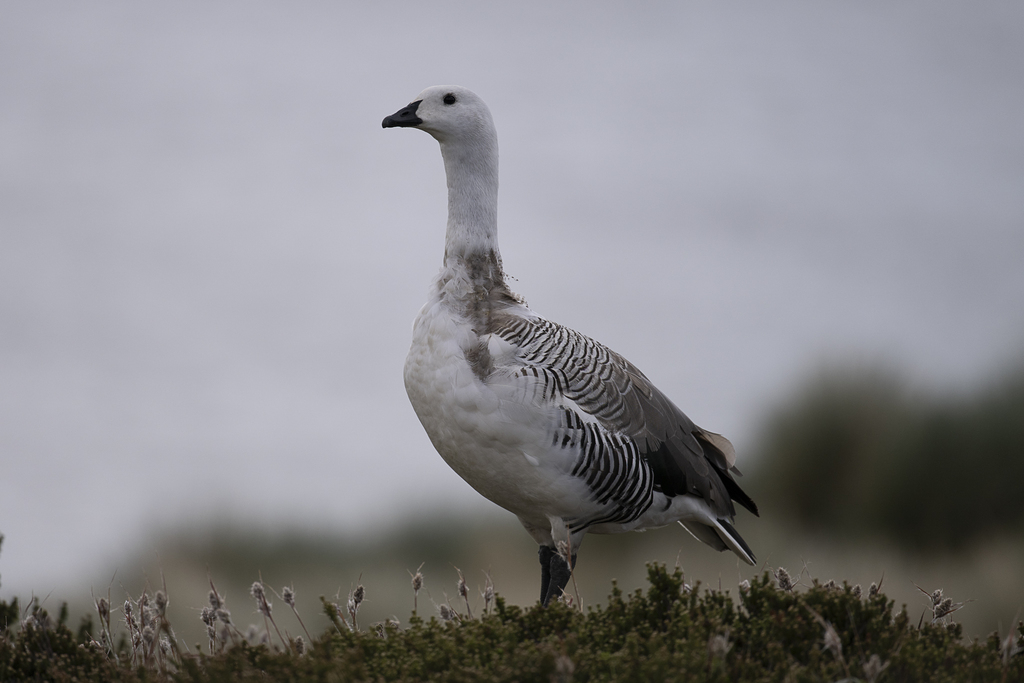
Upland Goose
Photo © Charlotte Kirchner
Photo © Charlotte Kirchner — CC BY 4.0 — Source: iNaturalist photo #594752192Identification
The upland goose, also known as the Magellan goose, is a medium-sized waterfowl displaying striking sexual dimorphism. Males are unmistakable with predominantly white heads and breast plumage contrasted by black legs, though some males display black-barred breast plumage instead. Females are quite different, featuring reddish-brown heads and breasts with yellow-orange legs, making them superficially resemble the ruddy-headed goose. Both sexes measure 60–72.5 centimetres in length. A closer look at males reveals a distinctive greenish-bronze speculum on the inner secondary flight feathers. The two subspecies differ notably in size: the larger greater Magellan goose of the Falkland Islands and the smaller lesser Magellan goose of the South American mainland.
Vocalisations provide another identification clue. Males produce a distinctive whistling "wheep" sound, while females make a lower, rattling "a-rrr" call. These geese belong to the sheldgoose group, which resemble true geese in appearance and behaviour but are more closely related to shelducks and dabbling ducks.
Range & Habitat
The upland goose inhabits the southern cone of South America and the Falkland Islands. The lesser Magellan goose subspecies ranges across southern and central Chile, Argentina, and Tierra del Fuego, with populations migrating north during austral winter towards central Argentina. The larger greater Magellan goose is endemic to the Falkland Islands and does not migrate. These geese typically occupy small, scattered groups on pasture types including temperate grasslands and arid lowland scrubs, showing a preference for areas with short green grasses. Recent land-use changes have forced them to adapt to crop fields and managed pastures.
Breeding occurs close to water sources—rivers, ponds, and coastal areas—in grasslands and coastal meadows at the beginning of the austral summer. They nest on the ground or near it among vegetation. Population estimates suggest the insular populations are stable, though continental populations have experienced recent declines in abundance.
Behaviour & Diet
Upland geese are strictly herbivorous, specialising in plant leaves, stems, and seeds. They are generally social birds, living in small, scattered groups throughout their range. A particularly unusual behaviour involves moulting: these geese shed both primary and secondary feathers in ponds or sheltered sea inlets, typically between late November and early January. Interestingly, some greater Magellan geese skip this crucial moult entirely, retaining their ability to fly throughout the austral summer—a strategy that may offer energetic advantages despite being metabolically costly.
Migratory behaviour differs between subspecies. Lesser Magellan geese migrate seasonally, with southernmost populations more likely to undertake these journeys, achieving flight speeds exceeding 40 km/h. Greater Magellan geese are non-migratory and rarely leave the Falkland Islands.
Best Time & Places to See It
The Falkland Islands offer reliable year-round sightings of the greater Magellan goose subspecies, which maintains resident populations there. For those visiting the South American mainland, central Argentina serves as the primary wintering destination for lesser Magellan geese during the austral winter months. The species breeds in southern Patagonia and Tierra del Fuego at the beginning of the austral summer, making this season ideal for observing breeding birds near water sources in grassland and coastal meadow habitats.
Look for them in areas with short green grass pastures and near freshwater or coastal wetlands. Their preference for specific habitat types means searching appropriate grassland and scrub environments increases the likelihood of successful sightings.
Photography Tips
The striking sexual dimorphism of upland geese makes them excellent photographic subjects. Capture males in profile to showcase their pure white plumage and distinctive head pattern, while females offer interesting opportunities to photograph their complex reddish-brown and barred plumage. The colour contrast between males and females is particularly striking when photographing mixed groups. Pay attention to leg colour—the black legs of males and yellow-orange legs of females provide useful identification markers.
Early morning light on grassland habitats will best illuminate their plumage details and colours. Photographing them near water during moulting season (late November to early January) may yield interesting behavioural images. The varied landscape of their habitat—from temperate grasslands to coastal meadows—offers diverse compositional opportunities to capture these geese in their natural environment.
Sea Lion Island
Sealion Island Settlement, Falkland Islands
+74 birds+3 mammals
Windswept tussock grasslands roll across volcanic terrain where Southern Ocean swells crash against rocky shores, creating one of the Falkland Islands' most dramatic wildlife theatres. This…
VIEW ISLAND & ARCHIPELAGOKidney Island
Stanley, Falkland Islands
+47 birds
Wind-scoured tussock grassland sweeps across this remote South Atlantic outcrop, where peaty soils and exposed rock formations create a landscape as austere as it is vital.…
VIEW ISLAND & ARCHIPELAGOPort Stephens
Port Stephens, Falkland Islands
+29 birds
Windswept moorlands sweep down to pristine beaches where kelp forests fringe the turquoise shallows, their giant fronds swaying in the southern current. Port Stephens, cradled on…
VIEW NATURE RESERVEMurrell Farm
falskland islands, Falkland Islands
+54 birds
Rolling grasslands sweep across windswept plateaux where the South Atlantic exerts its relentless influence on the vegetation, sculpting tussock grassland into a tapestry of browns and…
VIEW NATURE RESERVECape Dolphin
falskland islands, Falkland Islands
+54 birds+1 mammals
Where windswept grasslands meet dramatic coastal cliffs, the Falkland Islands' northern reaches reveal one of the Southern Hemisphere's most compelling seabird sanctuaries. The terrain here is…
VIEW NATURE RESERVEVolunteer Point
Stanley, Falkland Islands
+70 birds+3 mammals
Windswept grasslands meet volcanic black sand beaches where three penguin species converge in the South Atlantic's most theatrical wildlife theatre. This remote peninsula on East Falkland…
VIEW NATURE RESERVEWest Point Island
West Point, Falkland Islands
+67 birds+3 mammals
Windswept cliffs plunge dramatically into the South Atlantic, their rust-coloured rock faces sculpted by millennia of gales and spray. This northwestern outpost of the Falkland Islands…
VIEW ISLAND & ARCHIPELAGOChiloé National Park
Dalcahue, Chile
+122 birds+6 mammals
Temperate rainforest cloaks the Chiloé archipelago's northwestern reaches, where granite ridges thrust through dense, moisture-laden canopy and freshwater streams carve ravines toward the Pacific. Across approximately…
VIEW NATIONAL PARKCabo de Hornos National Park
Cape Horn, Chile
+88 birds+9 mammals
Where the Andes plunge into the Southern Ocean and the Drake Passage churns between two continents, Cabo de Hornos National Park sprawls across one of Earth's…
VIEW NATIONAL PARKTorres del Paine National Park
Torres del Paine, Chile
+143 birds+10 mammals
Where granite spires pierce the Patagonian sky, Torres del Paine commands one of South America's most dramatic landscapes. Across 4,106 square kilometres of southern Chile, jagged…
VIEW NATIONAL PARKLaja National Park Lagoon
Antuco, Chile
+123 birds+1 mammals
Where the Andes descend into the Biobío Region's temperate forests, a vast lagoon fills the caldera of the extinct Antuco volcano, cradled by steep native woodland…
VIEW NATIONAL PARKPuyehue National Park
Puyehue, Chile
+110 birds+4 mammals
Across the volcanic spine of the Los Lagos Region, where the Andes descend toward temperate rainforest, Puyehue National Park encompasses nearly 2,600 square kilometers of one…
VIEW NATIONAL PARKVicente Pérez Rosales National Park
Puerto Varas, Chile
+109 birds+8 mammals
Where the Andes descend toward the temperate rainforests of Chile's Lake District, nearly 4,641 square kilometers of pristine wilderness unfolds across Vicente Pérez Rosales National Park.…
VIEW NATIONAL PARKCerro Castillo National Park
Coyhaique, Chile
+89 birds+3 mammals
Granite peaks and windswept steppe converge across this vast Patagonian landscape, where the Andes' eastern flank drops into terrain sculpted by ice age glaciers and relentless…
VIEW NATIONAL PARKPatagonia National Park
Cochrane, Chile
+133 birds+8 mammals
Where the Andes meet the Patagonian steppe, vast grasslands and shrublands sweep across rolling terrain carved by ancient glaciation, their contours softened by distance and dramatic…
VIEW NATIONAL PARKReserva Nacional Magallanes
Punta Arenas, Chile
+78 birds+2 mammals
Where windswept steppe meets sub-Antarctic forest near the southern tip of continental South America, Reserva Nacional Magallanes unfolds across roughly 352 square kilometres of profound ecological…
VIEW NATIONAL PARKParque Provincial Península de Magallanes
Argentina
+125 birds+4 mammals
Granite peaks and windswept steppe converge across this 415-square-kilometre peninsula jutting into the cold Atlantic waters of southern Patagonia, where the Magallanes landscape embodies the raw,…
VIEW NATIONAL PARKParque Municipal Llao Llao
San Carlos de Bariloche, Argentina
+73 birds+1 mammals
Where the Andes meet the Patagonian lakes, granite peaks rise above temperate rainforest in a landscape of startling contrasts. Parque Municipal Llao Llao, sprawling across 23…
VIEW NATIONAL PARKMonte León National Park
Argentina
+100 birds+4 mammals
Where the Patagonian steppe meets the Atlantic, Monte León National Park protects a landscape of windswept coastal cliffs, rocky outcrops, and semi-arid grassland spanning over 1,200…
VIEW NATIONAL PARKLos Glaciares National Park
Argentina
+121 birds+3 mammals
Where granite peaks and sprawling ice fields dominate the landscape, Los Glaciares National Park encompasses over ten thousand square kilometres of Patagonian wilderness in southern Argentina.…
VIEW NATIONAL PARKPerito Moreno National Park
Argentina
+78 birds
Where the Patagonian steppe descends into a landscape carved by ancient ice, Perito Moreno National Park sprawls across nearly 1,590 square kilometres of some of South…
VIEW NATIONAL PARKNahuel Huapi National Park
Argentina
+124 birds+11 mammals
Where the Andes descend toward Patagonia, vast glacial lakes cut through a landscape of southern beech forest and granite peaks, creating one of South America's most…
VIEW NATIONAL PARKLanín National Park
Argentina
+128 birds+7 mammals
Where the volcanic spine of the Andes plunges into Patagonian steppe, Lanín National Park sprawls across nearly 4,700 square kilometers of one of Argentina's most visually…
VIEW NATIONAL PARKLago Puelo National Park
Argentina
+109 birds+1 mammals
Where temperate forests descend to crystalline waters in the foothills of the Andes, Lago Puelo National Park sprawls across nearly 300 square kilometers of pristine wilderness…
VIEW NATIONAL PARKLos Alerces National Park
Argentina
+84 birds+3 mammals
Where the temperate rainforests of southern Patagonia sweep down towards crystalline lakes, Los Alerces National Park unfolds across nearly 3,000 square kilometres of one of South…
VIEW NATIONAL PARKNo community photos yet. Log in to add the first one.
No community observations of this species yet.