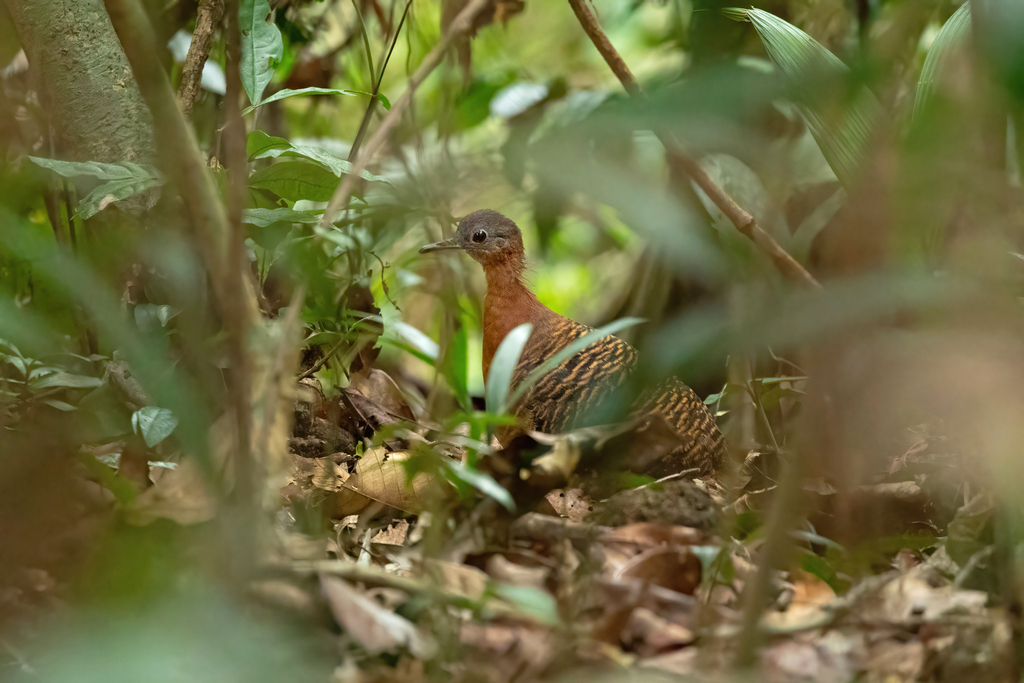
Variegated Tinamou
Photo © Thibaud Aronson
Photo © Thibaud Aronson — CC BY-SA 4.0 — Source: iNaturalist photo #346736950Identification
The variegated tinamou is a small ground-dwelling bird, measuring approximately 29.5 to 33 cm in length. Despite its modest size, it is distinctly patterned and relatively easy to identify once spotted. Its most striking features include a rufous upper back contrasting with black lower back and wings marked by conspicuous yellowish bands. The throat is white, while the neck and upper breast display bright rufous coloring, transitioning to buff on the lower breast and belly. The flanks are tinged with cinnamon and dusky light barring. The crown and sides of the head are black, offset by a yellow bill and greenish to yellowish-brown legs, providing useful field marks for identification.
Range & Habitat
This species is commonly found across moist forest lowlands in subtropical and tropical regions of northern South America. Its range extends through southern and eastern Colombia, southern Venezuela, French Guiana, Suriname, Guyana, Amazonian Brazil, eastern Peru, eastern Ecuador, and northern Bolivia. The variegated tinamou shows a preference for humid lowland forests with dense undergrowth, typically inhabiting altitudes between 100 and 1,300 meters. With an occurrence range spanning 5,400,000 square kilometers, it remains widespread and relatively common throughout its distribution.
Behaviour & Diet
Like other tinamous, the variegated tinamou is primarily a ground forager, pecking for fruit fallen on the forest floor or reaching low-lying bushes. In addition to fruit, its diet includes small amounts of invertebrates, flower buds, tender leaves, seeds, and roots. The species exhibits an interesting breeding system in which males are solely responsible for incubation and chick-rearing. A single male may incubate eggs from as many as four different females, demonstrating a polyandrous mating system. After hatching, he raises the young until they are independent, typically within two to three weeks. Nests are simple affairs, located on the ground in dense brush or sheltered between raised root buttresses of forest trees.
Best Time & Places to See It
The variegated tinamou's preference for dense undergrowth in humid lowland forests makes it a challenging but rewarding species to observe. Visitors exploring protected lowland rainforests throughout its range—particularly in areas of French Guiana, Suriname, Guyana, and the Amazon basin—have the best chances of encountering this bird. Early morning is typically the most productive time for wildlife observation. The bird's presence is often betrayed by its distinctive call before visual contact is made, making careful listening essential for locating individuals within the forest understory.
Photography Tips
Photographing the variegated tinamou presents unique challenges due to its preference for dense forest undergrowth and cryptic behavior. Success requires patience and a willingness to spend extended periods in humid lowland forests listening for the bird's distinctive five-note tremulous call. When the bird is located, a telephoto lens is essential for capturing images without disturbing it. Early morning light, when the bird is most vocal and active, provides the best opportunities. Ground-level positioning may help when the bird is foraging on the forest floor, and photographers should be prepared for the challenging lighting conditions typical of dense tropical understory habitats.
Yasuní National Park
Aguarico, Ecuador
+601 birds+43 mammals
Where the western Amazon basin converges with Ecuador's Orellana Province, lowland rainforest reaches toward the horizon in an unbroken canopy of staggering botanical density. Yasuní National…
VIEW NATIONAL PARKNatural Sierra de Chiribiquete National Park
Solano, Colombia
+359 birds+27 mammals
Massive table-top mountains rise abruptly from the lowland rainforest of southeastern Colombia, their sheer sandstone cliffs and isolated summits creating some of the most dramatic topography…
VIEW NATIONAL PARKNatural la Paya National Park
Puerto Leguízamo, Colombia
+262 birds+4 mammals
Where the Amazon's western reaches fold into the Andes foothills, La Paya National Park sprawls across more than 8,500 square kilometers of pristine Amazonian rainforest in…
VIEW NATIONAL PARKNatural Sierra de la Macarena National Park
Vista Hermosa, Colombia
+566 birds+15 mammals
Across nearly 20,000 square kilometres of Colombia's Meta Department, the terrain rises from lowland savanna into Andean foothills through a mosaic of gallery forests, palm-fringed wetlands,…
VIEW NATIONAL PARKAmacayacu National Park
Leticia, Colombia
+567 birds+25 mammals
Where the Rio Amazonas curves through the tri-border region where Colombia, Peru, and Brazil converge, Amacayacu National Park sprawls across more than 5,250 square kilometres of…
VIEW NATIONAL PARKViruá National Park
Brazil
+389 birds+6 mammals
Across the northern frontier of Roraima, where the forest canopy rises from ancient Amazonian lowlands, Viruá National Park protects nearly 3,700 square kilometres of terra firme…
VIEW NATIONAL PARKPau Brasil National Park
Brazil
+211 birds
Tropical Atlantic forest cloaks the rolling terrain of northeastern Bahia, where Pau Brasil National Park protects nearly 390 square kilometers of one of Brazil's most biodiverse…
VIEW NATIONAL PARKMonte Roraima National Park
Brazil
+226 birds+1 mammals
Where the tepuis rise from the Amazon basin like islands in a sea of forest, Monte Roraima National Park sprawls across 3,714 square kilometres of one…
VIEW NATIONAL PARKChapada Diamantina National Park
Brazil
+346 birds+5 mammals
Where granite peaks and sandstone cliffs rise abruptly from the Brazilian interior, Chapada Diamantina National Park sprawls across 4,215 square kilometers of some of Brazil's most…
VIEW NATIONAL PARKAmazônia National Park
Brazil
+439 birds+6 mammals
Where the Rio Amazonas and its tributaries weave through the heart of Pará state, a vast tapestry of rainforest stretches across 23,611 square kilometers of unbroken…
VIEW NATIONAL PARKMapinguari National Park
Brazil
+354 birds
Vast tracts of western Amazonian rainforest blanket the remote terrain of this 56,827 square kilometre national park in Amazonas state, where seasonal rivers wind through dense…
VIEW NATIONAL PARKJaú National Park
Brazil
+354 birds+3 mammals
Vast floodplain forests and blackwater rivers define this remote corner of western Amazonas, where the Rio Negro and its tributaries have carved an intricate mosaic of…
VIEW NATIONAL PARKPacaás Novos National Park
Brazil
+279 birds+1 mammals
Across the border between Rondônia and Amazonas, vast tracts of humid tropical forest rise and fall in gentle undulations, carved by clear-flowing rivers that feed into…
VIEW NATIONAL PARKAnavilhanas National Park
Brazil
+468 birds+8 mammals
Across the Rio Negro in central Amazonas, an archipelago of over a thousand islands rises from the world's largest rainforest river system, creating a labyrinth of…
VIEW NATIONAL PARKCampos Amazónicos National Park
Amazonas, Brazil
+434 birds+7 mammals
Sprawling across the southwestern Amazon basin in Amazonas state, this 27,263-square-kilometre national park encompasses some of the region's most pristine lowland rainforest, where terra firme forest…
VIEW NATIONAL PARKSerra do Divisor National Park
Brazil
+448 birds+10 mammals
Where the western Amazon meets the Andes foothills, Serra do Divisor National Park sprawls across one of South America's most biodiverse and least accessible frontiers. Spanning…
VIEW NATIONAL PARKManu National Park
Manu, Peru
+892 birds+26 mammals
Across the eastern slopes of the Peruvian Andes, tropical rainforest descends into the Amazon basin with a complexity that few terrestrial ecosystems match. Manu National Park…
VIEW NATIONAL PARKBahuaja Sonene National Park
San Pedro de Putina Punco, Peru
+602 birds+8 mammals
Where the Madre de Dios and Heath rivers converge in southeastern Peru rises one of South America's most biodiverse wilderness regions: a vast protected realm of…
VIEW NATIONAL PARKNo community photos yet. Log in to add the first one.
No community observations of this species yet.