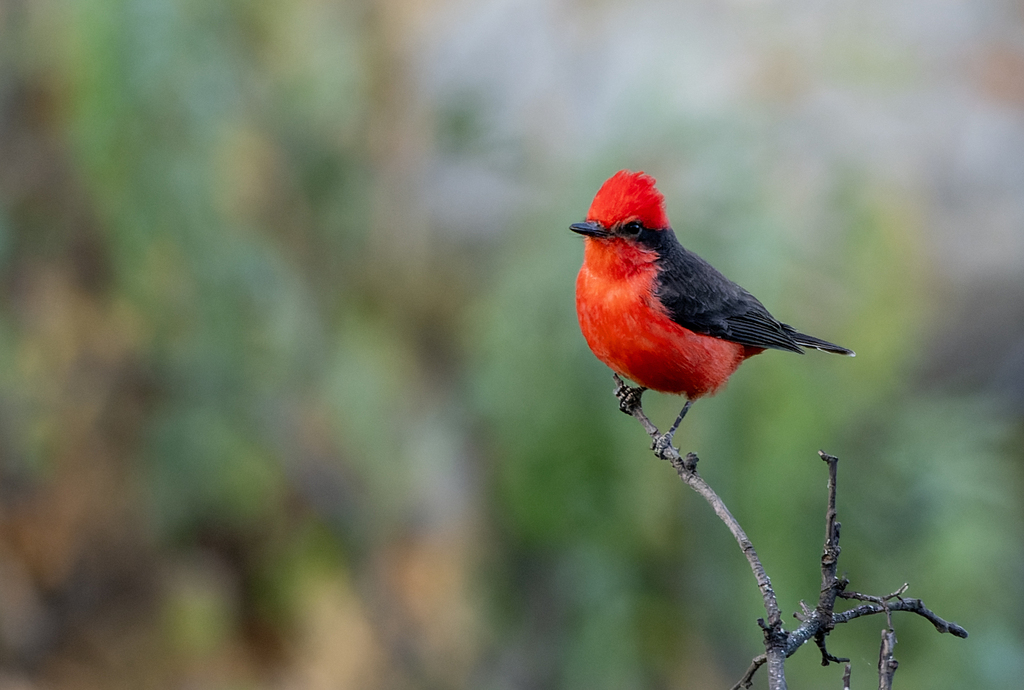
Vermilion Flycatcher
Photo © David F. Belmonte
Photo © David F. Belmonte — CC BY 4.0 — Source: iNaturalist photo #542006754Identification
The Vermilion Flycatcher is a small bird, measuring about 14 cm (5.5 inches) and weighing 12 to 15 grams. Males are unmistakable, with an intense poppy-red forehead and crown extending down to the eye, contrasting with a dark grayish-brown "mask" formed by the lores and ear coverts. Their nape, back, and tail are blackish, while the lower face, throat, and underparts display a slightly lighter poppy red, sometimes with an orangey tinge. Females are far subtler, sporting a grayish-brown head and back with a faint whitish supercilium, duskier wings, and dull white underparts streaked with grayish brown and occasionally tinged pale yellow on the belly. Both sexes share a dark brown iris, brownish-black bill, and dark legs and feet.
Range & Habitat
This species is found across a vast South American range, from southeastern Colombia east through central Brazil and south through eastern Ecuador, Peru, and Bolivia into Paraguay, Uruguay, and northern Argentina. It is highly migratory, with populations breeding in the southern part of its range (south to Río Negro Province in Argentina) before withdrawing northward during austral winter to Amazonian regions. Year-round residents inhabit eastern Bolivia, far northern Argentina, Paraguay, and southern Brazil. The Vermilion Flycatcher favors semi-open to open landscapes including open woodland, woodland edges, pastures with scattered trees, and agricultural areas.
Behaviour & Diet
The Vermilion Flycatcher is primarily an insectivore, catching prey in mid-air through characteristic hawking sallies from a perch, and also foraging on the ground. Its vocalizations include an extremely high-pitched song described as "tic-tic-psiieh," with the last note often upslurred, and a similarly high-pitched call of "psi." Details of its breeding biology remain poorly documented for this South American population, distinguishing it from the more-studied North American vermilion flycatcher species.
Best Time & Places to See It
The Vermilion Flycatcher's highly migratory nature means timing is crucial for observation. During the austral summer and breeding season, look for it throughout much of Argentina, Paraguay, southern Brazil, and Uruguay. In austral winter, concentrate your efforts in Amazonian regions, particularly Amazonian Peru, Ecuador, Colombia, and central Brazil where northern populations congregate. Open, semi-open habitats such as woodland edges and pastures offer the best viewing opportunities across all seasons and locations.
Photography Tips
The brilliant scarlet plumage of males makes them relatively conspicuous subjects, especially against open backgrounds typical of their habitat. Position yourself with backlighting to enhance the intensity of the red coloration. Early morning light often reveals the most vivid hues. Females are cryptic and require patience; scan woodland edges and open pastures during active feeding periods. Since the species hunts from exposed perches, this behavior aids photographers seeking clean shots without excessive foliage obstruction. The bird's small size demands adequate focal length to capture detail; a telephoto lens of at least 400mm is recommended for quality results.
Amacayacu National Park
Antisana National Park
Araucárias National Park
Bahuaja Sonene National Park
Big Bend National Park
Bitter Lake National Wildlife Refuge
Bosque del Apache National Wildlife Refuge
Brasília National Park
Cabeza Prieta National Wildlife Refuge
Nothing matches these filters.
No community photos yet. Log in to add the first one.
No community observations of this species yet.