Footsteps Birdhide
Footsteps Eco-Lodge·Nyatang Faraba·The Gambia
Little Bee-eater · Yellow-crowned Gonolek+7
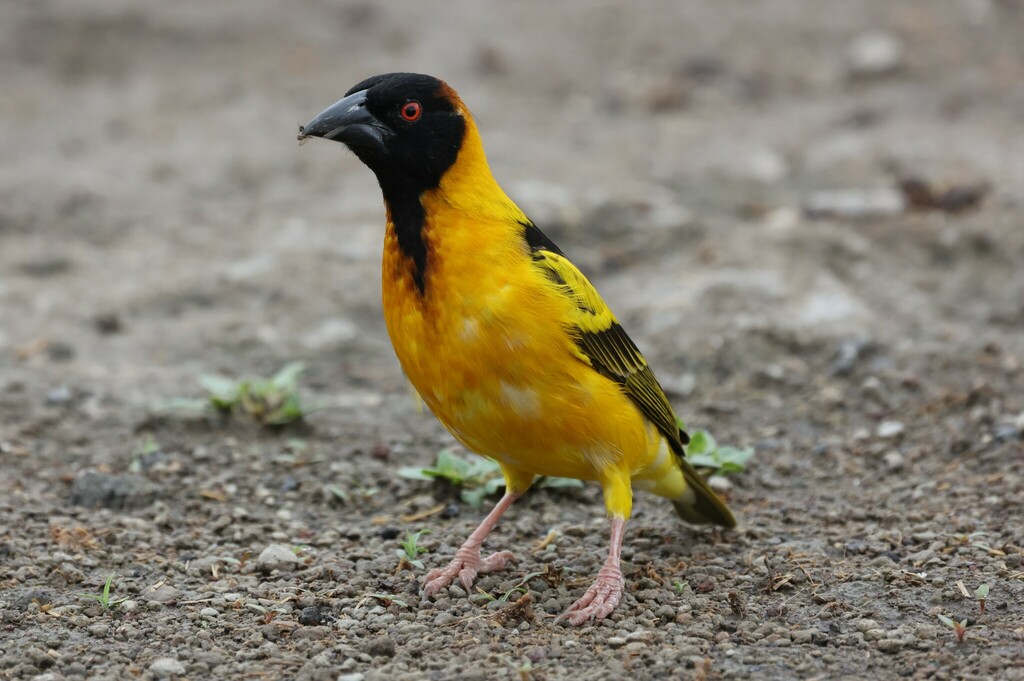
The village weaver is a stocky bird measuring 15–17 cm in length, with a distinctive strong conical bill and dark reddish eyes. The appearance varies significantly between breeding and non-breeding plumage, and across its geographic range. Breeding males in the northern part of the range display a striking black head edged with chestnut, most prominent on the nape and chest, combined with black and yellow upperparts and yellow underparts. Towards the southern part of its range, breeding males show progressively less black and chestnut coloring, with the southernmost subspecies displaying only a black face and throat while the nape and crown turn yellow. Non-breeding males are noticeably different, featuring a yellow head with an olive crown, grey upperparts, and whitish underparts, though the wings retain their yellow and black pattern. Females have streaked olive upperparts, yellow and black wings, and pale yellow underparts, while young birds resemble females but appear browner on the back.
The village weaver is widespread throughout much of sub-Saharan Africa, though notably absent from arid regions in the southwest and northeast. The species has also been successfully introduced to several locations outside Africa, including Portugal and Venezuela, as well as Caribbean islands (Hispaniola, Martinique, and Puerto Rico) and Indian Ocean islands (Mauritius and Réunion). Within its range, this abundant species occupies a wide variety of open or semi-open habitats, including woodlands and human habitation. It shows a particular affinity for human settlements and frequently forms large, noisy colonies in towns, villages, and hotel grounds.
Village weavers are highly social birds that forage and roost in large groups, often mixing with other weaver species. In some areas, they move periodically along fixed routes in search of food. The species is renowned for its remarkable nest-building ability, constructing large, coarsely woven nests from grass and leaf strips with a distinctive downward-facing entrance, suspended from tree branches. Colonial breeders by nature, multiple nests frequently hang from a single tree. Females lay two or three eggs per clutch.
The diet consists principally of seeds and grain, which can make them agricultural pests in some areas. However, they readily consume insects, especially when feeding young, which helps offset crop damage. Village weavers are vocal birds, producing harsh buzzes and chattering calls that contribute to the noisy atmosphere of their colonies.
Village weavers are among the more common weaver species and can be readily observed throughout much of sub-Saharan Africa in suitable habitats. The best locations for encounters are towns, villages, and hotel grounds where large colonies have become established. Look for the birds in open and semi-open woodlands and areas of human habitation. Their abundance and gregarious nature, combined with their preference for accessible human settlements, make them relatively easy to find compared to many other weaver species.
The colonial nesting behavior of village weavers provides excellent opportunities for photography, particularly when capturing images of multiple nests hanging from a single tree. The striking differences between breeding and non-breeding plumage offer varied photographic subjects depending on the season and location within the species' range. The birds' social nature and large group gatherings allow for both behavioral and habitat photography. Be prepared for the noisy, active nature of these colonies, and position yourself to capture the characteristic downward-facing nest entrances, which are a distinctive feature of the species.
Nothing matches these filters.
Nothing matches these filters.
No community photos yet. Log in to add the first one.
No community observations of this species yet.
We'd love to hear from you. We'll reply as soon as possible.
Found an error? Have a suggestion? We read every message.
A compact view of how this species lives, moves and responds to its environment.
Select a card to explore the details.
Please confirm the photo rights and credit terms first.
I'm the author of this photo or hold the rights to it, and I keep full ownership. I grant Wild Atlas Guide a free, non-exclusive licence to display it on the site and in Wild Atlas Guide's own channels, including social media, always credited to me by my display name or the Instagram handle I choose to provide. I confirm it does not reveal a sensitive wildlife location or a recognisable person without their permission. I can withdraw future social use for this photo or ask for it to be removed at any time.
Please accept the photo rights and credit terms to continue.
Uploading…
We use cookies to measure traffic and improve Wild Atlas Guide. You decide. Privacy policy