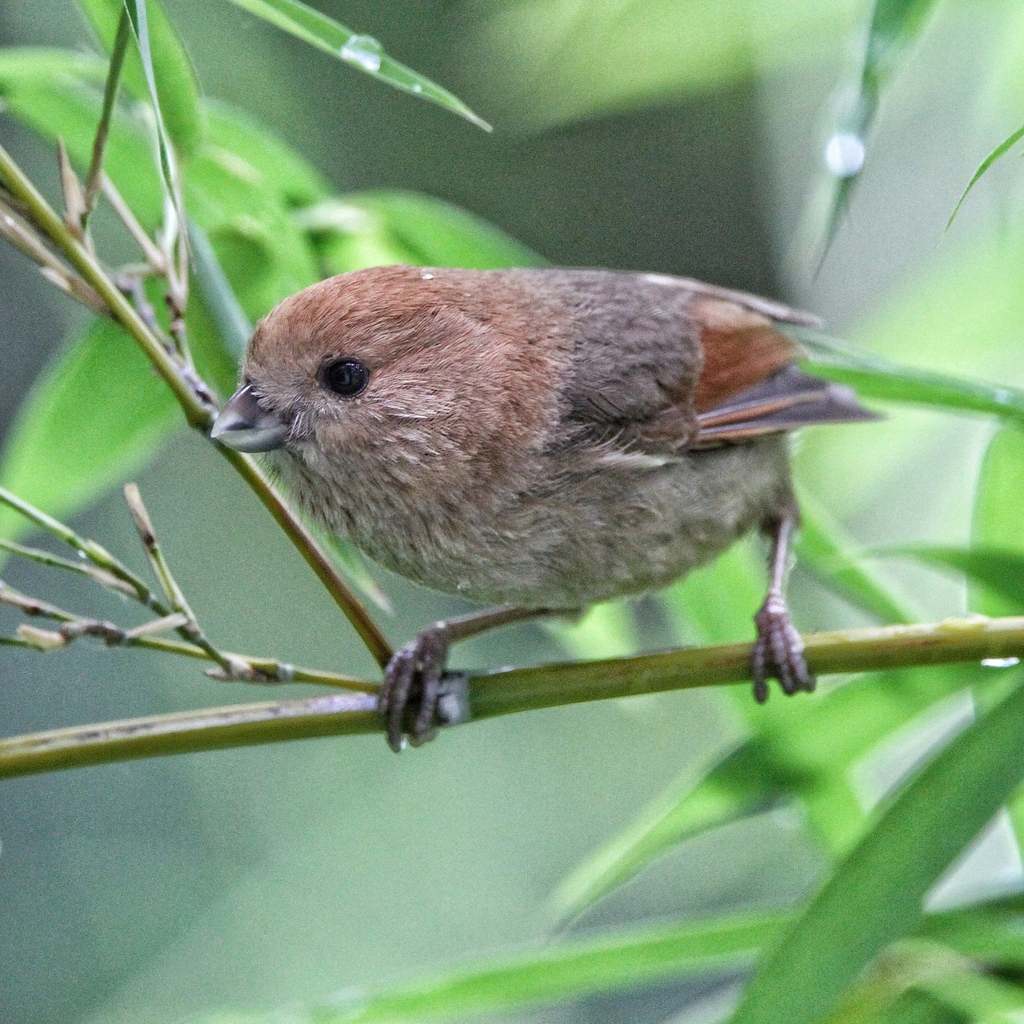
Vinous-throated Parrotbill
Photo © capacoscar
Photo © capacoscar — CC BY 4.0 — Source: iNaturalist #284304604The vinous-throated parrotbill (Suthora webbiana) is a species of parrotbill in the family Paradoxornithidae; formerly, it was placed in the closely related Sylviidae or Timaliidae. It is found in China, Japan, Korea, Mongolia, Russia, Taiwan, and Vietnam. Its natural habitat is subtropical or tropical moist montane forests. == Taxonomy and systematics == The vinous-throated parrotbill was described in 1852 by John Gould and placed in the genus Suthora, where it sat with other small browner parrotbills. Later parrotbills were merged into two genera, Conostoma and Paradoxornis; with this species being placed in Paradoxornis. Recent DNA studies have shown that the genus Paradoxornis is paraphyletic, and that it should be split. It is suggested that the vinous-throated parrotbill should be placed in the genus Sinosuthora. The vinous-throated parrotbill is very closely related to the ashy-throated parrotbill, and hybrids have been reported between the two species in Vietnam and China, as well as in Italy where both species have become established. It is now placed in its original genus, the Suthora in International Ornithologists' Union bird list 13.2. The specific name webbiana commemorates the English botanist Philip Barker Webb. The species is sometimes referred to as Webb's parrotbill. == Habitat and movements…
Wulingyuan
Jundiping, China
+97 birds+3 mammals
Sandstone peaks erupting from forested valleys define this sprawling 993-square-kilometre national park in Hunan Province, where vertical cliffs rise dramatically above lush subtropical woodland. The landscape—a…
VIEW NATURAL MONUMENTMount Nanling Forest Park
Ruyang Forest Farm, China
+179 birds+3 mammals
Granite ridges and weathered peaks rise through a canopy of subtropical montane forest where Ruyang Forest Farm anchors one of southern China's most biodiverse landscapes. Across…
VIEW FOREST & JUNGLEJiuzhai Valley
Jiuzhaigou County, China
+226 birds+7 mammals
Where crystalline alpine streams cascade through limestone gorges and karst terrain rises in dramatic vertical walls, Jiuzhai Valley unfolds across nearly 1,300 square kilometers of southwestern…
VIEW NATURAL MONUMENTHuanglong Scenic and Historic Interest Area
Ngawa Tibetan and Qiang Autonomous Prefecture, China
+194 birds+7 mammals
Across the high plateau of northwestern Sichuan, a geological wonder unfolds where limestone terraces and mineral-rich springs have sculpted one of China's most distinctive natural monuments.…
VIEW NATURAL MONUMENTNortheast China Tiger and Leopard National Park
Mu Dan Jiang Shi, China
+202 birds+19 mammals
Across the temperate forests of northeastern China, where winters grip the landscape in subzero silence and summers remain cool and brief, the Mudanjiang region supports a…
VIEW NATIONAL PARKWuyishan National Park
Yanshan County, China
+141 birds+2 mammals
Where subtropical monsoon rains sustain a perpetually humid landscape, Wuyishan National Park rises from Fujian's eastern plateau as a realm of forested ridges, cascading streams, and…
VIEW NATIONAL PARKWolong National Nature Reserve
Wenchuan County, China
+333 birds+17 mammals
Where the Qingyi River cuts through the eastern flanks of the Minshan Range, a temperate montane forest cloaks steep valleys in dense canopy that thins dramatically…
VIEW NATURE RESERVEYancheng National Nature Reserve
Yancheng, China
+208 birds+4 mammals
Where the East China Sea's tidal rhythms sculpt the Jiangsu coast, Yancheng National Nature Reserve sprawls across one of Asia's most dynamic wetland complexes. This vast…
VIEW NATURE RESERVEPoyang Lake National Nature Reserve
Shangrao, China
+270 birds+7 mammals
Where the Yangtze River's massive floodplain spreads across central China, Poyang Lake National Nature Reserve encompasses one of the continent's most dynamic and water-rich wetland systems.…
VIEW NATURE RESERVENo community photos yet. Log in to add the first one.
No community observations of this species yet.