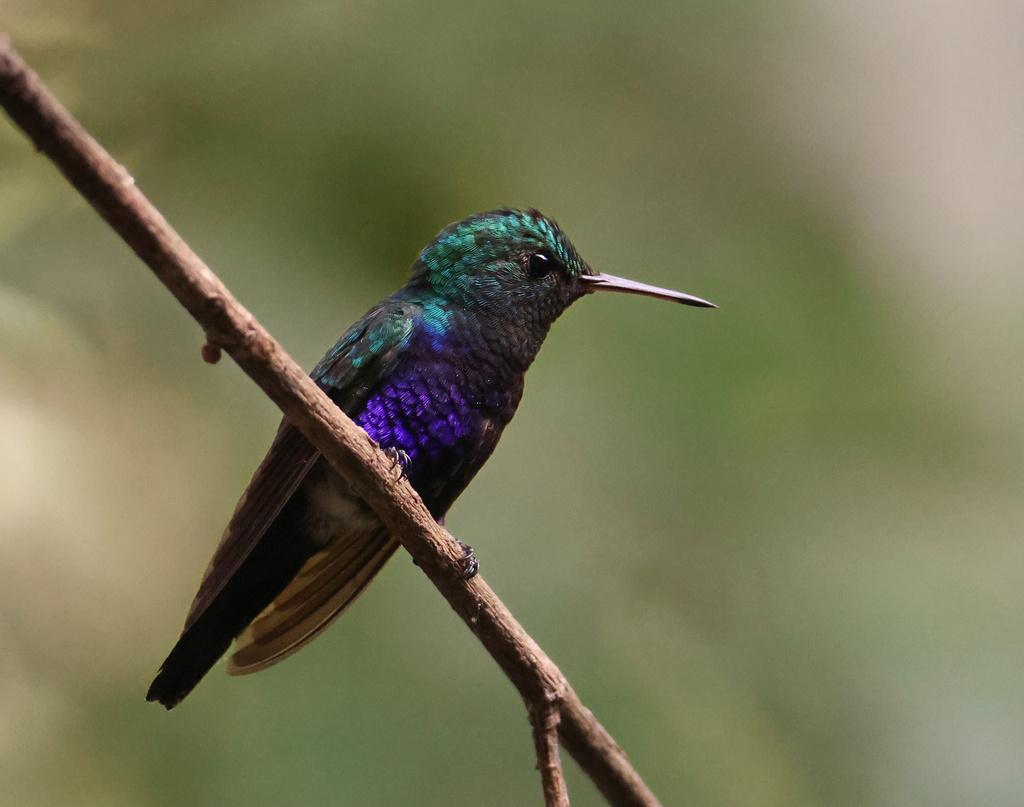
Violet-bellied Hummingbird
Photo © Aitor
Photo © Aitor — CC BY 4.0 — Source: iNaturalist photo #276430044Identification
The violet-bellied hummingbird is a striking small hummingbird, measuring just 7–7.5 cm in length. Sexual dimorphism is pronounced in this species. Males are brilliantly colored with a shimmering violet-blue breast and belly, metallic green back and crown, and a bronze-green rump. Females are considerably duller, featuring a metallic bronze-green back and crown but a pale gray belly instead of violet. Both sexes share long, rounded tails, straight and short bills with pink lower mandibles, and dusky wings with a purple sheen. Males average 3.4 g while females weigh around 3.0 g. Immature males resemble females but may display patches of violet on the belly or sparkling green on the foreneck.
When identifying this species, note the distinctive white tufts around the tibia framed by partly white spots on the belly—a helpful field mark. Take care not to confuse violet-bellied hummingbirds with similar species in their range. The green-crowned woodnymph, which overlaps in distribution, is larger with a violet back and notched tail; the violet-bellied hummingbird has a green back and rounded tail. The sapphire-throated hummingbird has a blue throat and green belly, easily distinguishing it from this species.
Range & Habitat
The violet-bellied hummingbird is found throughout central Panama, Colombia, southwestern Ecuador, and the extreme northwestern point of Peru. Three subspecies occupy this range with subtle differences: panamensis in Panama, julie in northern Colombia, and feliciana in western Ecuador and northwestern Peru. Unlike many hummingbird species, violet-bellied hummingbirds do not migrate seasonally and remain resident year-round throughout their distribution.
This species inhabits the understory of humid deciduous forests, forest edges, and regrowth forests. They show remarkable tolerance for disturbed habitats, making them relatively common in modified landscapes. This adaptability contributes to their stable conservation status and makes them accessible to birdwatchers exploring a variety of forest types across their range.
Behaviour & Diet
Violet-bellied hummingbirds are polygynous, with males mating with multiple females and then departing to leave females solely responsible for breeding. Males attract mates by singing from perches positioned 1–10 m high and by performing U-shaped aerial displays in front of females. Females construct tiny cup nests from plant fibers, animal hair, and feathers in shrubs or trees 1.2–4.2 m above ground. They lay clutches of two white eggs measuring 8 by 13 mm, with incubation lasting 15 days followed by a 20–22 day nestling period. Successfully fledged individuals live approximately 4.2 years on average.
Though primarily nectarivorous, violet-bellied hummingbirds are better described as omnivorous, supplementing nectar with small arthropods. They feed from flowering plants in the Rubiaceae, Ericaceae, Gesneriaceae, and Fabaceae families. Males defend feeding territories from other males and large insects. While they do not form flocks, they may congregate at fruit trees and feeders, providing excellent viewing opportunities for patient observers.
Best Time & Places to See It
Violet-bellied hummingbirds are present year-round throughout their range, so any season offers opportunities to observe them. They are featured attractions on organized bird-watching tours in Panama, where tourists and local guides regularly encounter this species. The birds' tolerance of disturbed areas and forest edges means they are not restricted to pristine wilderness; they can be found in a variety of accessible habitats across their range from central Panama south through Colombia to Ecuador and Peru.
Look for them in the understory of humid forests and along forest edges, particularly near flowering plants in the families mentioned above. Since males sing from exposed perches and perform their distinctive U-shaped displays, visiting areas with known feeding aggregations—whether natural fruit trees or maintained feeders—increases your chances of close observation and photography.
Photography Tips
Photographing violet-bellied hummingbirds presents both rewards and challenges. The males' shimmering violet belly and metallic green back are spectacular in good light, but hummingbirds require fast shutter speeds—typically 1/1000 second or faster—to freeze their rapid wing beats. Position yourself near flowering plants or feeders where birds congregate predictably. Early morning light is ideal for capturing the iridescent plumage at its most vibrant.
The rounded tail, distinctive white tibia tufts, and spotted belly markings are useful diagnostic features to capture for identification purposes. Males singing from low perches offer excellent opportunities for photography without excessive depth-of-field challenges. Remember that females and immatures are significantly duller than males; position yourself where both sexes visit to document the dramatic sexual dimorphism that characterizes this species.
Cerros de Amotape National Park
District of San Jacinto, Ecuador
+246 birds+1 mammals
Arid mountains rise abruptly from Peru's northwestern frontier, their slopes clothed in xerophytic scrubland and seasonal deciduous forest that transforms these Andean foothills into one of…
VIEW NATIONAL PARKSoberanía National Park
Cristóbal, Panama
+495 birds+34 mammals
Rainforest and riverine woodland blanket the rolling terrain of this 714-square-kilometre national park in Colón Province, where the Caribbean watershed feeds a maze of streams and…
VIEW NATIONAL PARKChagres National Park
Caimitillo, Panama
+486 birds+19 mammals
Where the Chagres River carves through the humid tropics of central Panama, a vast montane and lowland forest sprawls across more than 2,300 square kilometers, anchoring…
VIEW NATIONAL PARKDarién National Park
Tucutí, Panama
+534 birds+13 mammals
Where the spine of Central America crumbles into wetland and rainforest, Darién National Park sprawls across more than 20,000 square kilometres of some of the tropics'…
VIEW NATIONAL PARKPortobelo National Park
Portobelo, Panama
+366 birds+9 mammals
Where the Caribbean's turquoise waters meet the Darién's verdant shore, Portobelo National Park sprawls across 570 square kilometers of coastal forest, mangrove wetland, and coral-fringed islands…
VIEW NATIONAL PARKNo community photos yet. Log in to add the first one.
No community observations of this species yet.