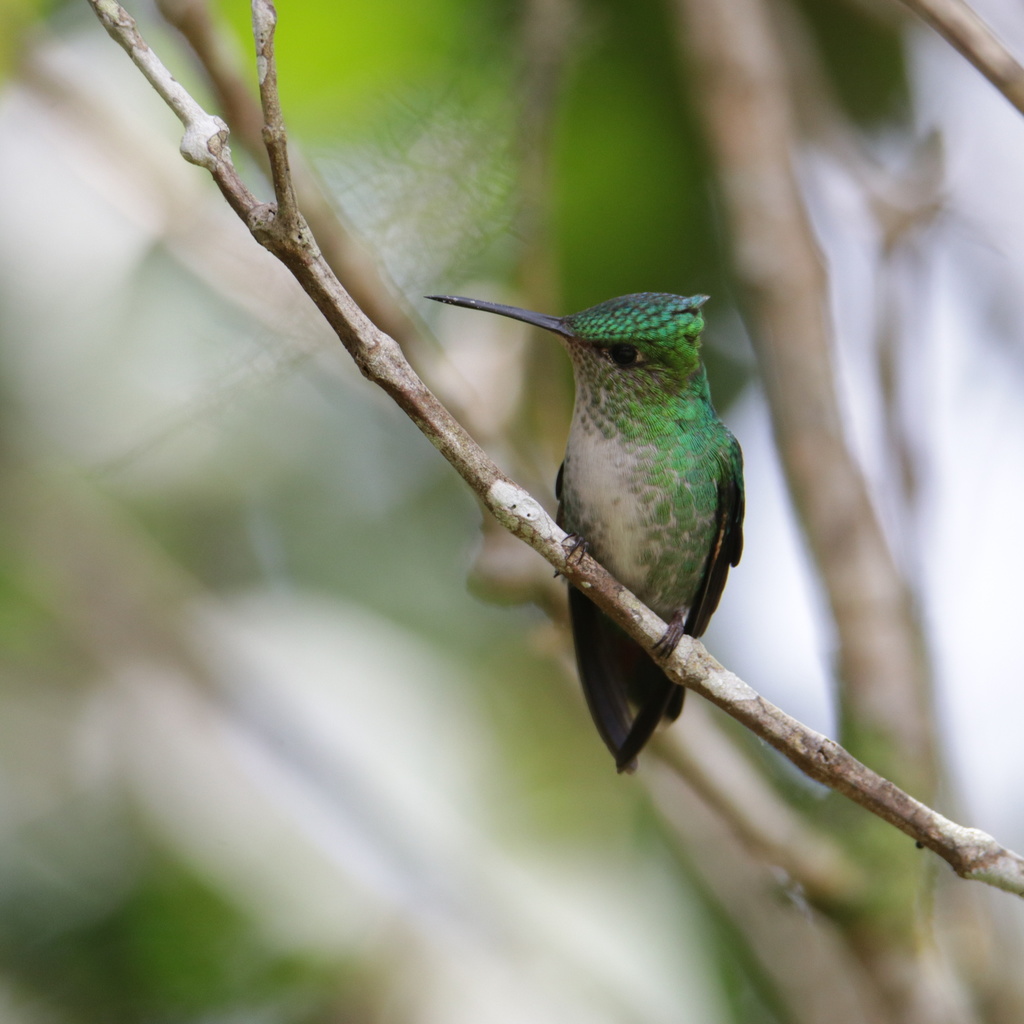
Violet-capped Hummingbird
Photo © Aitor
Photo © Aitor — CC BY 4.0 — Source: iNaturalist #39250812Identification
The violet-capped hummingbird is a tiny species, measuring just 8.5 to 9.5 cm in length, with males weighing 3.8 to 4.4 g and females slightly lighter at 3.4 to 3.9 g. The most striking feature is the male's iridescent violet-blue crown, which gives the species its name, contrasting sharply with the metallic green of the rest of the body. Males display a slightly forked tail that is maroon with distinctive wide white edges on the feathers. Females are more subtly plumaged, with green upperparts and whitish underparts decorated with gray spots on the throat and green spots along the sides; their tails are similarly maroon but with white tips rather than edges. Both sexes share a straight bill that is mostly black with a pink base on the lower mandible.
Range & Habitat
This species is endemic to the mountains of central and eastern Panama and extreme northwestern Colombia, occurring in several unconnected mountainous areas. The violet-capped hummingbird favors the edges and interior of humid forests at elevations between 600 and 1,200 m, with populations most concentrated around 900 m. It is a year-round resident throughout its range, never undertaking significant migrations.
Behaviour & Diet
The violet-capped hummingbird forages for nectar in dense undergrowth, specializing in low-growing flowering shrubs including Salvia, Pachystachis, Palicourea, and Psammisia. Its vocalizations are distinctive: the song consists of low, rapid chirping, while its call is a series of irregularly repeated, nasal, and fairly low-pitched notes that sound like "kyek...kyek-kyek-kyek...kyek," typically delivered while hovering or feeding.
Recent discoveries have expanded our understanding of the species' breeding biology. The breeding season extends longer than previously thought, spanning from December through August. Females construct tiny cup-shaped nests from lichen, fern fibers, and dry moss bound together with spider web and lined with additional spider web. Nests may be attached to fern fronds about 1 m above ground or to shrub branches as high as 4 m. Each clutch contains two white eggs, which the female incubates and tends alone, providing all care for any resulting nestlings.
Best Time & Places to See It
The violet-capped hummingbird is considered fairly common to locally common within its range, making it a realistic target for dedicated travelers to the mountainous regions of Panama and northwestern Colombia. Since it is a year-round resident, any season offers opportunities to observe this species. Focus your search in humid montane forest between 600 and 1,200 m elevation, particularly around 900 m, where populations are most concentrated. Look for the bird in dense undergrowth and near flowering shrubs.
Photography Tips
The violet-capped hummingbird's small size and preference for dense undergrowth present challenges for photographers. Its iridescent violet crown is most striking when photographed with light hitting the head at the correct angle, so position yourself to take advantage of directional sunlight. The bird's rapid movements and feeding behavior in low vegetation demand fast shutter speeds and patience. Early morning light often provides the best conditions for capturing the metallic greens and violet iridescence that make this species visually distinctive.
Chagres National Park
Caimitillo, Panama
+486 birds+19 mammals
Where the Chagres River carves through the humid tropics of central Panama, a vast montane and lowland forest sprawls across more than 2,300 square kilometers, anchoring…
VIEW NATIONAL PARKDarién National Park
Tucutí, Panama
+534 birds+13 mammals
Where the spine of Central America crumbles into wetland and rainforest, Darién National Park sprawls across more than 20,000 square kilometres of some of the tropics'…
VIEW NATIONAL PARKNo community photos yet. Log in to add the first one.
No community observations of this species yet.