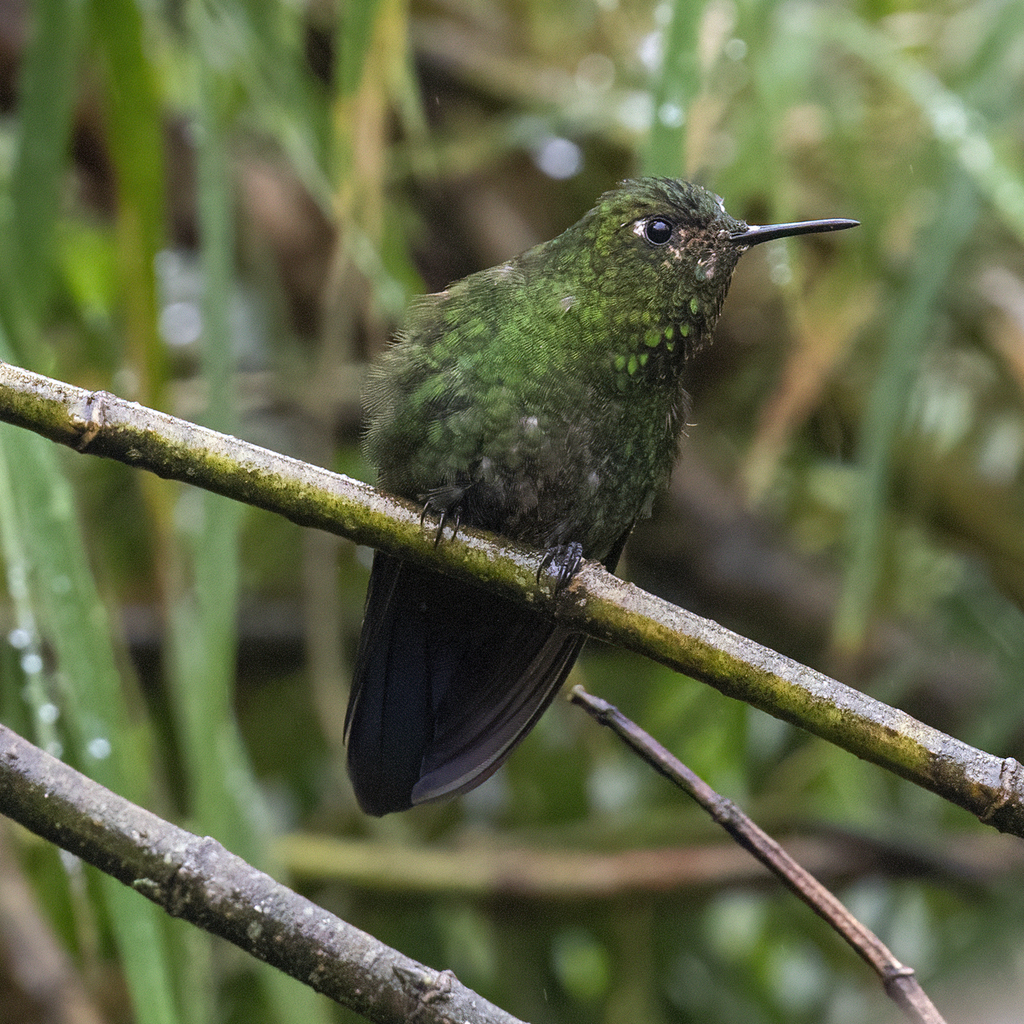
Viridian Metaltail
Photo © Dan Vickers
Photo © Dan Vickers — CC BY 4.0 — Source: iNaturalist #259392418Identification
The viridian metaltail is a small hummingbird, measuring 11 to 12 cm in length and weighing only 4.1 to 5.3 grams. Both males and females display striking bottle-green plumage on their upperparts. Males are particularly distinctive, featuring a glittering bottle-green gorget and a purplish-blue, slightly forked tail. Females have mottled green-and-white underparts with whitish tips on the underside of their outer tail feathers. The species has a medium-length, straight black bill. Four subspecies are recognized, each with subtle plumage variations: recisa shows shinier underparts and a more deeply forked tail; primolina displays a reddish-black tail with shining green below; and atrigularis features a distinctive black patch in the center of its gorget.
Range & Habitat
The viridian metaltail is endemic to the Andes mountains of Colombia and Ecuador, with different subspecies occupying distinct ranges. The nominate subspecies inhabits both slopes of Colombia's Central Andes, while recisa is found in the Western Andes of Antioquia Department. Primolina ranges from southern Colombia's Nariño Department into Ecuador as far as northern Azuay Province, and atrigularis occupies the southern Ecuadorian Andes. This species favors high-elevation páramo grasslands with scattered shrubs and the shrubby edges of humid montane and elfin forests, typically occurring between 2,700 and 3,600 meters elevation in Ecuador, with Colombian populations ranging up to 4,000 meters.
Behaviour & Diet
The viridian metaltail is presumed to be largely sedentary, though males may disperse to higher elevations outside the breeding season. These hummingbirds forage at all vegetation levels, feeding on nectar while hovering and showing a preference for shrubs in the Ericaceae and Melastomataceae families. Males vigorously defend feeding territories from competitors. The breeding season extends from February to August, during which females construct delicate nests from moss lined with soft plant down and small feathers, typically placing them in rocky niches or sheltered spots. Each clutch consists of two white eggs, incubated by the female alone. The species produces distinctive vocalizations: a descending series of 3 to 5 squeaky notes often followed by jumbled dry buzzy trills, as well as repeated gravelly buzzing calls.
Best Time & Places to See It
The viridian metaltail's extended breeding season from February through August offers the best opportunities for observation, when males are most vocal and territorial. Birdwatchers should focus on páramo grasslands and montane forest edges at elevations above 2,700 meters. Several protected areas within its range provide reliable viewing opportunities, though much of the natural páramo habitat has been degraded by burning for cattle pasture conversion, limiting populations in some regions. Early mornings typically offer the best activity levels for hummingbird viewing.
Photography Tips
Photographing this diminutive hummingbird requires patience and fast shutter speeds to freeze wing movement. The male's iridescent gorget and tail are best captured with direct or side-lighting to showcase their brilliant metallic colors. Position yourself near flowering shrubs where the birds forage, particularly plants in the Ericaceae and Melastomataceae families. The high-elevation páramo habitat often features dramatic cloud formations that can add striking backgrounds. Early morning light at high altitude produces particularly vibrant colors on the bird's plumage, making this the optimal time for photography.
Sangay National Park
Cebadas, Ecuador
+320 birds+10 mammals
High in Ecuador's Andean spine, where the Western Cordillera rises to touch perpetual snow, a landscape of volcanic drama and ecological intensity unfolds across Sangay National…
VIEW NATIONAL PARKPodocarpus National Park
Zamora, Ecuador
+496 birds+6 mammals
Where the Andes descend toward the Amazon basin, Podocarpus National Park sprawls across nearly 2,800 square kilometres of the most biodiverse terrain in Ecuador's southern highlands.…
VIEW NATIONAL PARKYacuri National Park
Las Juntas, Ecuador
+166 birds+1 mammals
Where the eastern slopes of the Andes descend into Ecuador's southern frontier, Yacuri National Park unfolds across nearly 1,300 square kilometers of montane cloud forest and…
VIEW NATIONAL PARKAntisana National Park
Quijos, Ecuador
+432 birds+21 mammals
Where the eastern Andean slopes descend into the Amazon basin, Antisana National Park sprawls across roughly 2,500 square kilometers of some of South America's most dramatic…
VIEW NATIONAL PARKCotopaxi National Park
Mulaló, Ecuador
+211 birds+6 mammals
High in Ecuador's volcanic corridor, where the páramo transitions into cloud forest along the slopes of Cotopaxi volcano, the national park unfolds across nearly 500 square…
VIEW NATIONAL PARKLlanganates National Park
Tena, Ecuador
+239 birds+8 mammals
Where the eastern slopes of the Andes plunge toward the Amazon basin, Llanganates National Park sprawls across nearly 3,500 square kilometers of montane wilderness, its terrain…
VIEW NATIONAL PARKCajas National Park
Cuenca, Ecuador
+190 birds+7 mammals
High in the Andes above Cuenca, where elevation ranges from 3,100 to 4,200 metres, the páramo landscape dominates—a windswept realm of cushion plants, alpine grasses, and…
VIEW NATIONAL PARKPuracé National Natural Park
Puracé, Colombia
+327 birds+2 mammals
Where the Andes thrust upward across southwestern Colombia, Puracé National Natural Park spans nearly 2,631 square kilometers of some of South America's most dramatic montane terrain.…
VIEW NATIONAL PARKNatural Nevado del Huila National Park
Planadas, Colombia
+117 birds
Where the Colombian Andes rise above 5,000 metres, tropical cloud forest yields to páramo and glaciated peaks, and the Planadas region of Tolima contains one of…
VIEW NATIONAL PARKNo community photos yet. Log in to add the first one.
No community observations of this species yet.