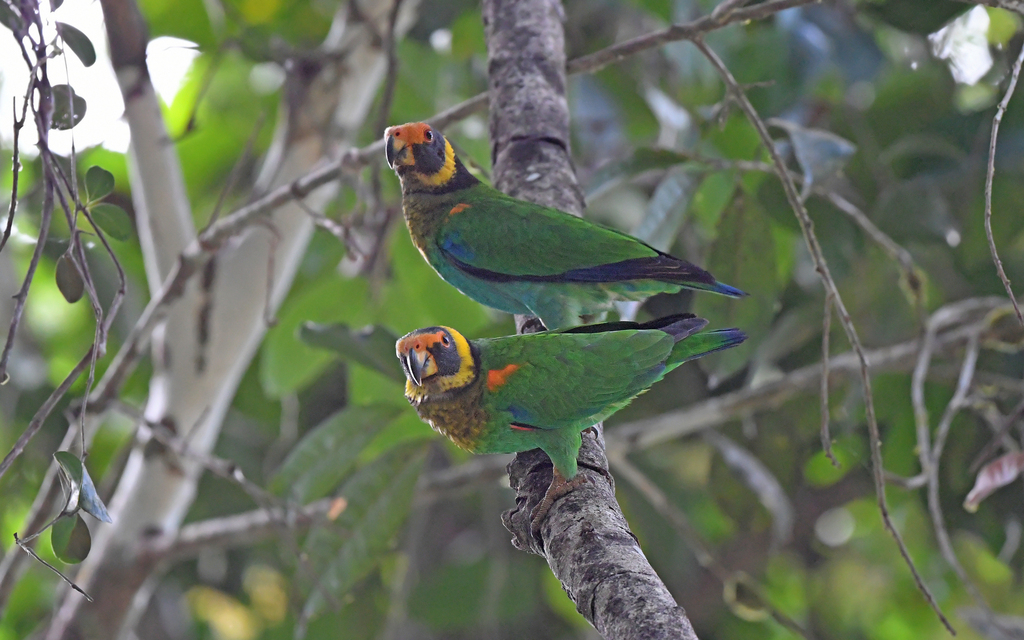
Vulturine Parrot
Photo © Christoph Moning
Photo © Christoph Moning — CC BY 4.0 — Source: iNaturalist photo #443639721Identification
The vulturine parrot is a small parrot, 23–25 cm long and weighing 138–165 g. Its most distinctive feature is the bare black skin on its face—a striking adaptation that gives the species its common name. Adults display yellowish lores and a collar of bright yellow feathers, with a band of black feathers below. The upperparts are green with a distinctive reddish-orange shoulder patch. The breast is olive-yellow, the belly green with blue-edged feathers, and the lower thighs yellow. The primaries are black with green edges, while the carpal edges and underwing coverts are red. The tail is green with blue tips on the upper surface and green-yellow below.
Immature birds are quite different, with fully feathered green heads, yellowish plumage around the lores and eye, and lacking the adult's striking yellow collar. This difference was once mistaken for a separate species until 2002.
Range & Habitat
This parrot is endemic to Brazil, found south of the Amazon River from the Madeira River eastward to near the Atlantic coast in Maranhão state. It inhabits both terra firme (upland) and seasonally flooded várzea forests, making it adaptable to varied forest conditions within its range.
Behaviour & Diet
Little is documented about the vulturine parrot's behavior. Its movements are essentially unknown. The bare facial skin is believed to be an adaptation to prevent feather-matting when feeding on large, sticky fruits—suggesting a diet rich in such fruits, though detailed foraging behavior remains poorly studied. Nothing is known about its breeding biology.
The vulturine parrot is vocal, producing a distinctive nasal, rhythmic flight call described as "tree ... trayaweet" or simply "trayaweet." When perched, it utters a wide variety of calls ranging from nasal yelps and barks to more melodious whistles, whining sounds, and typical parrot-like vocalizations.
Best Time & Places to See It
The vulturine parrot is considered uncommon throughout its range, and the timing of movements—if any occur—is unknown, making it difficult to predict seasonal patterns for observation. The species occurs in terra firme and várzea forests across central-eastern Brazil. Only one protected area exists within its range, located in the western part of its distribution, which may offer the most reliable viewing opportunities, though even there the species is not common.
Photography Tips
The vulturine parrot's striking bare facial pattern and reddish-orange shoulder make for compelling subjects. The contrast between the bare black face and the surrounding yellow collar and green plumage provides excellent photographic interest. Shooting in early morning light will highlight the iridescent blues and reds in the wings and tail. Its uncommon status and preference for forest canopy mean patience and luck are essential; look for mixed feeding flocks and listen for its distinctive flight call to locate birds.
Nothing matches these filters.
No community photos yet. Log in to add the first one.
No community observations of this species yet.