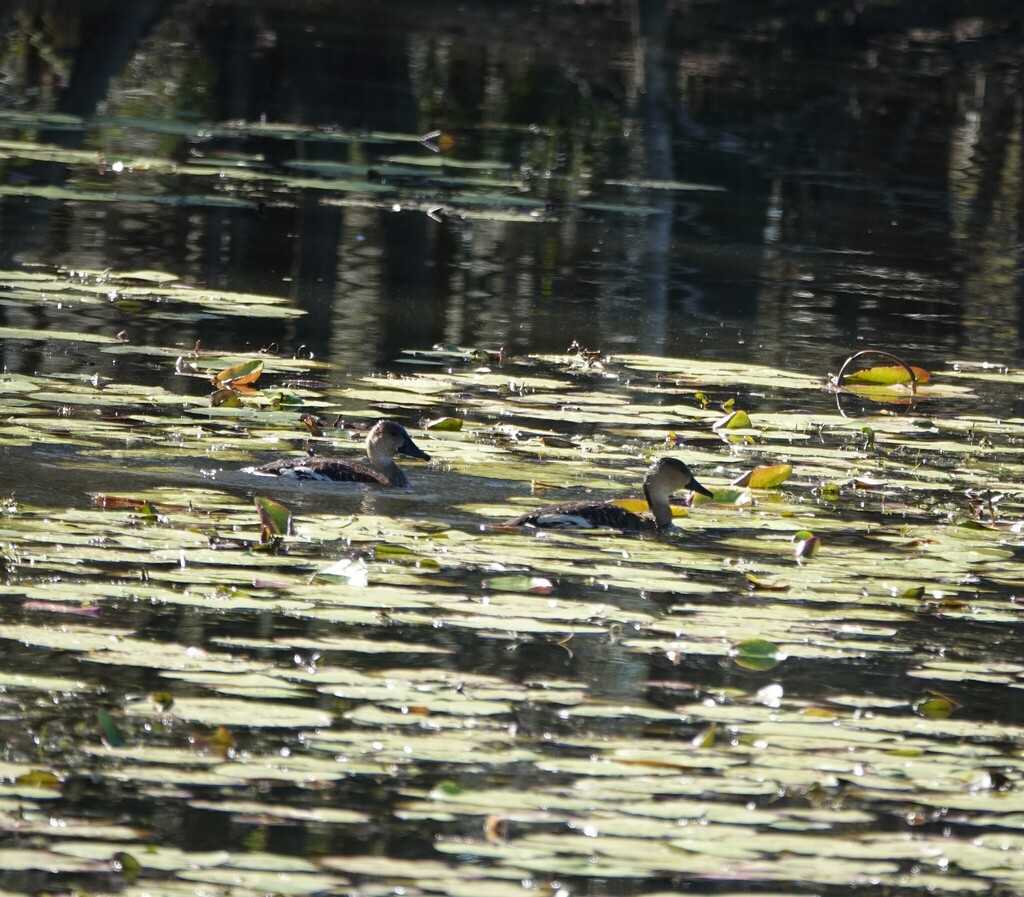
Wandering Whistling Duck
Photo © Mark Clarke
Photo © Mark Clarke — CC BY 4.0 — Source: iNaturalist #296408137Identification
The wandering whistling duck is unmistakable in its appearance, with a distinctive silhouette that seems to blend characteristics of both geese and ducks. These birds are notably tall with long necks and long legs that set them apart from many other waterfowl species. They measure 54–60 cm in height and weigh approximately 750 grams on average. Their plumage is predominantly dark brown, with a darker crown and hindneck, while the breast features distinctive black spotting. The species gets its name from two particularly notable features: their loud, distinctive whistling calls and the whistling noise their wings produce during flight, making them instantly recognizable once heard.
Range & Habitat
The wandering whistling duck inhabits tropical and subtropical regions across a vast geographic area spanning Australia, the Philippines, Borneo, Indonesia, Papua New Guinea, Timor-Leste, and the Pacific Islands. Three subspecies are recognized: the Indonesian wandering whistling duck (D. a. arcuata), the Australian wandering whistling duck (D. a. australis), and the New Britain wandering whistling duck (D. a. pygmaea).
These ducks prefer deep lagoons, flooded grasslands, and dams where they spend most of their time in and around the water. They are highly aquatic birds that rarely venture far from the shore and demonstrate impressive swimming and diving abilities. Their strong affinity for water-based habitats makes them particularly dependent on wetland ecosystems.
Behaviour & Diet
As their name suggests, wandering whistling ducks are vocal birds, producing loud whistling calls and creating distinctive whistling sounds with their wings during flight. Their diet is primarily herbivorous, consisting mainly of grasses, waterlilies, and various water plants. Occasionally, they supplement their diet with insects and aquatic vertebrates, though plant matter remains their dietary staple. They are skilled divers and swimmers, well-adapted to their aquatic lifestyle.
Best Time & Places to See It
To encounter wandering whistling ducks during breeding season, plan your visit between December and May, when these birds are most active and territorial during the tropical wet season. This period offers excellent opportunities for observation and photography. The species' wide geographic range means multiple destination options: northern Australia, particularly areas like Kakadu National Park in western Arnhem Land, provides reliable sightings within an accessible location rich in Indigenous cultural significance. The Philippines, Indonesian wetlands, and other tropical Pacific regions also offer viewing opportunities where the birds inhabit deep lagoons and flooded grasslands.
Photography Tips
Capture these birds at dawn or dusk when they are most active and light conditions are optimal for photography. Their tall stature and long necks make them relatively easy to frame, but their preference for staying close to water means a telephoto lens is essential for approaching without disturbance. The distinctive black spotting on their breasts and dark coloring photograph well in soft, diffused light. Listen for their characteristic whistling calls to locate them, and be patient—waiting quietly near lagoons and flooded grasslands increases your chances of capturing natural, unguarded behavior.
Bunya Mountains National Park
Australia
+149 birds+11 mammals
Where subtropical rainforest meets open eucalyptus woodland on the elevated plateau of southeastern Queensland, Bunya Mountains National Park unfolds across 483 square kilometres of some of…
VIEW NATIONAL PARKKakadu National Park
Kakadu, Australia
+273 birds+46 mammals
Kakadu National Park is Australia’s largest national park and one of the world’s most remarkable protected areas, covering nearly 20,000 square kilometres in the tropical north…
VIEW NATIONAL PARKDaintree National Park
Dedin, Australia
+362 birds+37 mammals
Daintree National Park is one of the world’s oldest and most biologically diverse tropical rainforests, protecting an extraordinary landscape where ancient forests meet the Great Barrier…
VIEW NATIONAL PARKLockyer National Park
Australia
+130 birds+5 mammals
Steep ridges and weathered escarpments rise from the Brisbane Valley in southeastern Queensland, where Lockyer National Park sprawls across 267 square kilometres of eucalypt woodland and…
VIEW NATIONAL PARKEndeavour River National Park
Philadelphia, Australia
+203 birds+1 mammals
Where the Endeavour River winds through northeastern Queensland's tropical lowlands, a compact mosaic of rainforest, open woodland, and riverine corridor creates one of Australia's most ecologically…
VIEW NATIONAL PARKRinyirru National Park
Lakefield, Australia
+258 birds+7 mammals
Where the savanna grasslands of far north Queensland meet seasonal wetlands and eucalypt woodlands, Rinyirru National Park sprawls across more than 12,500 square kilometres of rugged,…
VIEW NATIONAL PARKBribie Island National Park
Brisbane, Australia
+284 birds+20 mammals
Across tidal flats and shallow waterways north of Brisbane, Bribie Island National Park spreads across nearly four hundred square kilometres of subtropical coastal wilderness—a patchwork of…
VIEW NATIONAL PARKWhitsunday Islands National Park
Whitsundays, Australia
+163 birds+9 mammals
Crystalline waters lap against seventy-four islands where rainforest canopies tumble down to pristine beaches and coral gardens flourish in the shallows. This archipelago off Queensland's coast…
VIEW NATIONAL PARKLore Lindu National Park
Indonesia
+177 birds+4 mammals
Across the mountainous spine of Central Sulawesi spreads a wilderness of montane forest, rolling ridges, and deep valleys that rises from the island's volcanic bedrock to…
VIEW NATIONAL PARKWay Kambas National Park
Lampung Timur, Indonesia
+237 birds+20 mammals
Across the low swamplands of eastern Lampung, where freshwater wetlands merge into tidal mangrove forests along the Sunda Strait, sprawls one of Sumatra's most vital sanctuaries.…
VIEW NATIONAL PARKKomodo National Park
Komodo, Indonesia
+155 birds+14 mammals
Where volcanic peaks rise dramatically from turquoise waters, a primordial landscape unfolds across three main islands and countless smaller ones scattered throughout the Lesser Sunda archipelago.…
VIEW NATIONAL PARKLitchfield National Park
Australia
+175 birds+15 mammals
Where weathered sandstone plateaus rise above the savanna woodlands of Australia's Top End, Litchfield National Park unfolds as a landscape of dramatic contrasts shaped by a…
VIEW NATIONAL PARKNitmiluk National Park
Australia
+186 birds+27 mammals
Dramatic sandstone gorges carved by the Katherine River slice through the tropical savanna of Australia's Top End, creating a landscape where escarpments tower above crystalline pools…
VIEW NATIONAL PARKGreat Sandy National Park
Australia
+306 birds+40 mammals
Where coastal dunes rise inland from the Queensland coastline, Great Sandy National Park encompasses a landscape of remarkable ecological diversity shaped by subtropical humid conditions year-round.…
VIEW NATIONAL PARKGirringun National Park
Australia
+231 birds+10 mammals
Where granite gorges cleave through subtropical woodland in North Queensland, Girringun National Park unfolds across rugged terrain shaped by millions of years of weathering and erosion.…
VIEW NATIONAL PARKNo community photos yet. Log in to add the first one.
No community observations of this species yet.