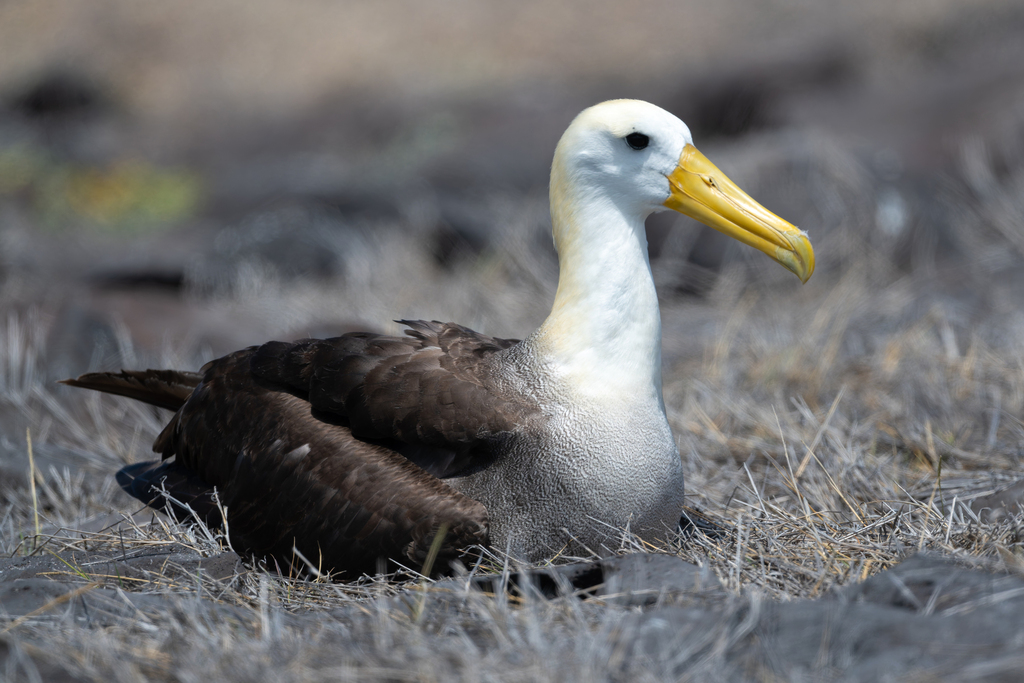
Waved Albatross
Photo © Adam Jackson
Photo © Adam Jackson — CC0 1.0 — Source: iNaturalist photo #458071053Identification
The waved albatross is a medium-sized albatross measuring 80 to 90 cm in length with a wingspan of 220–250 cm, weighing between 2.7 and 4.0 kg. The species derives its name from the distinctive wave-like pattern of barring on its feathers. Most striking is the very long, bright yellow bill that appears disproportionately large compared to the relatively small head and long, slender neck. Adults display a yellowish-cream neck and head contrasting sharply with chestnut-brown upper parts and underparts, except for a whitish breast. The upper-wings, back, and tail are brown, while the underwings are whitish with brown axillaries. Their feet are bluish. Juveniles are similar to adults but with more white on the head, while chicks are covered in brown fluffy feathers. The lifespan may reach 40 to 45 years.
Range & Habitat
The waved albatross breeds primarily on Española Island in the Galápagos archipelago, with small numbers also recorded on Genovesa Island and Isla de la Plata. During the non-breeding season, they shift eastward and southeastward to the continental shelf region off the coasts of Peru and Ecuador, and are sometimes seen in Colombia. When foraging, they follow a straight path to a single site off the coast of Peru, approximately 1,000 km to the east of the Galápagos. They nest on areas with lava encircled by boulders and sparse vegetation, or thick brush, laying eggs in simple depressions on bare ground rather than constructed nests.
Behaviour & Diet
Waved albatrosses are spectacular flyers that use dynamic soaring to glide for hours without stalling, exploiting the wind-speed differential between the ocean surface and higher altitudes. However, they experience difficulty landing due to their high stalling speed and take-off challenges due to their weight and wingspan; they sometimes launch from inland cliffs to overcome this. Their primary diet consists of fish, squid, and crustaceans, along with smaller birds, and they occasionally scavenge regurgitated food from other birds. When foraging for chicks, they venture 10 to 100 km from nesting sites. During breeding season, they perform spectacular courtship displays involving rapid bill circling, bowing, beak clacking, and producing a whoo hoo call. Eggs are laid between April and June and incubated for two months; chicks remain in small nurseries while parents hunt, returning to feed them up to 2 kg of nutrient-rich stomach oil. Young reach adult size by December and leave the colony by January. Partners remain mates for life.
Best Time & Places to See It
The primary location for viewing waved albatrosses is Española Island in the Galápagos archipelago, where the species breeds. The breeding season, with eggs laid between April and June and young fledging by January, offers the best opportunities for observation. During the non-breeding season, birds relocate to the continental shelf waters off Peru and Ecuador, where they can occasionally be encountered during marine excursions in those regions.
Photography Tips
Photograph the distinctive bright yellow bill, which is the species' most striking feature and photographs well in natural light. Capture the wave-like barring pattern on the plumage by using adequate depth of field. During courtship displays on breeding grounds, position yourself to record the spectacular bill-circling, bowing, and head-raising behaviors. Their dynamic soaring flight is extraordinary; anticipate their gliding patterns near cliff edges and coastal areas where they launch. The contrast between the yellowish-cream head and the darker body provides good compositional opportunities. Note that in-flight photography will be challenging given their high speed and endurance, so patience and fast shutter speeds are essential for capturing sharp images of these aerial masters.
No community photos yet. Log in to add the first one.
No community observations of this species yet.