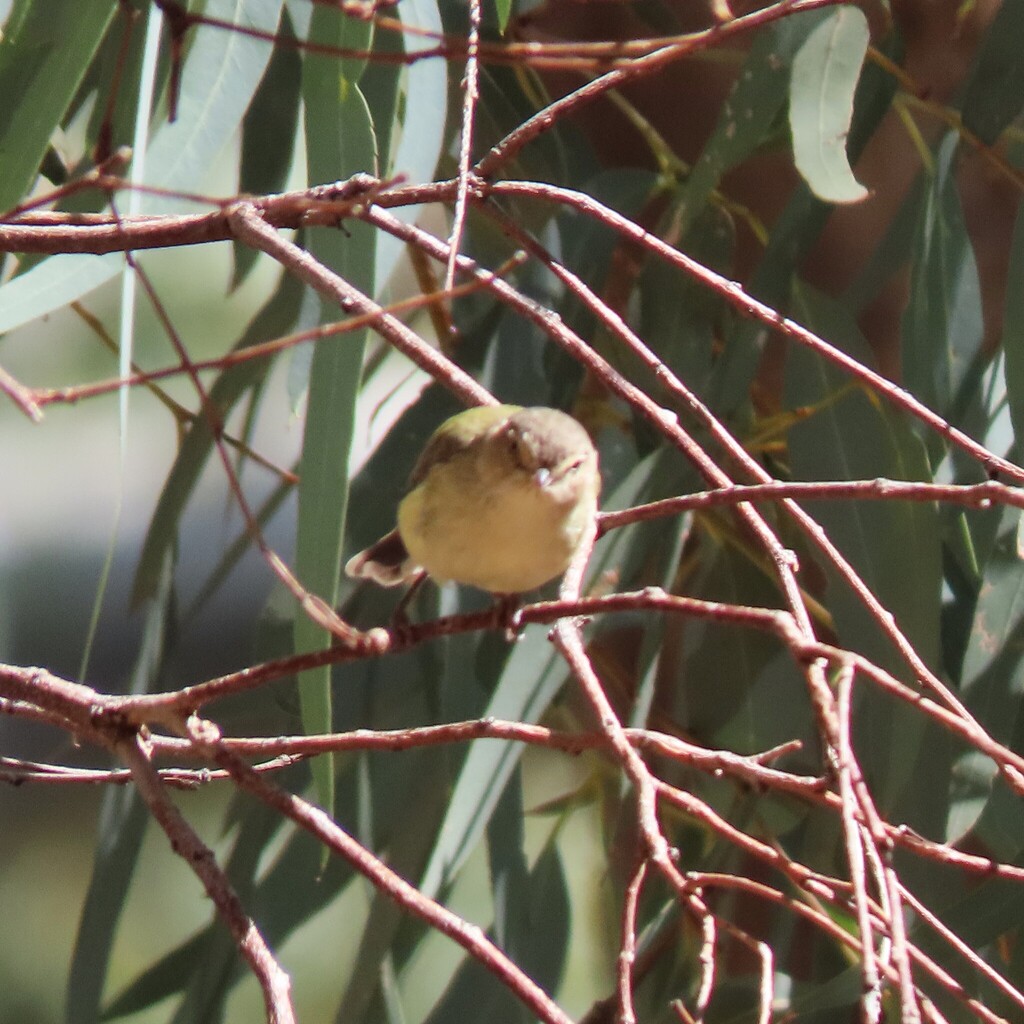
Weebill
Photo © pimelea
Photo © pimelea — CC BY 4.0 — Source: iNaturalist #283847091Identification
The weebill is Australia's smallest bird, measuring just 8 to 9 cm long and weighing around 6 grams. Despite its diminutive size, it is surprisingly vocal, producing a loud, clear, musical call described as "pee-pee p'wee" or "wee bit," often heard from considerable distances. Its plumage is nondescript but subtly beautiful: olive-grey upperparts contrast with paler, yellowish underparts. Adults display pale yellow eyes, a faint cream-coloured supercilium, and distinctive white spots and black bars on the tail feathers. The most diagnostic feature is the weebill's very short, pale grey bill—stubbier than that of similar thornbills—which gives the species its common name.
Geographical variation exists across the four recognised subspecies. Northern and inland Australian weebills are paler and more yellow, while southern and eastern populations are lighter brown. Western populations show greyer plumage. Juveniles resemble adults but have a brighter yellow bill and greyer eye. Both sexes are identical in plumage colouration.
Range & Habitat
The weebill is widespread across mainland Australia, excluding Tasmania, where all subspecies are sedentary year-round. The nominate subspecies ranges from central and eastern Queensland southward through eastern Australia to Victoria and southeast South Australia. The northern subspecies flavescens extends from the Kimberley across tropical Australia to Cape York Peninsula and down to central desert regions. Western populations occupy areas from the Pilbara and Murchison Range southward, with the southwestern subspecies occidentalis distributed around the southern Nullarbor Plain.
Weebills prefer dry, open eucalyptus forests, woodlands, and mallee, typically foraging in the canopy but occasionally descending to the midstory. They show a marked preference for healthy eucalyptus trees where insects are abundant. In arid zones, they become localised to watercourses. These birds are somewhat gregarious, often associating with other small insectivorous species such as thornbills, silvereyes, and pardalotes.
Behaviour & Diet
The weebill's diet consists primarily of small insects and their larvae, supplemented occasionally by seeds and beetles. Arthropod prey includes spiders, beetles (particularly weevils), and flies. These birds are active and noisy foragers, working busily in pairs or small parties of up to eight individuals. They glean insects by hovering and clinging to twigs while picking insects from the outer foliage of the canopy and midstory. Their gleaning behaviour provides a valuable ecological service, controlling scale insects, psyllids and their protective coverings (lerps), and other tree-damaging arthropods.
Weebills breed according to local latitude and climatic conditions, potentially breeding at almost any time of year, with activity most common from July onwards. They construct distinctive dome-shaped pendant nests from fine grasses and plant fibres, suspended from branches and concealed within dense tree canopy foliage. These masterfully constructed nests incorporate cobwebs, insect cocoons, and animal hair for binding and camouflage.
Best Time & Places to See It
Weebills are resident and regular throughout the year across their range, making them accessible to travellers in any season. To locate them, search dry eucalyptus woodlands and open forests in the canopy and upper midstory, particularly where healthy eucalyptus trees provide abundant insect life. Listen carefully for their distinctive loud, musical calls, which often give away their presence before they are seen. Early morning is typically the most active period. In arid regions, focus your search near permanent water sources where weebills congregate.
The best experience involves visiting diverse Australian woodland habitats: eastern woodland areas, western mallee regions, and northern tropical woodlands will all provide opportunities to encounter different subspecies and observe variations in plumage colouration related to latitude and climate.
Photography Tips
The weebill's tiny size and preference for high canopy foliage present genuine challenges for photographers. A telephoto lens of at least 400–600 mm is essential to achieve adequate image size and isolate subjects from busy backgrounds. Position yourself beneath fruiting or flowering eucalypts where insects are abundant, as weebills will forage more predictably in these productive areas. Early morning light, when birds are most active, offers the best photography opportunities.
Patience and listening are crucial skills. Locate birds by their loud calls, then position yourself with the morning light behind you and ahead of the bird's likely movement. Weebills often hover while gleaning, creating momentary opportunities for sharp images. Because they often forage in small flocks, multiple individuals may visit the same productive tree—establish yourself near such trees and wait. The bird's small size means that hand-holding is difficult; consider using a camera support or tripod with a gimbal head to achieve sharp, stable images of this Australia's tiniest and most enchanting songbird.
Bald Rock National Park
Belair National Park
Blue Mountains National Park
Boodjamulla National Park
Bunya Mountains National Park
Cania Gorge National Park
Cape Range National Park
Carnarvon National Park
Chiltern-Mt Pilot National Park
Nothing matches these filters.
No community photos yet. Log in to add the first one.
No community observations of this species yet.