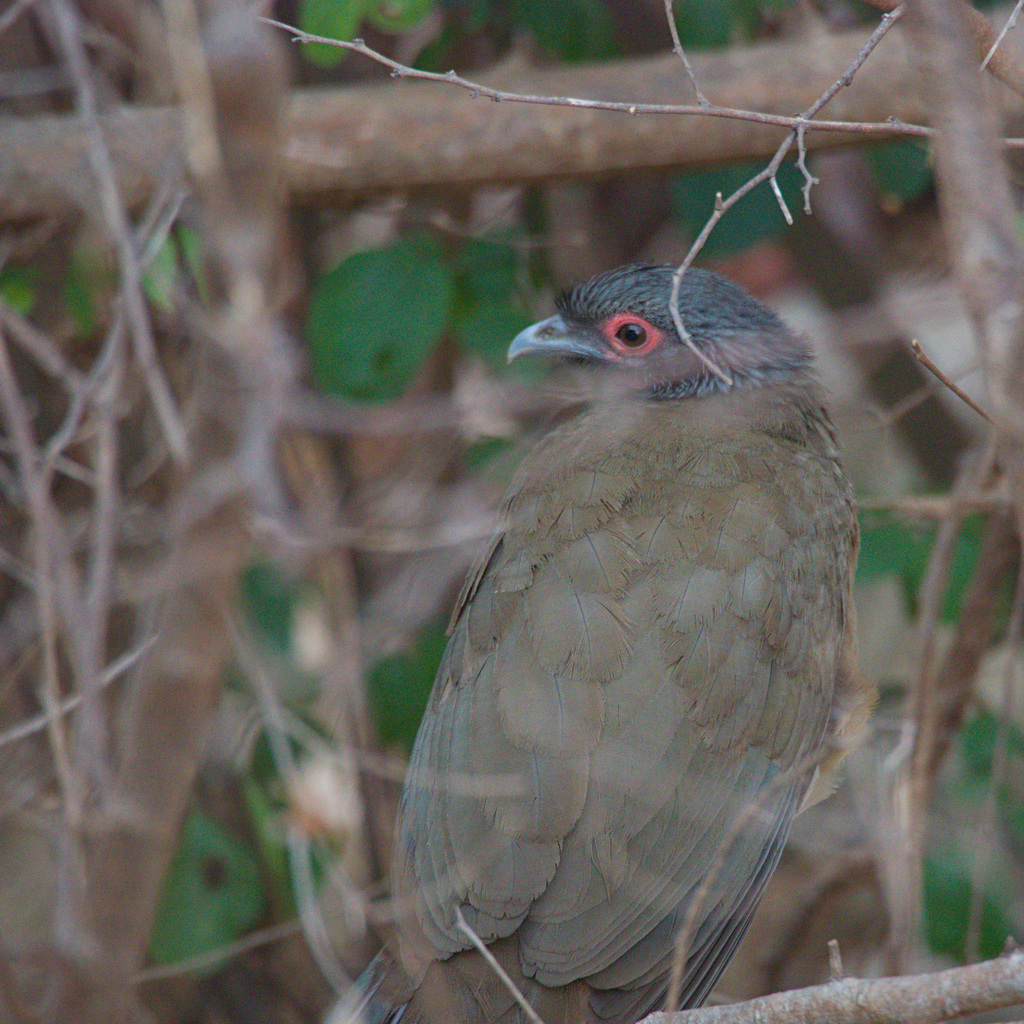
West Mexican Chachalaca
Photo © a6475
Photo © a6475 — CC BY-SA 4.0 — Source: iNaturalist #339787936Identification
The West Mexican chachalaca is a medium-sized bird measuring 58.5 to 68.5 cm in length, with one recorded male weighing 760 g. Its most distinctive features are its dull brownish-gray crown and nape, contrasting with pale brownish-olive upperparts. The tail is slightly grayer with broad buff tips on the feathers. The breast appears grayish-olive, while the belly is whitish with a buff wash. A striking field mark is the hazel eye surrounded by bare carmine (red) skin, which is conspicuous even at a distance.
Range & Habitat
This species is endemic to Mexico, found in a swath of southwestern Mexico stretching from northern Jalisco south to southwestern Chiapas, with its range extending inland as far as southwestern Puebla. The West Mexican chachalaca primarily inhabits mature deciduous forest, thorn scrub, and secondary forest. Locally, it also occupies pine-oak forest and can sometimes be found in mangroves and palm plantations. The species is remarkably adaptable to elevation, ranging from sea level up to 2,400 m (7,900 ft).
Behaviour & Diet
The West Mexican chachalaca is primarily a ground forager, though it readily ascends into vegetation when feeding. Approximately two-thirds of its diet consists of fruit, with flowers, seeds, leaves, and insects comprising the remainder. The breeding season spans April to August, with peak activity in June and July. Both sexes construct the nest, a shallow platform of sticks lined with leaves and bromeliads, typically positioned up to 5 m above the ground. Clutches of three eggs have been recorded, with the female incubating alone while both parents care for the young.
Best Time & Places to See It
The West Mexican chachalaca is deemed fairly common to common throughout its range, making it a reliable sighting for travellers visiting southwestern Mexico. The breeding season from April to August, particularly June and July, is an excellent time to locate birds, as they are more vocal and active during this period. Look for this species in mature deciduous forests, secondary growth, and thorn scrub habitats across its range from northern Jalisco through Chiapas and into southwestern Puebla.
Photography Tips
The bare carmine skin around the eye provides an excellent focal point for close-up photography and is a reliable field mark to include in your images. Since the bird forages both on the ground and in low vegetation, photographers should position themselves to capture it in its natural habitat rather than relying solely on elevated shots. The principal vocalization—a distinctive group of gruff, throaty, rhythmic chattering—can help you locate birds by sound; listen for the "chur-uh-uh-uhr" call to pinpoint individuals before attempting photography. Early morning and late afternoon typically offer the best light for capturing this species in deciduous and secondary forest habitats.
Parque Nacional Benito Juárez
San Andrés Huayápam, Mexico
+128 birds+4 mammals
High in the Sierra Madre del Sur of Oaxaca, where cloud forest mingles with pine woodland and the terrain climbs steeply through ravines carved by mountain…
VIEW NATIONAL PARKParque Nacional Grutas de Cacahuamilpa
Pilcaya, Mexico
+97 birds+12 mammals
Where limestone ridges rise abruptly from the tropical deciduous forests of central Guerrero, the Grutas de Cacahuamilpa National Park shelters one of Mexico's most extensive cave…
VIEW NATIONAL PARKNo community photos yet. Log in to add the first one.
No community observations of this species yet.