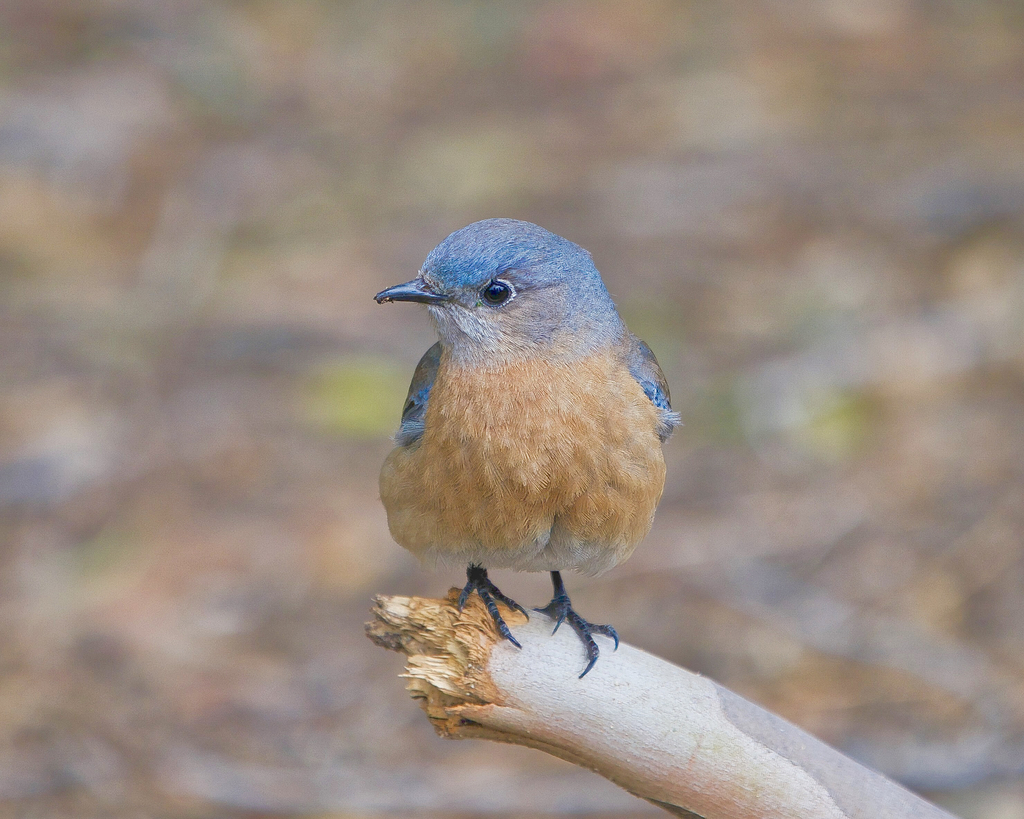
Western Bluebird
Photo © Bill Levine
Photo © Bill Levine — CC BY 4.0 — Source: iNaturalist photo #262275956Identification
The western bluebird is a small, stocky thrush measuring 15 to 18 cm in length. Adult males are strikingly colorful, with bright blue upperparts and throat, a rusty-orange breast and sides, a brownish patch on the back, and gray belly and undertail coverts. Females are considerably duller, displaying grayish-blue tones on the body, wings, and tail, a gray throat, muted orange on the breast, and gray underparts. Both sexes have a thin, straight bill and relatively short tail. Immature birds show duller plumage with spots on the chest and back. The species can be reliably distinguished from its congeners: the eastern bluebird has an orange throat, while the mountain bluebird lacks orange coloration entirely.
Western bluebirds produce distinctive calls including "cheer," "chur-chur," and "chup" sounds, which serve both for mate attraction and territorial advertisement among males in forested habitats.
Range & Habitat
The western bluebird's year-round range spans California, the southern Rocky Mountains, Arizona, and New Mexico, extending southward into the Mexican states of Oaxaca and Veracruz. Summer breeding populations reach as far north as the Pacific Northwest, British Columbia, and Montana. Northern populations migrate seasonally toward southern portions of the range, while southern birds typically remain year-round residents.
Though historically displaced by deforestation, the species has proven adaptable, now occupying coniferous forests, farmlands, semi-open terrain, and even desert habitats where suitable conditions exist.
Behaviour & Diet
Western bluebirds are cavity nesters, relying on woodpeckers or nest boxes for breeding sites, as their weak bills cannot excavate their own holes. They face significant competition from tree swallows, house sparrows, and European starlings. Clutches typically contain two to eight eggs, with nestlings remaining in the nest for 19 to 22 days before fledging. Successful pairs may rear two broods in favorable years. Genetic studies reveal that approximately 45% of nests contain young fathered by extra-pair males, and failed breeders sometimes assist parents with subsequent broods.
These birds forage by pouncing on the ground for worms and berries, and by flycatching aerial insects from perches. They regularly visit bird baths and readily patronize feeders offering mealworms or other insects. Their diet consists primarily of insects and berries, adjusted seasonally by availability.
Best Time & Places to See It
Western bluebirds are best observed in open woodlands, farmland edges, and semi-open terrain throughout their range. In northern regions, spring and summer offer the most reliable viewing during breeding season. Year-round residents in the southern portions of the range—California, Arizona, New Mexico, and central Mexico—can be found consistently across all seasons. Birds are most active during early morning hours and often perch conspicuously on low branches or fences while foraging.
Photography Tips
The bright plumage of males makes them rewarding subjects in good light, particularly for capturing the contrast between blue and orange coloration. Position yourself near suitable habitat edges or open perches where birds typically forage and rest. Patience near established nest boxes or natural cavities can yield excellent breeding behavior photographs. Early morning light enhances the vivid colors of males; avoid harsh midday sun that can wash out subtle female plumage details. A remote camera near active nest boxes may capture feeding and fledging sequences without disturbance.
Arches National Park
Banff National Park
Big Bend National Park
Bitter Lake National Wildlife Refuge
Black Canyon of the Gunnison National Park
Bosque del Apache National Wildlife Refuge
Bryce Canyon National Park
Cabeza Prieta National Wildlife Refuge
Canyonlands National Park
Nothing matches these filters.
No community photos yet. Log in to add the first one.
No community observations of this species yet.