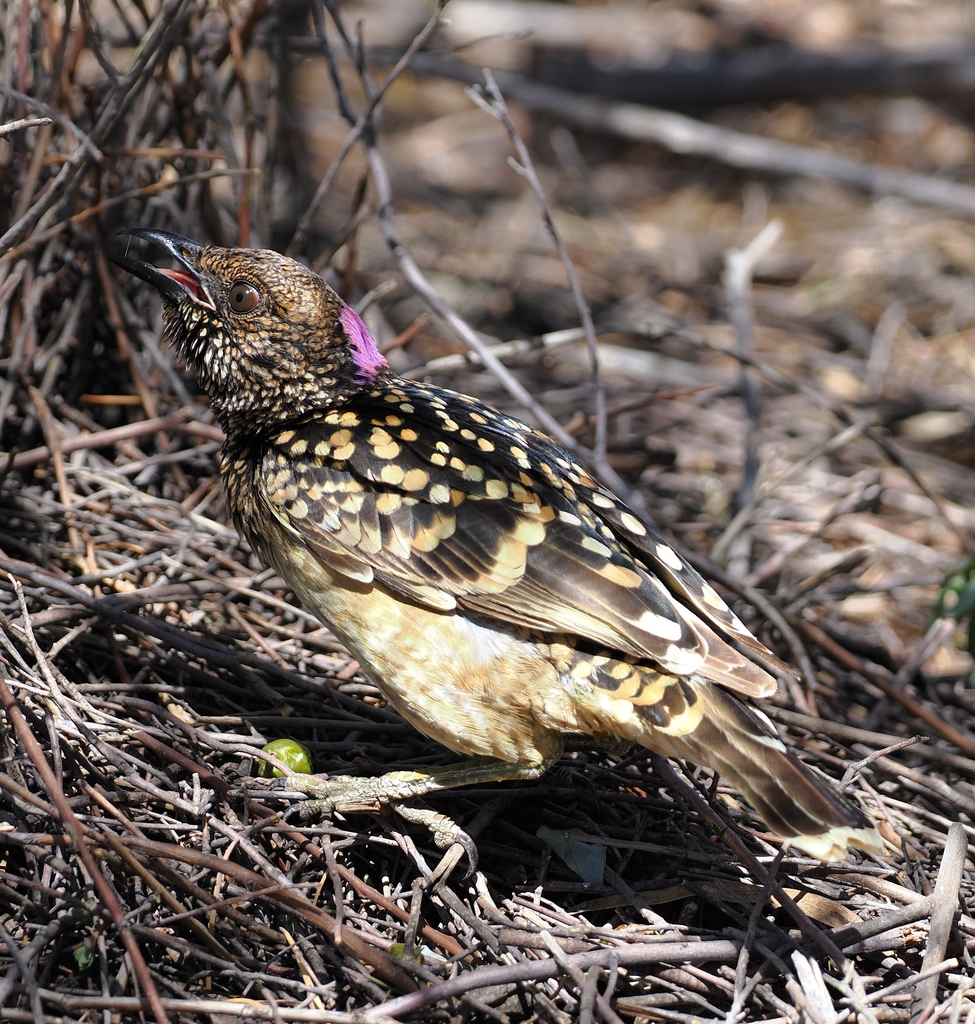
Western Bowerbird
Photo © desertnaturalist
Photo © desertnaturalist — CC BY 4.0 — Source: iNaturalist #321785867The western bowerbird (Chlamydera guttata) is a species of bird in the family Ptilonorhynchidae. The species is a common endemic of Australia. It has a disjunct distribution, occurring in Central Australia and the Pilbara region of Western Australia. == Taxonomy == There are two subspecies, the nominate Chlamydera guttata guttata, which occupies most of its range, and C. guttata cateri, which occurs only the North West Cape in Western Australia. The species was first collected in 1861 by the explorer Francis Gregory, who gave the specimen to John Gould. The specific name guttata means spotted, referring to its plumage. The species is similar to Chlamydera maculata, the spotted bowerbird, and has often been treated as a subspecies of it. == Description == The western bowerbird is smaller than the other bowerbird it shares its range with, the great bowerbird. It measures 24–28 cm (9.4–11.0 in) in length and weighs 120–150 g (4.2–5.3 oz). Both sexes are similar in size and dimensions, except that the tail of the female is slightly longer. The plumage is brown with reddish or buff spots over the throat, chest, neck, back, head and wings, with a pink erectile crest on the nape. The tail is…
Uluru-Kata Tjuta National Park
Petermann, Australia
+146 birds+10 mammals
Uluru-Kata Tjuta National Park is one of Australia’s most iconic protected areas, renowned for its breathtaking desert landscapes, extraordinary geological formations, and deep cultural significance. Located…
VIEW NATIONAL PARKKarijini National Park
Australia
+117 birds+5 mammals
Ochre ridges and rust-coloured gorges slice through the Pilbara's ancient landscape, where Karijini National Park sprawls across a wilderness of iron-rich plateaus and plunging ravines carved…
VIEW NATIONAL PARKCape Range National Park
Australia
+159 birds+15 mammals
Where arid limestone ridges plunge toward turquoise waters, Cape Range National Park frames one of Australia's most dramatic desert-ocean interfaces. The park's spine—a stark, weathered range…
VIEW NATIONAL PARKNo community photos yet. Log in to add the first one.
No community observations of this species yet.