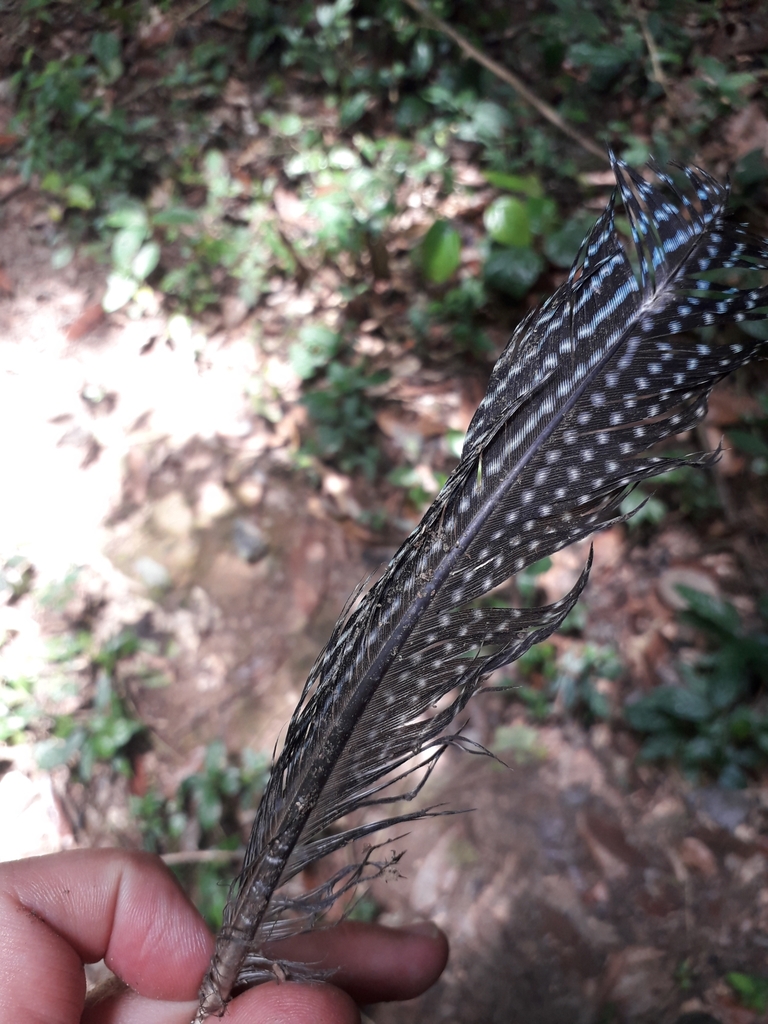
Western Crested Guineafowl
Photo © Tommy Andriollo
Photo © Tommy Andriollo — CC BY 4.0 — Source: iNaturalist #134965867Identification
The western crested guinea fowl is a medium-sized game bird measuring around 50 cm in length. Its most distinctive feature is the prominent black crest atop its head, composed of curly feathers that are immediately recognizable among guinea fowl species. The overall plumage is blackish with dense white spotting throughout, creating a striking speckled appearance that aids identification in woodland settings. This crested appearance easily separates it from other guinea fowl species, though it can be confused with the plumed guinea fowl, as the names "crested" and "plumed" are often misapplied across species.
Range & Habitat
The western crested guinea fowl is found across a broad swath of sub-Saharan Africa, ranging from Guinea-Bissau through West and Central Africa to East Africa, with its distribution extending through Kenya, Angola, and Zambia. Two subspecies are recognized: the nominate subspecies verreauxi (the Lindi crested guinea fowl) occupies most of this range from Guinea-Bissau to western Kenya, Angola, and Zambia, while the smaller population of sclateri (Sclater's crested guinea fowl) is confined to northwestern Cameroon.
These birds prefer open forests, woodland areas, and forest-savanna mosaics where scattered trees provide both cover and foraging opportunities. They are well-adapted to the transitional habitats that characterize much of their range, making them a characteristic sight where woodland meets grassland.
Behaviour & Diet
Western crested guinea fowl are monogamous birds that form strong and long-lasting pair bonds. Their breeding season is marked by engaging courtship behaviors, particularly courtship feeding, in which males actively present food items to females—sometimes running several metres to offer a prized morsel. This behavior reflects the strength of their pair bonds and is a fascinating aspect of their natural history.
For nesting, they create well-hidden scrapes in long grass or beneath bushes, providing excellent camouflage for their clutches. Females typically lay four or five eggs, which range in color from nearly white to buff. While specific dietary details are limited in available sources, like other guinea fowl they are ground foragers, likely consuming seeds, insects, and other invertebrates found in their woodland habitats.
Best Time & Places to See It
The western crested guinea fowl can be encountered throughout its range in suitable woodland and forest-savanna habitats across Guinea-Bissau, Cameroon, Kenya, Zambia, and Angola. These birds are generally most active during early morning and late afternoon hours when they forage on the ground, though specific seasonal patterns are not well documented. Visiting protected areas and national parks within their range offers the best opportunities for observation, particularly in regions where forest-savanna mosaics provide their preferred habitat type.
Photography Tips
Photographing the western crested guinea fowl requires patience and attention to their ground-feeding habits. Early morning light is ideal for capturing the striking contrast between their blackish plumage and white spotting. Position yourself quietly along woodland edges and near clearings where these birds forage, as they are relatively wary. The distinctive crest is the key identifying feature, so try to capture clear images of the head to showcase this characteristic. Wide shots showing their habitat context can also be valuable, as they often blend remarkably well with dappled woodland shadows.
Virunga National Park
Uganda
+418 birds+13 mammals
Where the Western Rift Valley fractures the landscape of North Kivu, Virunga National Park sprawls across terrain as geologically dramatic as it is ecologically vital. Volcanic…
VIEW NATIONAL PARKKidepo Valley National Park
Uganda
+478 birds+24 mammals
Where the Narus and Kidepo rivers carve through northeastern Uganda's semi-arid lowlands, a landscape of sparse acacia woodland, grassland, and riverine thickets creates one of East…
VIEW NATIONAL PARKLake Mburo National Park
Uganda
+505 birds+24 mammals
Rolling acacia woodland and scattered lakes define this intimate savanna preserve in southwestern Uganda, where the rift valley's geological drama shapes every water source and grassland.…
VIEW NATIONAL PARKQueen Elizabeth National Park
Uganda
+672 birds+30 mammals
Across the southwestern escarpment of Uganda, where the Western Rift Valley descends through ancient volcanic terrain, Queen Elizabeth National Park sprawls across more than 8,300 square…
VIEW NATIONAL PARKMabamba Swamp
Memere, Uganda
+464 birds+2 mammals
Across the Central Region of Uganda spreads one of Africa's most biodiverse freshwater wetlands, a sprawling nature reserve of roughly 283 square kilometres where papyrus swamps…
VIEW NATURE RESERVENo community photos yet. Log in to add the first one.
No community observations of this species yet.