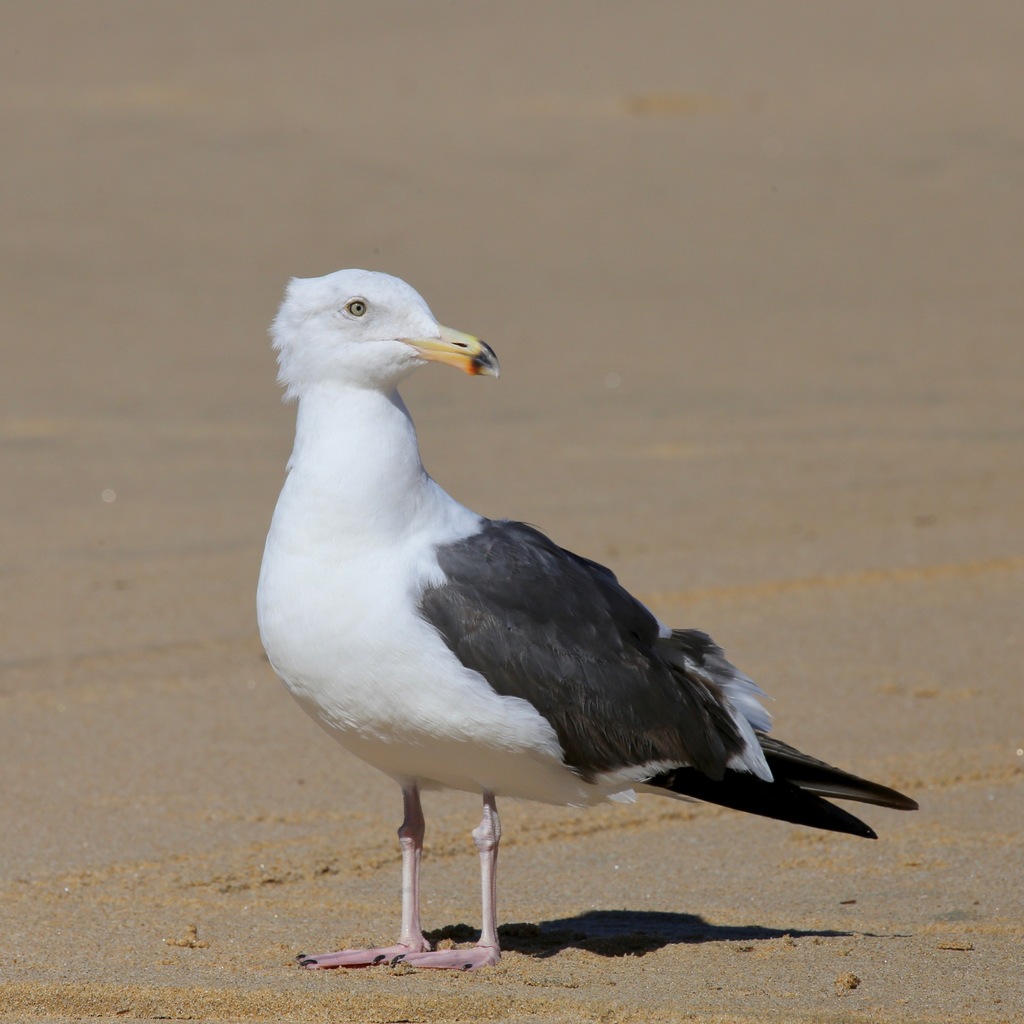
Western Gull
Photo © Laura Gaudette
Photo © Laura Gaudette — CC BY 4.0 — Source: iNaturalist #254614880Identification
The western gull is a large gull measuring 55 to 68 cm in length with a wingspan of 130 to 144 cm. Adults are unmistakable with a white head and body contrasted by dark grey upperparts. The head remains predominantly white year-round in most populations, with little to no streaking during the nonbreeding season. A distinctive large, bulbous-tipped yellow bill bears a red subterminal spot that chicks peck to stimulate feeding. Eye colour varies geographically, averaging pale yellow in southern birds and darker in northern populations. Western gulls require approximately four years to reach full adult plumage. Two subspecies are recognized: the northern L. o. occidentalis with dark grey mantle and darker eyes, found from Central Washington to Central California, and the southern L. o. wymani with a darker mantle approaching that of the Great Black-backed Gull and paler eyes on average, found in central and southern California.
Range & Habitat
The western gull inhabits the west coast of North America from British Columbia, Canada, to Baja California, Mexico. It is a year-round resident in California, Oregon, Baja California, and southern Washington, with migratory movements to northern Washington, British Columbia, and Baja California Sur during the nonbreeding season. This is an almost exclusively marine gull, rarely venturing more than 100 miles inland. It nests on offshore islands and rocks along the coast, and on islands within estuaries, with major colonies found on the Farallon Islands (approximately 26 miles west of San Francisco), Anacapa Island, Santa Barbara Island, Año Nuevo Island, and Alcatraz Island in San Francisco Bay.
Behaviour & Diet
Western gulls are highly territorial birds, with long-term pairs aggressively defending their nesting territories throughout the breeding season and often for the life of the male. They feed in both pelagic and intertidal environments. At sea, they take fish and invertebrates including krill, squid, and jellyfish, feeding exclusively from the water's surface as they are unable to dive. On land, they consume seal and sea lion carcasses, cockles, starfish, limpets, and snails, as well as human food refuse in altered habitats. Western gulls are notably predatory, killing and eating young of other birds, especially ducklings, and even smaller bird species and pigeons. They are known to snatch fish from cormorants' and pelicans' mouths and have been observed stealing milk directly from elephant seal teats. Their call is bright, piercing, and repetitive.
Best Time & Places to See It
Western gulls are present year-round throughout their range, making them accessible to visitors in any season. Coastal areas of California and Oregon offer the best viewing opportunities, particularly around major colonies. The Farallon Islands, accessible by boat from San Francisco, support the largest colony with an estimated 30,000 gulls in the San Francisco Bay area. Channel Islands National Park, featuring Anacapa and Santa Barbara Islands, provides excellent viewing and photography opportunities. Rocky coastlines, estuaries, marinas, and beaches throughout the Pacific coast from Washington to Baja California are reliable locations to observe this species in its natural marine habitat.
Photography Tips
The contrast between the white head and dark grey mantle makes western gulls visually striking subjects, especially in strong coastal light. Photograph adults during breeding season when territorial behaviour is most active and visible. For capturing characteristic plumage details, focus on the distinctive yellow bill with its red subterminal spot, which is particularly visible when birds are calling. The four-year maturation process means younger birds will lack the full adult plumage; plan visits to established colonies where multiple age classes can be photographed together. Early morning light on rocky islands and coastal outcrops enhances the dramatic contrast of their plumage. Watch for feeding behaviour in intertidal zones at low tide or around fishing operations where their predatory and kleptoparasitic behaviours provide dynamic photo opportunities.
Gulf Islands National Park Reserve
Southern Gulf Islands Electoral Area, Canada
+268 birds+26 mammals
Scattered across the Salish Sea in British Columbia's southwestern corner, this national park reserve stitches together a fragmented archipelago of forested islands and rocky outcrops where…
VIEW NATIONAL PARKMount Rainier National Park
Pierce County, United States
+187 birds+25 mammals
A volcanic colossus dominates the Cascade Range in western Washington, its 4,392-meter summit crowned year-round with glacial ice that cascades down toward temperate rainforest and subalpine…
VIEW NATIONAL PARKOlympic National Park
Jefferson County, United States
+263 birds+35 mammals
Where temperate rainforest meets alpine wilderness, Olympic National Park sprawls across nearly 11,000 square kilometers of the Pacific Northwest's most pristine landscape. The park's three distinct…
VIEW NATIONAL PARKEl Vizcaíno
Laguna San Ignacio, Mexico
+317 birds+29 mammals
Where the Baja California peninsula thins into a tapestry of salt lagoons and coastal desert, one of Mexico's most biodiverse reserves sprawls across half a million…
VIEW BIOSPHERE RESERVEParque Nacional Isla Isabel
Santiago Ixcuintla, Mexico
+107 birds+2 mammals
A volcanic island sanctuary rises from the Pacific waters off Nayarit's coast, where three dormant cones define a landscape of sharp ridges, coastal cliffs, and sheltered…
VIEW NATIONAL PARKChannel Islands National Park
Santa Barbara County, United States
+330 birds+15 mammals
A chain of eight volcanic islands rises from the cold Pacific waters off the California coast, their rugged sea cliffs and windswept terrain shaped by millions…
VIEW NATIONAL PARKKodiak National Wildlife Refuge
United States
+221 birds+22 mammals
Where temperate rainforest meets subarctic coast, Kodiak National Wildlife Refuge sprawls across Alaska's largest island, a sanctuary defined by steep valleys carved by tidewater glaciers and…
VIEW WILDLIFE SANCTUARYAlaska Maritime National Wildlife Refuge
Alaska, United States
+391 birds+58 mammals
Where the North Pacific collides with Alaska's rugged coastline, a sprawling archipelago of islands, rocky outcrops, and coastal headlands forms one of North America's most remote…
VIEW WILDLIFE SANCTUARYDon Edwards San Francisco Bay National Wildlife Refuge
Fremont, United States
+286 birds+20 mammals
Where the San Francisco Bay's shallow margins dissolve into tidal salt marshes and mudflats, this wildlife sanctuary preserves one of California's most ecologically vital estuarine systems.…
VIEW WILDLIFE SANCTUARYFarallon National Wildlife Refuge
San Francisco, United States
+384 birds+16 mammals
Windswept granite peaks rising abruptly from the Pacific, the Farallon Islands form a wildlife sanctuary of extraordinary seabird abundance and ecological significance just twenty-seven miles west…
VIEW WILDLIFE SANCTUARYSalton Sea National Wildlife Refuge
Imperial County, United States
+289 birds+4 mammals
Across the floor of California's inland desert, where summer temperatures soar and rainfall is measured in tenths of inches, lies an improbable oasis of shallow water…
VIEW WILDLIFE SANCTUARYMidway Atoll National Wildlife Refuge
United States
+91 birds+1 mammals
Straddling the international date line roughly midway between North America and Asia, this atoll sanctuary rises from the North Pacific as a cluster of coral and…
VIEW WILDLIFE SANCTUARYNo community photos yet. Log in to add the first one.
No community observations of this species yet.