Western Rockhopper Penguin
Photo © Charlotte Kirchner
Photo © Charlotte Kirchner — CC BY 4.0 — Source: iNaturalist photo #595298149Identification
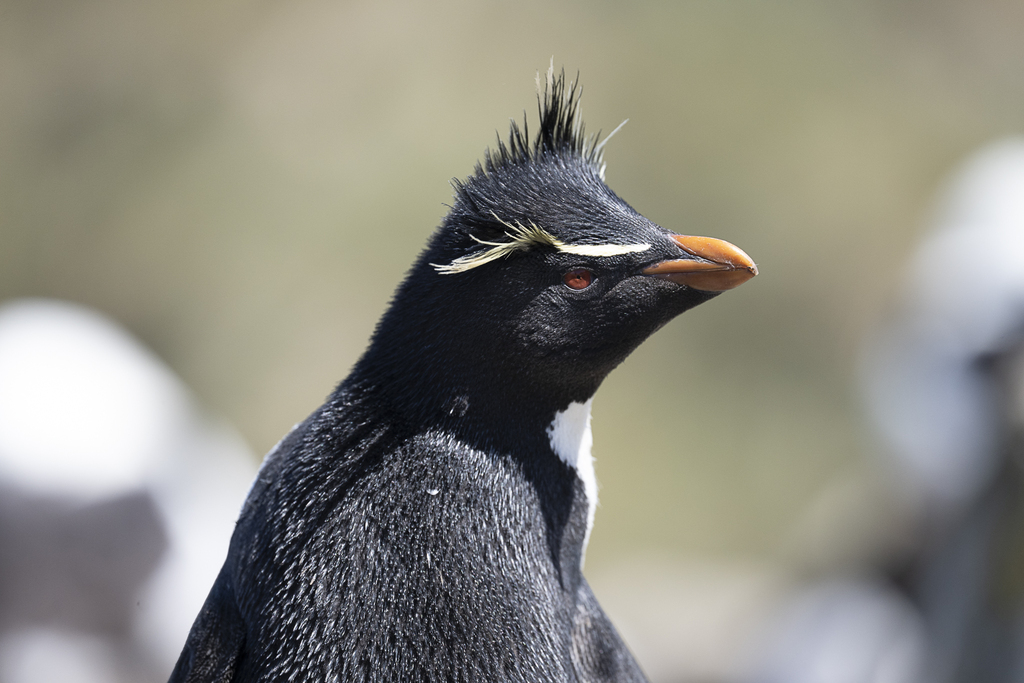
The western rockhopper penguin is the smallest of the yellow-crested penguins in its genus, measuring 45–58 cm in length and typically weighing 2–3.4 kg, though exceptional individuals may reach 4.5 kg. Its most distinctive features are its slate-grey upper parts contrasted with black and white plumage, bright yellow eyebrows that extend into long yellowish plumes projecting sideways behind a striking red eye. These eye-catching crests give the species its common name within the crested penguin group.
Range & Habitat
The western rockhopper penguin inhabits subantarctic waters around the southern coast of South America and nearby islands. It breeds on the Falkland Islands and on islands off Patagonia, with colonies ranging from sea level to cliff-tops and sometimes extending inland. Outside the breeding season, these penguins roam the offshore waters surrounding their colonies. The species was separated from its eastern cousin, the eastern rockhopper penguin, based on molecular phylogenetic research published in 2021; the two species occupy distinct geographic regions, with the western species confined to Cape Horn and the Falkland Islands while the eastern species ranges across the Southern Indian and Pacific Oceans.
Behaviour & Diet
Western rockhoppers earn their name from their distinctive behaviour: unlike many penguins that slide on their bellies or awkwardly climb over obstacles, these birds attempt to jump over boulders and across cracks. Their breeding season runs from September to November, during which two eggs are laid but typically only one is incubated. Incubation lasts 35 days, followed by 26 days of brooding the chick. The global population is estimated at roughly one million pairs.
These penguins employ sophisticated foraging strategies adapted to varying conditions such as sea ice abundance, prey availability, and breeding stage. They travel in groups and may venture up to 157 km from their colonies. Females typically make 11–12 hour daytime foraging trips involving multiple dives lasting around 12 hours, though occasional night dives occur at shallower depths. Their diet consists of krill, squid, octopus, lantern fish, mollusks, plankton, cuttlefish, and various crustaceans.
Best Time & Places to See It
The breeding season from September through November offers the best opportunity to observe western rockhoppers at their colonies on the Falkland Islands and Patagonian islands. During this period, birds return regularly to their nesting sites, making them more predictable and easier to locate. Outside breeding season, viewing becomes more challenging as birds disperse into offshore waters.
Photography Tips
The vibrant yellow eyebrows and distinctive red eye make striking photographic subjects, particularly in strong natural light that accentuates the contrast between their dark upper parts and white undersides. Colonial breeding sites offer opportunities for capturing behavioural shots, including their characteristic hopping locomotion. Early morning and evening light during the breeding season will best reveal the plumage details and personality of these charismatic small penguins.
Sea Lion Island
Sealion Island Settlement, Falkland Islands
+74 birds+3 mammals
Windswept tussock grasslands roll across volcanic terrain where Southern Ocean swells crash against rocky shores, creating one of the Falkland Islands' most dramatic wildlife theatres. This…
VIEW ISLAND & ARCHIPELAGOKidney Island
Stanley, Falkland Islands
+47 birds
Wind-scoured tussock grassland sweeps across this remote South Atlantic outcrop, where peaty soils and exposed rock formations create a landscape as austere as it is vital.…
VIEW ISLAND & ARCHIPELAGOPort Stephens
Port Stephens, Falkland Islands
+29 birds
Windswept moorlands sweep down to pristine beaches where kelp forests fringe the turquoise shallows, their giant fronds swaying in the southern current. Port Stephens, cradled on…
VIEW NATURE RESERVEMurrell Farm
falskland islands, Falkland Islands
+54 birds
Rolling grasslands sweep across windswept plateaux where the South Atlantic exerts its relentless influence on the vegetation, sculpting tussock grassland into a tapestry of browns and…
VIEW NATURE RESERVECape Dolphin
falskland islands, Falkland Islands
+54 birds+1 mammals
Where windswept grasslands meet dramatic coastal cliffs, the Falkland Islands' northern reaches reveal one of the Southern Hemisphere's most compelling seabird sanctuaries. The terrain here is…
VIEW NATURE RESERVEVolunteer Point
Stanley, Falkland Islands
+70 birds+3 mammals
Windswept grasslands meet volcanic black sand beaches where three penguin species converge in the South Atlantic's most theatrical wildlife theatre. This remote peninsula on East Falkland…
VIEW NATURE RESERVEWest Point Island
West Point, Falkland Islands
+67 birds+3 mammals
Windswept cliffs plunge dramatically into the South Atlantic, their rust-coloured rock faces sculpted by millennia of gales and spray. This northwestern outpost of the Falkland Islands…
VIEW ISLAND & ARCHIPELAGOCabo de Hornos National Park
Cape Horn, Chile
+88 birds+9 mammals
Where the Andes plunge into the Southern Ocean and the Drake Passage churns between two continents, Cabo de Hornos National Park sprawls across one of Earth's…
VIEW NATIONAL PARKMonte León National Park
Argentina
+100 birds+4 mammals
Where the Patagonian steppe meets the Atlantic, Monte León National Park protects a landscape of windswept coastal cliffs, rocky outcrops, and semi-arid grassland spanning over 1,200…
VIEW NATIONAL PARKNo community photos yet. Log in to add the first one.
No community observations of this species yet.