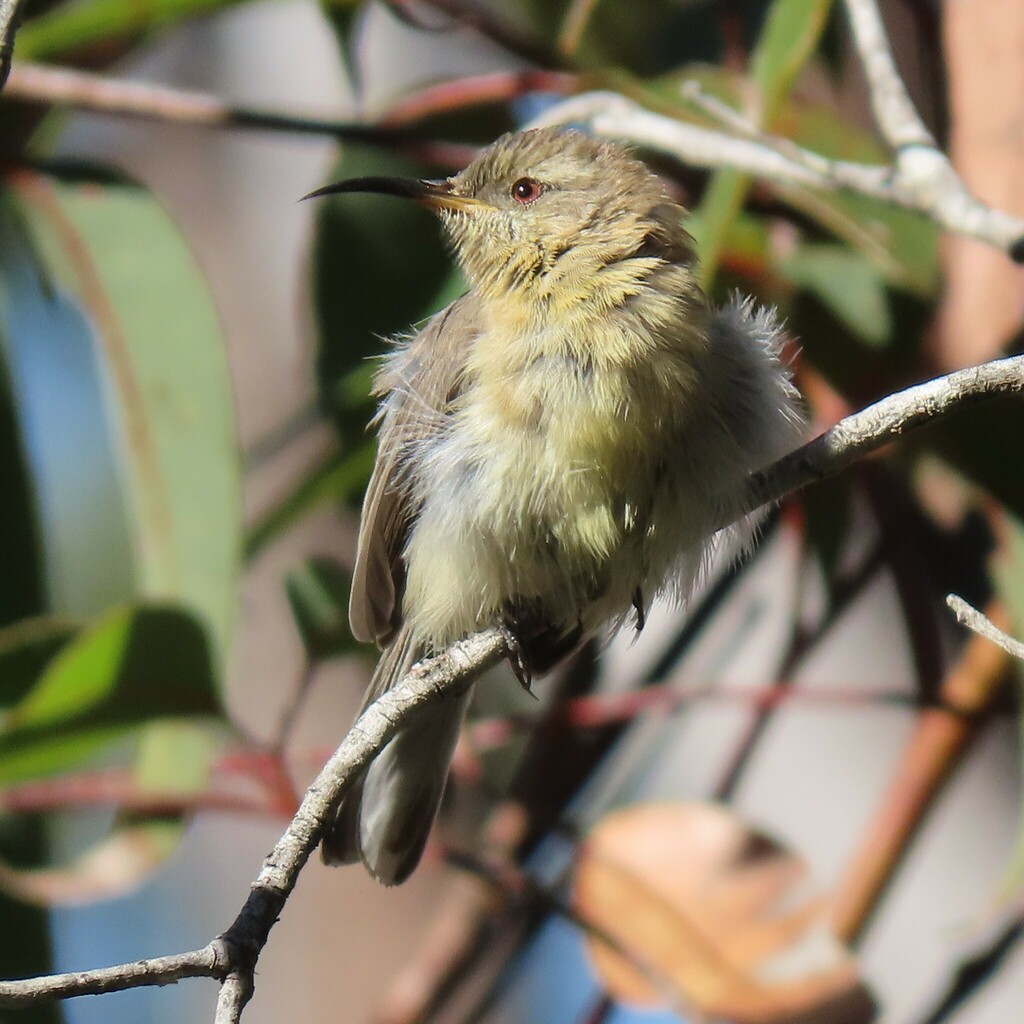
Western Spinebill
Photo © pimelea
Photo © pimelea — CC BY 4.0 — Source: iNaturalist #206942153Identification
The western spinebill is a small honeyeater, measuring 12–16 centimetres long and weighing around 10 grams. Its most distinctive feature is a long, slender, curved bill—an adaptation that makes it the only honeyeater able to extract nectar from tube-like flowers. Males are striking, with a black head and mask, bold white eyebrow, dark olive-grey back and wings, chestnut nape, and a distinctive chestnut throat and breast edged with white and black bands. Females are plainer, with a pale rufous nape and buff or grey underparts lacking the male's bold markings. Both sexes show white outer tail feathers, which are characteristically flicked in flight. Immature birds resemble females but have a yellow base to the bill.
In the field, listen for the western spinebill's distinctive voice: a high, shrill, staccato piping transcribed as 'kleet-kleet' or 'kleat-kleat'. This vocal signature often announces the bird's presence before it comes into view.
Range & Habitat
Endemic to southwestern Western Australia, the western spinebill is found from north of Jurien Bay to Israelite Bay, with its inland range extending to an arc described by Moora, Corrigin, and Lake Grace. It is common in the understorey of heaths, coastal scrub, woodlands, and forests, particularly in Banksia thickets where it finds abundant flowering plants.
Behaviour & Diet
Like all honeyeaters, the western spinebill feeds primarily on nectar, with peak feeding activity in the first 60 to 90 minutes after dawn. It characteristically forages in the lower shrub layer, targeting flowers of Banksia, Dryandra, Grevillea, Adenanthos, and Verticordia—a feeding strategy that allows it to avoid competition with larger, more aggressive honeyeaters. It also visits herb flowers such as Anigozanthos and occasionally takes insects captured in flight or gleaned from plants. Males are highly territorial, frequently contesting borders with rivals while allowing females within their territories, which range from 0.2 to 0.5 hectares. The species is locally nomadic, moving in response to flower availability.
Best Time & Places to See It
The breeding season from September to January offers excellent opportunities to observe western spinebills, as birds are most active and vocal during this period. Visit heathlands and Banksia woodlands in southwestern Western Australia, particularly areas with dense Adenanthos obovatus shrubs, which attract frequent visitors. Early morning visits are recommended to catch peak feeding activity. The species is common throughout its range, making it a reliable sighting for patient observers in suitable habitat.
Photography Tips
The western spinebill's small size and active, restless behaviour require a fast shutter speed (at least 1/1000th second) and tracking capability. Position yourself near flowering shrubs at dawn when birds feed most actively and deliberately. Males are more boldly marked and visually striking than females; look for the white eyebrow stripe and contrasting throat patch to identify males. The characteristic tail flicking in flight provides a distinctive photo opportunity. Use natural perches and flowering plants as foreground interest, and photograph against soft, shaded backgrounds to emphasize the bird's striking plumage.
Fitzgerald River National Park
Fitzgerald River National Park, Australia
+209 birds+11 mammals
Where granite peaks rise above windswept heathlands and pristine river systems carve through untamed wilderness, one of Australia's most biodiverse landscapes unfolds across the southwestern corner…
VIEW NATIONAL PARKNambung National Park
Grey, Australia
+124 birds+2 mammals
Where limestone pinnacles rise like sharpened teeth from golden sand, Nambung National Park unveils one of Western Australia's most distinctive landscapes. The Pinnacles Desert, the park's…
VIEW NATIONAL PARKStirling Range National Park
Australia
+149 birds+7 mammals
Where ancient quartzite ranges rise abruptly from the southwestern Australian plateau, Stirling Range National Park unfolds as a realm of dramatic escarpments, deep valleys, and surprising…
VIEW NATIONAL PARKNo community photos yet. Log in to add the first one.
No community observations of this species yet.