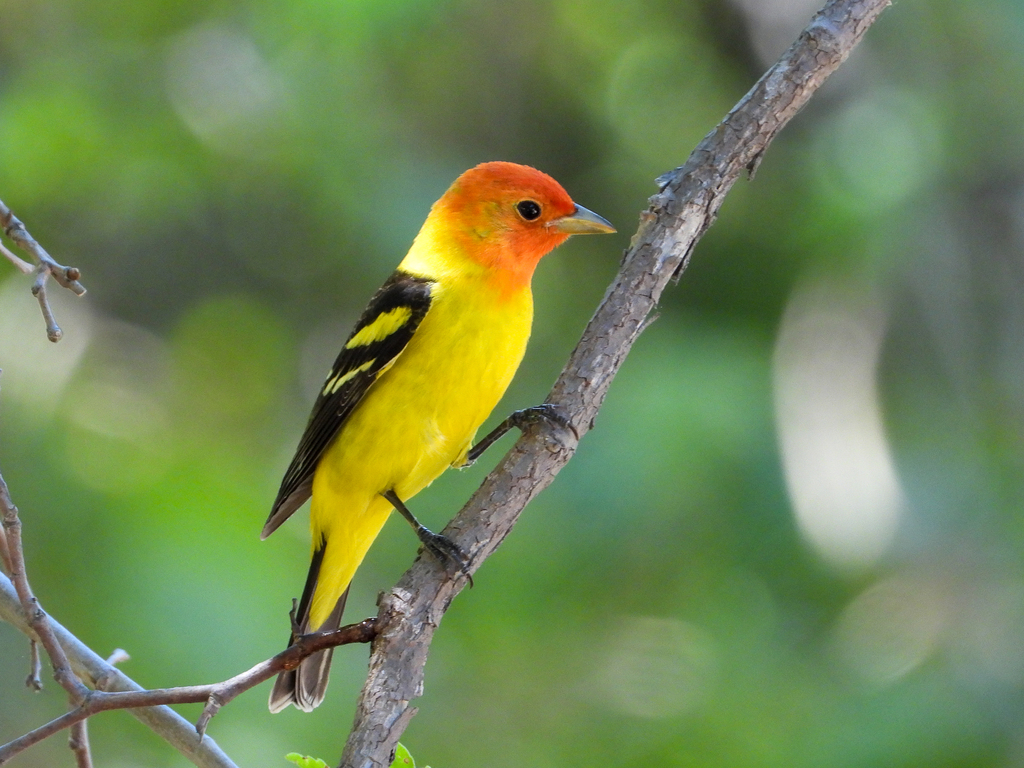
Western Tanager
Photo © James M. Maley
Photo © James M. Maley — CC BY 4.0 — Source: iNaturalist photo #130284266Identification
The western tanager is a medium-sized songbird measuring 6.3–7.5 inches in length with a wingspan of 11.5 inches. Adults display a pale, stout pointed bill, yellow underparts, and light wing bars. Breeding males are striking: bright red face with yellow nape, shoulder, and rump contrasting sharply with black upper back, wings, and tail. Non-breeding males lose much of this brilliance, showing only a reddish cast on the head and an olive tinge to the body. Females are subtly colored with a yellow head, olive back, and dark wings and tail.
The song comprises disconnected short phrases resembling an American robin's but hoarser and rather monotonous. The call is a distinctive pit-er-ick.
Range & Habitat
The western tanager is the northernmost-breeding tanager in North America. Its breeding range spans coniferous and mixed forests from southeastern Alaska south through the western coast to northern Baja California, extending east to western Texas and north through the Rocky Mountain region to the southern Northwest Territories, Canada. During migration, these birds use diverse habitats including disturbed areas, logged forests with regenerating vegetation, riparian corridors along the Rio Grande, and saltcedar and Russian olive communities.
They winter from central Costa Rica through Central America and Mexico, with some populations remaining in southern California. Vagrants occasionally appear in the eastern United States, though such sightings are rare to casual.
Behaviour & Diet
Western tanagers are migratory birds that travel alone or in groups of up to 30 individuals. Migration timing varies by age, with hatching-year birds typically captured later in fall (early September) than adults (mid-August). Breeding usually begins in May and continues into July among birds two years or older, though some first-year birds also breed. Females construct flimsy cup nests on horizontal tree branches, typically in conifers, where they lay four bluish-green eggs spotted with brown. Brooding begins earlier in southwestern regions (early May) compared to northwestern areas (mid-June).
Best Time & Places to See It
Spring arrival marks the beginning of the breeding season when males are most vocal and conspicuous in their breeding plumage. The peak breeding period extends from early June through early July, making this an excellent time to locate singing males in coniferous forests throughout the western mountains. Migration periods in spring and fall offer opportunities to see these birds in riparian habitats and disturbed areas outside their core breeding range, particularly along waterways like the Rio Grande.
Photography Tips
Capture breeding males during late spring and early summer when their red and yellow plumage is most vibrant. Early morning hours offer the best light and highest activity levels, particularly during the peak breeding season. Patience near open canopy areas where birds forage and sing will yield better photographic opportunities. Remember that non-breeding males and females are far more subdued in coloration; accurate identification requires careful attention to plumage patterns, bill shape, and wing bar characteristics rather than relying on color alone.
Acadia National Park
Alaska Maritime National Wildlife Refuge
Arches National Park
Arenal Volcano National Park
Badlands National Park
Banff National Park
Baru Volcano National Park
Bear River Migratory Bird Refuge
Big Bend National Park
Nothing matches these filters.
No community photos yet. Log in to add the first one.
No community observations of this species yet.