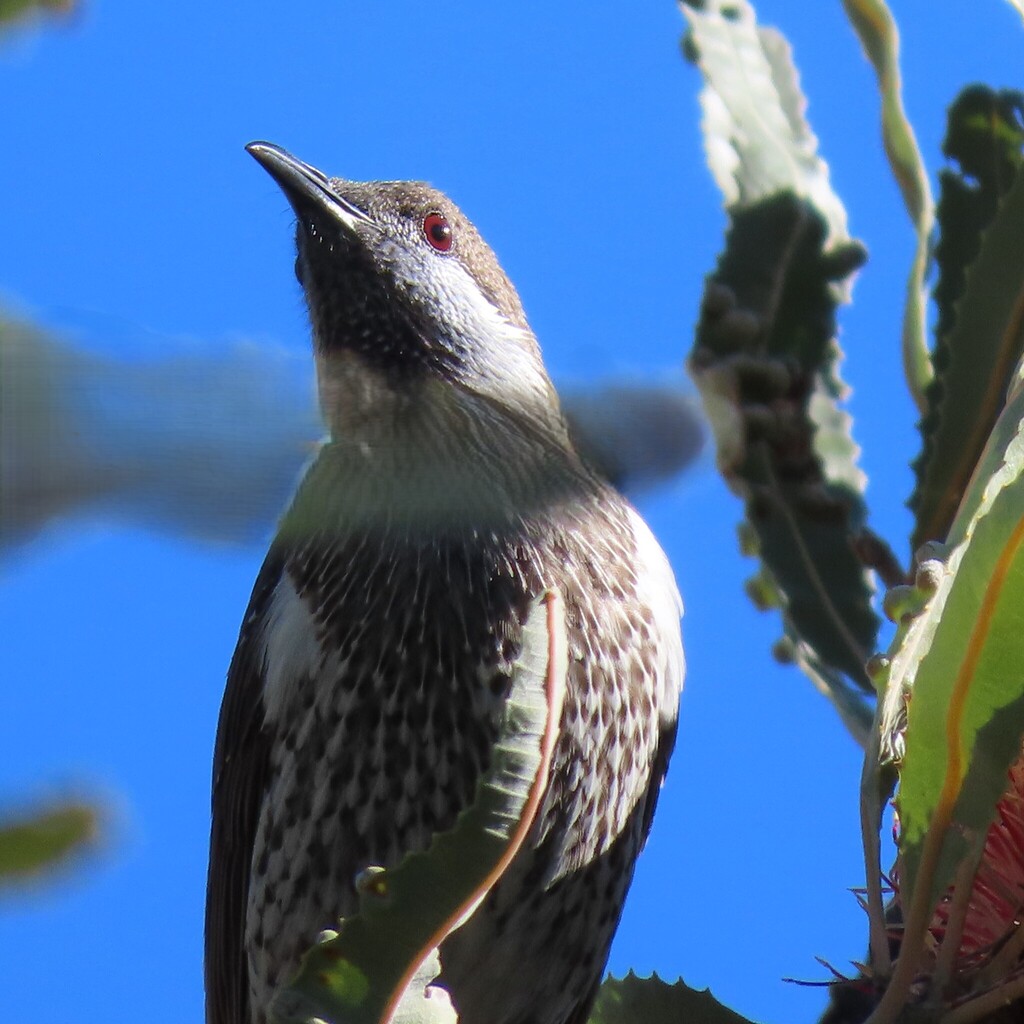
Western Wattlebird
Photo © pimelea
Photo © pimelea — CC BY 4.0 — Source: iNaturalist #293383369Identification
The western wattlebird is a large, long and slender honeyeater measuring 27–33 centimetres in length. Adults display dark grey-brown upperparts with pale streaks and spots, while the forehead, crown and nape are dark brown with fine whitish streaks. The underparts are dark grey, heavily streaked and tipped white. A distinctive blackish-brown streak borders the eye, and the iris is notably red—a key field mark that distinguishes this species from its eastern relatives. Males are noticeably larger than females, weighing 65–78 grams compared to females at 47–57 grams.
Range & Habitat
This species is restricted to south-western Australia, occurring in the high rainfall region formerly dominated by forest and woodland. Its range extends from Israelite Bay in the southeast northward to Geraldton on the coast, with inland populations reaching the Stirling Range, Lake Grace and Northam. The western wattlebird is endemic to this region and found nowhere else in Australia.
Behaviour & Diet
As a member of the honeyeater family, the western wattlebird is adapted for feeding on nectar and insects. Like other honeyeaters, it is an active forager, moving through vegetation in search of flowering plants and invertebrate prey. The species is typically encountered singly or in small groups as it works through its preferred habitats.
Best Time & Places to See It
To find western wattlebirds, focus your search in the high rainfall forests and woodlands of south-western Australia, particularly in areas from the Stirling Range northward to Geraldton and along the coastal regions. The best viewing opportunities occur in suitable habitat with flowering plants that attract honeyeaters. Local knowledge of current flowering patterns will greatly improve your chances of encounter.
Photography Tips
The red iris and blackish-brown eye-stripe are key diagnostic features worth capturing in photographs. The pale streaking on dark plumage requires careful exposure management to retain detail in both highlights and shadows. Position yourself to photograph the bird in good light that reveals the subtle plumage patterns and, critically, the distinctive red eye that separates this species from its eastern counterparts.
Fitzgerald River National Park
Fitzgerald River National Park, Australia
+209 birds+11 mammals
Where granite peaks rise above windswept heathlands and pristine river systems carve through untamed wilderness, one of Australia's most biodiverse landscapes unfolds across the southwestern corner…
VIEW NATIONAL PARKKalbarri National Park
Australia
+157 birds+6 mammals
Where ochre cliffs and weathered gorges slice through Western Australia's semi-arid interior, Kalbarri National Park reveals a landscape shaped by millions of years of erosion and…
VIEW NATIONAL PARKNambung National Park
Grey, Australia
+124 birds+2 mammals
Where limestone pinnacles rise like sharpened teeth from golden sand, Nambung National Park unveils one of Western Australia's most distinctive landscapes. The Pinnacles Desert, the park's…
VIEW NATIONAL PARKStirling Range National Park
Australia
+149 birds+7 mammals
Where ancient quartzite ranges rise abruptly from the southwestern Australian plateau, Stirling Range National Park unfolds as a realm of dramatic escarpments, deep valleys, and surprising…
VIEW NATIONAL PARKNo community photos yet. Log in to add the first one.
No community observations of this species yet.