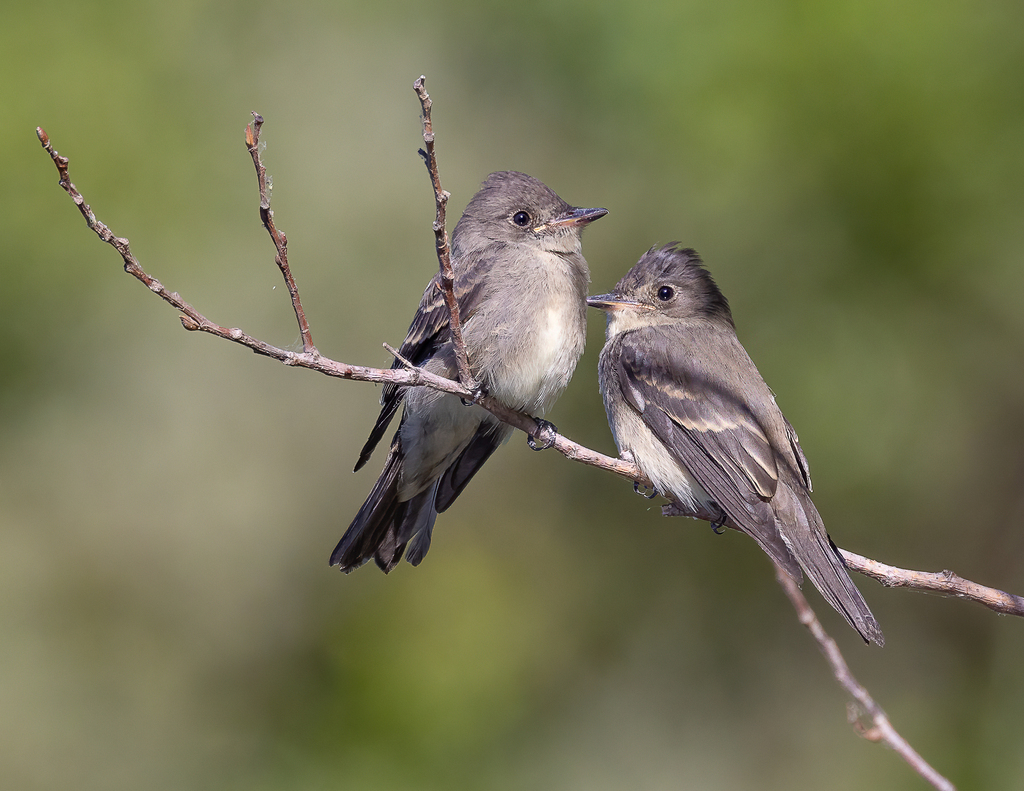
Western Wood Pewee
Photo © Frank Schulenburg
Photo © Frank Schulenburg — CC BY-SA 4.0 — Source: iNaturalist photo #218280038Identification
The Western Wood Pewee is a small tyrant flycatcher measuring 5.5–6.3 inches (14–16 cm) in length with a wingspan of 10.2 inches (26 cm) and weighing just 0.4–0.5 oz (11–14 g). Adults display gray-olive upperparts with light underparts washed in olive on the breast. Two distinct wing bars and a dark bill with yellow at the base of the lower mandible are key field marks. This species is remarkably similar to the Eastern Wood Pewee; the two were historically considered one species before being split.
The Western Wood Pewee is best identified by its vocalizations. Its call is a loud, buzzy peeer, while its song consists of three rapid descending tsees ending with a descending peeer—quite different from its eastern cousin's song pattern, making audio identification particularly useful in the field.
Range & Habitat
The Western Wood Pewee breeds throughout open wooded areas in western North America. Come late summer, these birds undertake a remarkable migration south to wintering grounds in South America, making them entirely absent from their breeding range during winter months.
They favor open woodlands and are notably associated with California black oak forests, among other suitable wooded habitats. These migratory birds exploit the abundance of insects during the northern breeding season before traveling thousands of miles to escape the scarcity of winter.
Behaviour & Diet
The Western Wood Pewee is an aerial insectivore with a distinctive hunting style. These birds typically perch at middle heights within trees, remaining alert and motionless before launching out to catch insects in flight—a technique called hawking. This patient sit-and-wait strategy allows them to scan for passing prey efficiently.
They supplement their hawking technique with gleaning, hovering near vegetation to pluck insects directly from leaves and branches. This versatile foraging approach ensures they can exploit various food sources throughout their range. Both parents participate in feeding the young, typically two or three nestlings per brood.
Best Time & Places to See It
The Western Wood Pewee is present in its breeding range during spring through summer, departing by late summer for South American wintering grounds. To observe this species, visit open wooded habitats in western North America during the breeding season—particularly areas with oak forests and similar open woodland types.
Early morning often offers the best viewing opportunities, when birds are most vocal and active. Listen carefully for their distinctive buzzy peeer call and three-note descending song, which will help you locate these small, relatively inconspicuous birds among the foliage.
Photography Tips
The Western Wood Pewee's small size and habit of perching in trees at medium heights present both challenges and opportunities. Position yourself with clear sight lines through open woodlands, allowing you to track the bird's position. Fast shutter speeds (1/1000s or faster) are essential for capturing the bird's frequent sallies out to snatch insects in mid-air.
Early morning or late afternoon light will showcase the subtle gray-olive tones of the upperparts and illuminate the contrasting light underparts. Focus on capturing the distinctive double wing bars and the dark bill with yellow base—these details confirm identification. Recording the bird's vocalizations alongside photographs creates a comprehensive field documentation of this charismatic flycatcher.
Tombstone Territorial Park
Alaska Maritime National Wildlife Refuge
Antisana National Park
Arches National Park
Arenal Volcano National Park
Badlands National Park
Bahuaja Sonene National Park
Banff National Park
Barbilla National Park
Nothing matches these filters.
No community photos yet. Log in to add the first one.
No community observations of this species yet.