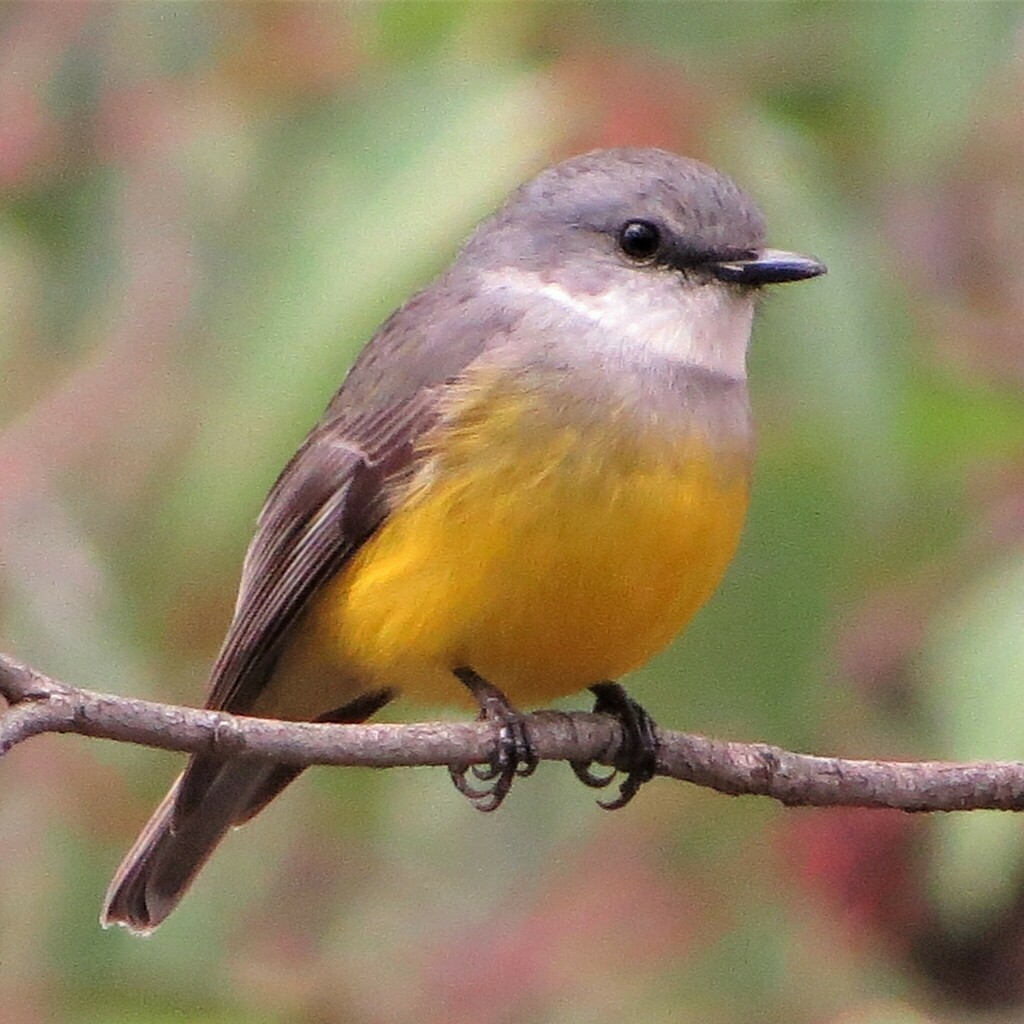
Western Yellow Robin
Photo © pimelea
Photo © pimelea — CC BY 4.0 — Source: iNaturalist #230704284Identification
The western yellow robin is a small songbird, measuring between 13.5 and 15.5 cm in length with a wingspan of 24–27.5 cm. The most striking feature is its conspicuous yellow belly, which contrasts sharply with its grey head, neck, and upperparts. The bird has a white throat that fades into a grey breast, black lores, and pale grey eyebrows with faint streaking over the ear coverts. Males and females are similar in appearance, with no seasonal plumage variation, making identification consistent year-round.
Two subspecies are recognized. The nominate subspecies griseogularis, found in southwestern Western Australia, displays a yellow rump, while subspecies rosinae, occurring on the Eyre Peninsula in South Australia, has an olive-green rump instead. Birds of subspecies rosinae tend to have longer wings and tail overall, with a shorter bill and tarsus. Juveniles look quite different, with dark brownish plumage heavily streaked with creamy white, gradually molting into adult-like plumage after a few months.
Range & Habitat
The western yellow robin is endemic to southern Australia, with its range comprising the southwest of Western Australia and the state's southern coastline, as well as the Eyre Peninsula in South Australia. Within this range, the species shows a preference for open eucalypt jungle, woodland, and scrub, generally favouring habitats with significant understory vegetation that provides cover and foraging opportunities.
The species was already reported as common by John Gould in the 1830s at the Swan Coastal Plain and in any site with brush-like shrubs. Although rated as least concern by conservation authorities, the western yellow robin has declined in parts of its range, making habitat preservation important for maintaining healthy populations.
Behaviour & Diet
The western yellow robin is predominantly insectivorous, hunting prey by pouncing from a low branch or foraging directly on the ground. This hunting strategy makes it relatively easy to observe as it goes about its daily feeding routine. The species breeds in a cup-shaped nest constructed in a tree, a typical nesting structure for many small songbirds.
Vocally, the western yellow robin produces its distinctive song through sequences of extended whistles, beginning with two briefly piped notes. The song has a mournful quality and is often heard before dawn, making it a familiar and evocative sound in southwest forests and woodlands. The bird also utters scolding calls when alarmed or defending territory.
Best Time & Places to See It
The best time to encounter western yellow robins is during early morning hours, when they are most vocal and actively singing from prominent perches. Their preference for open eucalypt woodlands and scrubland with good understory cover makes them most reliably found in well-vegetated areas rather than in dense forest or open grassland. Look for them in suitable habitat throughout southwestern Western Australia and on the Eyre Peninsula in South Australia.
Since the species has declined in parts of its range, visiting protected areas and well-maintained natural reserves within its range will offer the best chances of observation. The bird's relatively small size and preference for low perches means patience and careful observation are rewarded with excellent viewing opportunities.
Photography Tips
The western yellow robin's compact size and preference for low perches make it an accessible subject for photographers. Its striking contrast between grey upperparts and bright yellow underparts provides excellent compositional opportunities, particularly when the bird is backlit to highlight the vibrant belly plumage. Early morning sessions, when the bird is most vocal and active, offer the best light and behavioral opportunities.
Position yourself quietly near suitable eucalypt woodland or scrubland habitat and wait for the robin to forage on the ground or perch on low branches. The bird's relatively bold behavior and lack of seasonal plumage changes mean consistent image quality can be achieved throughout the year. Capturing the distinctive pale eyebrow stripe and black lores will help showcase the species' subtle facial markings.
Lincoln National Park
Australia
+149 birds+5 mammals
Across the mid-north of South Australia, where the landscape transitions from coastal lowlands toward semi-arid interior plains, sprawls a wilderness of 2,671 square kilometres where red-earth…
VIEW NATIONAL PARKCoffin Bay National Park
Australia
+143 birds+5 mammals
Across South Australia's Eyre Peninsula, where limestone headlands rise above turquoise shallows and eucalypt woodland gives way to coastal heath, lies a 1,319-square-kilometre sanctuary shaped by…
VIEW NATIONAL PARKFitzgerald River National Park
Fitzgerald River National Park, Australia
+209 birds+11 mammals
Where granite peaks rise above windswept heathlands and pristine river systems carve through untamed wilderness, one of Australia's most biodiverse landscapes unfolds across the southwestern corner…
VIEW NATIONAL PARKKalbarri National Park
Australia
+157 birds+6 mammals
Where ochre cliffs and weathered gorges slice through Western Australia's semi-arid interior, Kalbarri National Park reveals a landscape shaped by millions of years of erosion and…
VIEW NATIONAL PARKStirling Range National Park
Australia
+149 birds+7 mammals
Where ancient quartzite ranges rise abruptly from the southwestern Australian plateau, Stirling Range National Park unfolds as a realm of dramatic escarpments, deep valleys, and surprising…
VIEW NATIONAL PARKNo community photos yet. Log in to add the first one.
No community observations of this species yet.