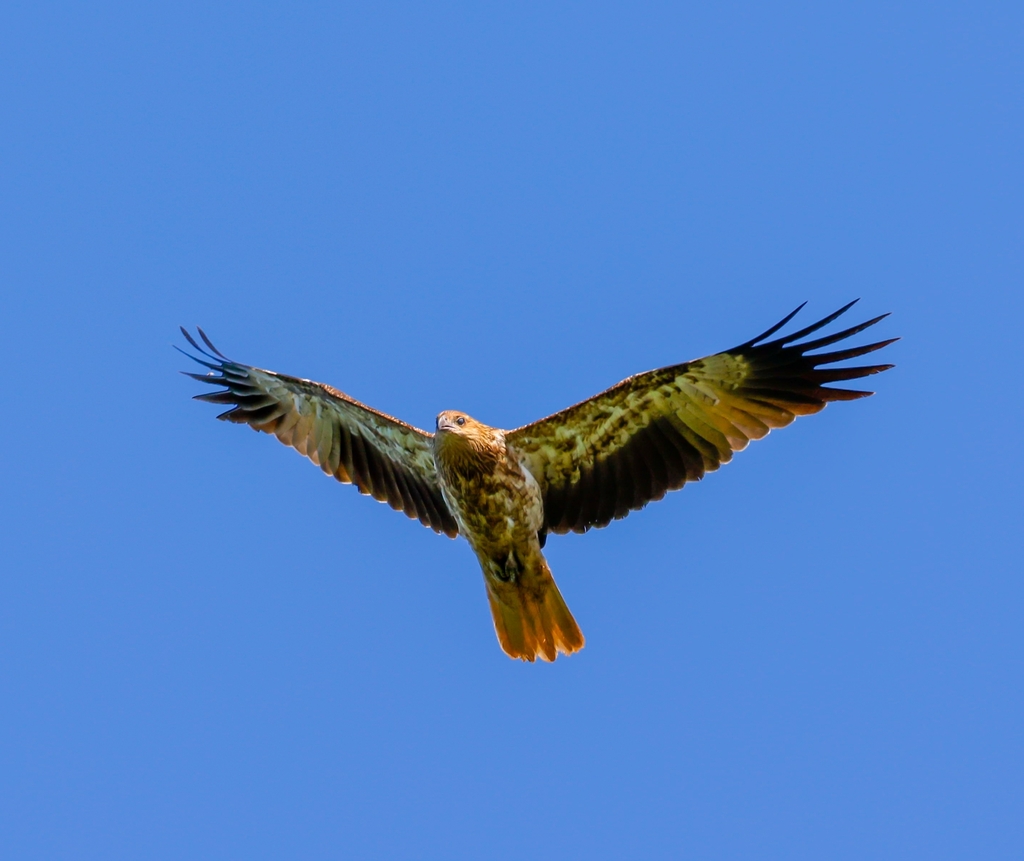
Whistling Kite
Photo © pittafisher
Photo © pittafisher — CC BY 4.0 — Source: iNaturalist #266379321Identification
The whistling kite is a medium-sized raptor measuring 50–60 cm in length, with a wingspan of 123–146 cm. Females are noticeably larger than males, up to 21% longer and 42% heavier. Adults display pale buff plumage on the head, breast, and tail, contrasting with browner wings and black flight feathers. Immature birds are heavily streaked reddish-brown with prominent pale spots on the wings. All ages have distinctive bone-colored, unfeathered legs and feet. In flight, the species appears small-headed and long-tailed, soaring on slightly bowed wings with splayed flight feathers that create a striking underwing pattern. When perched, the wingtips fall well short of the tail tip.
Range & Habitat
The whistling kite is found throughout Australia (including coastal islands), New Caledonia, and most of New Guinea, excluding the central mountains and northwest regions. It inhabits open or lightly wooded areas, typically near water, from sea level to 1,400 meters elevation. While generally sedentary, some Australian populations are nomadic, moving to coastal northern areas during the dry season or migrating southward in autumn. The species has declined locally in southern Australia due to wetland drainage and associated loss of food supplies.
Behaviour & Diet
Whistling kites are typically solitary or found in pairs, though they gather in larger groups during nomadic movements and at roost sites. They are vocal birds, calling regularly in flight and from perches with a distinctive clear descending whistle often followed by rapid rising notes. Their diet is highly varied: they take small mammals, birds, fish, reptiles, amphibians, crustaceans, insects, and carrion. Australian birds primarily hunt live prey except in winter when carrion becomes important, while New Guinea populations are principally scavengers. Most food is captured from the ground or water surface, though insects may be taken in flight. They are opportunistic feeders, regularly patrolling roads for roadkill, hovering over grass fires to catch fleeing prey, and even kleptoparasitizing meals from ibises, herons, and other raptors.
Best Time & Places to See It
Whistling kites can be observed year-round throughout their range in suitable open or semi-open habitats near water. In Australia, breeding occurs June–October in the south and February–May in the north, with timing flexible following rainfall. They are most active during daylight hours and can often be spotted soaring overhead or perched in tall trees, particularly eucalypts and pines in riparian areas. Wetlands, coastal areas, and regions with grasslands and water bodies offer the best viewing opportunities.
Photography Tips
The whistling kite's striking underwing pattern and pale plumage make it highly photogenic in flight. Capture birds soaring on bowed wings during their regular patrols, or focus on perched individuals in tall trees where they command good visibility. The contrast between pale head and breast and darker wings provides excellent compositional opportunities. Early morning and late afternoon light enhance the detail of their plumage. Look for them hovering over roads or watching water margins—patient observers may document their versatile feeding behavior.
Alpine National Park
Annan River (Yuku Baja-Muliku) National Park
Bald Rock National Park
Barrington Tops National Park
Belair National Park
Ben Boyd National Park
Blue Mountains National Park
Boodjamulla National Park
Bouddi National Park
Nothing matches these filters.
No community photos yet. Log in to add the first one.
No community observations of this species yet.