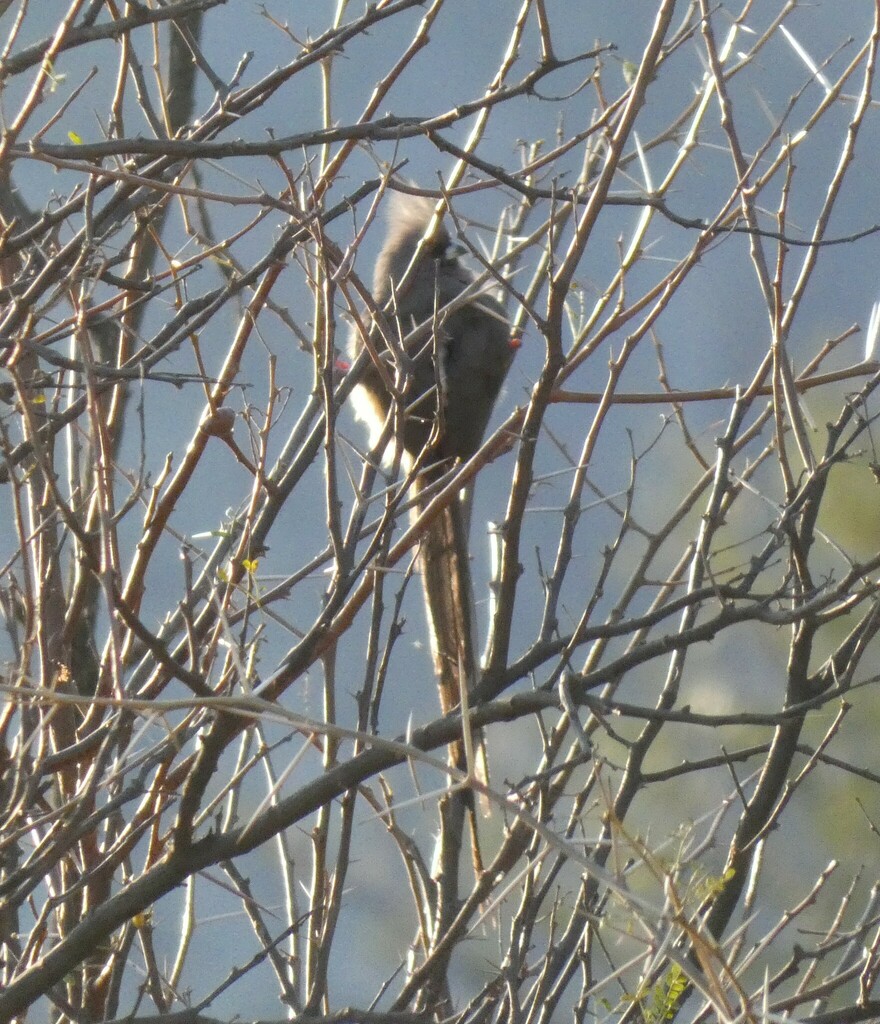
White-backed Mousebird
Photo © agujaceratops
Photo © agujaceratops — CC BY 4.0 — Source: iNaturalist #240534732Identification
The white-backed mousebird is a large mousebird species, measuring about 34 cm in length with a notably long tail that comprises approximately half its body length. This distinctive bird weighs between 38–64 g. Its most characteristic feature is a white back stripe flanked by two broad black stripes, though this white marking is only visible when the wings are at least partly open, such as during landing or in hot weather. The upper parts, head, and prominent crest are grey, while the breast is also grey and the belly is buff-coloured. A dark red or maroon transverse band marks the base of the tail. The bill is bluish-white with a black tip, and the legs and feet are bright red. The speckled mousebird is a similar species but can be distinguished by its differently coloured beak, legs, and upperparts.
Vocally, the white-backed mousebird produces a distinctive whistled "zwee-wewit" call. It also makes buzzing or crackling sounds, likely used for alarm signalling or maintaining contact within its social groups.
Range & Habitat
This species is distributed across western and central regions of southern Africa, ranging from Namibia and southern Botswana eastwards to Central Transvaal and the eastern Cape. The white-backed mousebird favours scrubby dry habitats, particularly thornveld, fynbos scrub, and semi-desert environments where it can find the vegetation it depends upon.
Behaviour & Diet
The white-backed mousebird is a frugivore that feeds on fruits, berries, leaves, seeds, and nectar. It will also consume plant buds, sometimes stripping branches of ornamental plants such as fiddlewoods. Its voracious appetite makes it unpopular with fruit farmers and gardeners. Occasionally, these birds settle on flowering grass to feed on stigmata and stamens. In natural ecosystems, their fruit-eating habits play an important ecological role in dispersing seeds of indigenous berry-producing plants like Halleria lucida, though they also inadvertently spread invasive species such as Cotoneaster.
These are markedly social birds, typically foraging in small groups of presumably related individuals while engaging in mutual preening. They roost together at night. The white-backed mousebird displays amusing, parrot-like perching habits, often hanging from its legs rather than squatting conventionally, and frequently gripping different upright branches with each leg. Despite their sociability, they are very shy around humans, either sitting quietly in trees or flying off immediately when spotted. Breeding can occur at any time of year when conditions favour reproduction. The nest is a large cup constructed and well hidden in a thicket, with both parents and helpers from previous clutches feeding the nestlings.
Best Time & Places to See It
The white-backed mousebird is a sedentary species, making it potentially viewable year-round within its southern African range. However, breeding season activity and favourable fruiting periods may offer the best viewing opportunities. Scrubby, arid habitats with thornveld and fynbos vegetation are your best bet for locating these birds, particularly in Namibia, Botswana, and the eastern regions of South Africa.
Photography Tips
Patience and a long lens are essential when photographing this shy species, as white-backed mousebirds typically flee when they detect humans. Early morning and late afternoon activity may increase your chances. Position yourself quietly near fruiting plants or flowering grass where birds congregate. Watch for the moment when birds take flight or land, as the white back stripe is only visible when wings are partly open. Their distinctive red legs and bluish-white bill provide excellent colour contrast, and their characteristic hanging posture offers unique compositional opportunities.
Garden Route National Park
George, South Africa
+353 birds+54 mammals
Sweeping across the Western Cape's coastal and mountainous terrain, this sprawling national park encompasses over five thousand square kilometers of extraordinarily diverse landscape—from coastal limestone cliffs…
VIEW NATIONAL PARKPilanesberg National Park
Moses Kotane Local Municipality, South Africa
+364 birds+49 mammals
Granite peaks and volcanic ridges rise unexpectedly from the savanna floor across this 734-square-kilometre expanse in the North West province, creating a landscape of profound ecological…
VIEW NATIONAL PARKMokala National Park
Siyancuma Local Municipality, South Africa
+246 birds+35 mammals
Across the semi-arid savanna of the Northern Cape, where red earth meets sparse acacia woodland and open grassland punctuated by rocky outcrops, lies a landscape shaped…
VIEW NATIONAL PARKCederberg Wilderness Area
Cederberg Local Municipality, South Africa
+136 birds+12 mammals
Where ancient sandstone ridges rise dramatically from the semi-arid lowlands of Western Cape, the Cederberg Wilderness Area spreads across nearly 1,700 square kilometres of some of…
VIEW NATIONAL PARKKruger National Park
Ba-Phalaborwa Local Municipality, South Africa
+540 birds+91 mammals
Across the low-lying savanna of northeastern South Africa unfolds one of Africa's largest and most ecologically intact protected areas, where acacia woodlands merge into mopane scrub…
VIEW NATIONAL PARKAgulhas National Park
Cape Agulhas Local Municipality, South Africa
+224 birds+13 mammals
Where the Atlantic and Indian Oceans meet at Africa's southernmost tip, Agulhas National Park stretches across 892 square kilometres of windswept coastal landscape and rugged limestone…
VIEW NATIONAL PARKTankwa-Karoo National Park
Hantam Local Municipality, South Africa
+201 birds+20 mammals
Across the semi-arid heartland of the Northern Cape, where winter rains carve ephemeral watercourses through endless ochre plains, Tankwa-Karoo National Park sprawls across more than 3,100…
VIEW NATIONAL PARKMountain Zebra National Park
Inxuba Yethemba Local Municipality, South Africa
+265 birds+35 mammals
Across the windswept plateaus and deeply incised valleys of the Eastern Cape's interior, Mountain Zebra National Park unfolds as a landscape of geological drama and ecological…
VIEW NATIONAL PARKBontebok National Park
Swellendam Local Municipality, South Africa
+204 birds+11 mammals
Where the Cape Fold Mountains give way to coastal lowlands, a landscape of rolling sandstone hills and fynbos heathland creates one of South Africa's most compact…
VIEW NATIONAL PARKAugrabies Falls National Park
Kai !Garib Local Municipality, South Africa
+176 birds+20 mammals
Where the Orange River cuts a dramatic scar through the Northern Cape's arid interior, Augrabies Falls National Park sprawls across nearly 1,200 square kilometers of raw,…
VIEW NATIONAL PARKAddo Elephant National Park
Sundays River Valley Local Municipality, South Africa
+388 birds+55 mammals
Where the Eastern Cape's semi-arid scrublands meet transitional woodland, Addo sprawls across 13,478 square kilometres of one of southern Africa's most biodiverse landscapes. The terrain rises…
VIEW NATIONAL PARKMarakele National Park
Modimolle Local Municipality, South Africa
+341 birds+36 mammals
Granite ridges and sprawling grasslands dominate this 1,176-square-kilometre reserve in Limpopo's heartland, where bushveld transitions between rocky outcrops and open savanna. The park's rugged topography creates…
VIEW NATIONAL PARKCamdeboo National Park
Camdeboo Local Municipality, South Africa
+272 birds+24 mammals
Granite ridges and weathered sandstone cliffs rise across a semi-arid landscape where the Karoo transitions into the eastern escarpment of South Africa, creating Camdeboo National Park's…
VIEW NATIONAL PARKSperrgebiet National Park
Barcelona, Namibia
+181 birds+18 mammals
Where the Namib's ancient gravel plains meet the Atlantic coast, one of Africa's most remote and geologically austere landscapes unfolds across more than 56,000 square kilometres.…
VIEW NATIONAL PARKSkeleton Coast Park
Barcelona, Namibia
+143 birds+7 mammals
Where the Atlantic's cold Benguela Current collides with one of Africa's most hostile coastlines, the Skeleton Coast Park sprawls across more than 104,000 square kilometres of…
VIEW OBSERVATION POINTBwabwata National Park
Namibia
+377 birds+35 mammals
Where the Kavango River winds through northeastern Namibia, vast floodplains and dense riparian woodland create one of southern Africa's most ecologically dynamic protected landscapes. Spanning 14,249…
VIEW NATIONAL PARKEtosha National Park
Namibia
+356 birds+58 mammals
Across northern Namibia's stark semi-arid plateau, a vast shallow depression transforms seasonally into one of Africa's most dramatic wildlife theaters. Etosha National Park, encompassing more than…
VIEW NATIONAL PARKWaterberg Plateau National Park
Okambukonde, Namibia
+198 birds+27 mammals
Where ancient sandstone cliffs rise 200 metres above the surrounding bushveld, a fortress of geology creates one of southern Africa's most compelling ecosystems. The plateau's steep…
VIEW NATIONAL PARKNo community photos yet. Log in to add the first one.
No community observations of this species yet.