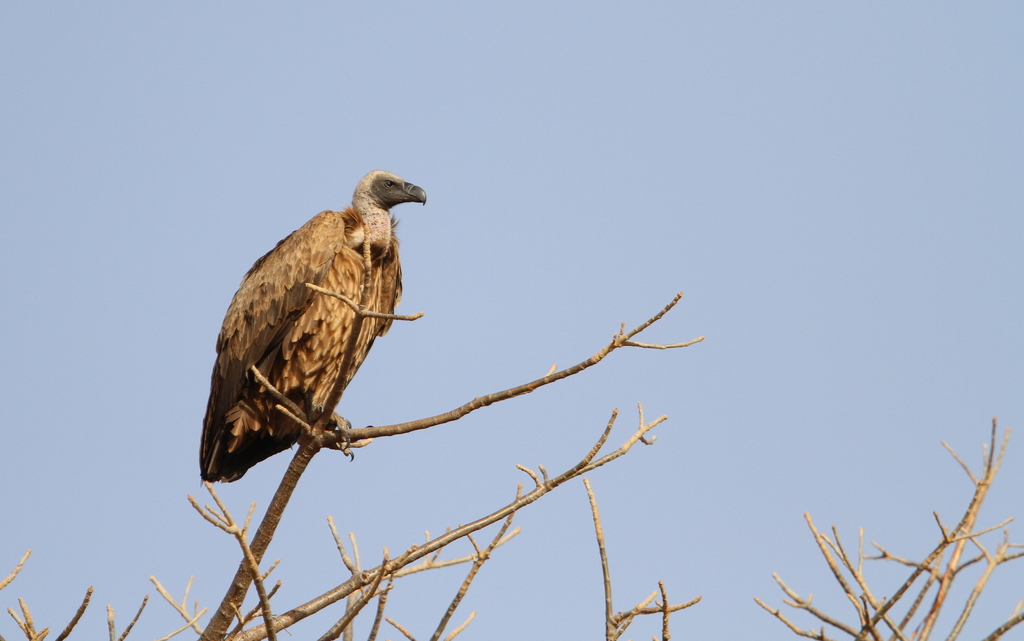
White-backed Vulture
Photo © Christoph Moning
Photo © Christoph Moning — CC BY 4.0 — Source: iNaturalist photo #95372162Identification
The white-backed vulture is a medium-sized Old World vulture with a distinctive appearance shaped by its scavenging lifestyle. Its most recognizable feature is the contrasting white back against otherwise dark plumage, particularly visible in adults. The bird has a white neck ruff, bare head and neck covered only in down feathers, very broad wings, and short tail feathers—all typical adaptations of vultures. Juveniles are largely dark, lacking the striking white back of mature birds.
White-backed vultures weigh between 4.2 and 7.2 kilograms, measure 78 to 98 centimeters in length, and possess an impressive wingspan of 1.96 to 2.25 meters. These proportions make them powerful fliers capable of soaring vast distances while searching for food across African landscapes.
Range & Habitat
This is the most common vulture species across Africa, with an estimated range of 24,300,000 square kilometers. The white-backed vulture is found from Senegal, Gambia, and Mali in the west, throughout the Sahel region to Ethiopia and Somalia in the east, and south through East Africa into Mozambique, Zimbabwe, Botswana, Namibia, and South Africa. However, the species has undergone rapid population declines in recent years.
White-backed vultures are most at home in wooded savannahs where their primary food sources—carcasses of large grazing animals—are readily available. They nest in tall trees, showing a strong preference for Acacia species in riparian habitats.
Behaviour & Diet
White-backed vultures are obligate scavengers with highly specialized feeding habits. They circle through the sky searching for freshly dead animals, often following other scavenger birds and mammalian carnivores. Their medium-sized beaks are not adapted for tearing tough skin, so they focus on soft tissues such as viscera, using a pulling feeding tactic. They feed primarily on carcasses of warthogs, zebras, gazelles, rhinoceroses, bovines, ostriches, and livestock found in their wooded savannah habitat.
As social vultures, they rely heavily on other individuals to provide information about food locations. Interestingly, their circling flight pattern is not a signal about food—such signaling would increase competition for limited resources. Instead, they use personal and social cues while balancing competitive risk. White-backed vultures feed in groups and are often among the first vulture species to arrive at a carcass. Their breeding cycle is lengthy, with an incubation period around 8 weeks and a nestling period of 4–5 months. Nests are large structures, roughly 1 meter in diameter, made of large sticks and lined with leaves and grasses.
Best Time & Places to See It
The white-backed vulture's widespread distribution across sub-Saharan Africa means viewing opportunities exist across much of the continent, from the Sahel to southern Africa. Areas with protected status and less human disturbance offer better chances of observation, as the species actively avoids anthropogenically-disturbed areas when selecting nest sites. Wooded savannahs with abundant large herbivores provide the best habitat for locating these birds, as they concentrate where carrion is most likely to be found.
Photography Tips
Photographing white-backed vultures requires patience and understanding of their behavior. The distinctive white back is a key identifying feature in adults and photographs should aim to capture this contrast against their dark plumage. The bird's impressive wingspan—up to 2.25 meters—is best showcased in flight photography. Early morning is often productive as vultures begin their daily thermals, offering opportunities to capture them soaring overhead with wings fully spread. Look for groups feeding at carcasses in savannah habitats, but approach carefully to avoid disturbing these increasingly vulnerable birds.
Wild South Africa: Safari + Coast
Nothing matches these filters.
Bwindi Impenetrable National Park
Lake Mburo National Park
Mabamba Swamp
Murchison Falls National Park
Queen Elizabeth National Park
Aberdare National Park
Abijata-Shalla Lakes National Park
Amboseli National Park
Arusha National Park
Nothing matches these filters.
No community photos yet. Log in to add the first one.
No community observations of this species yet.