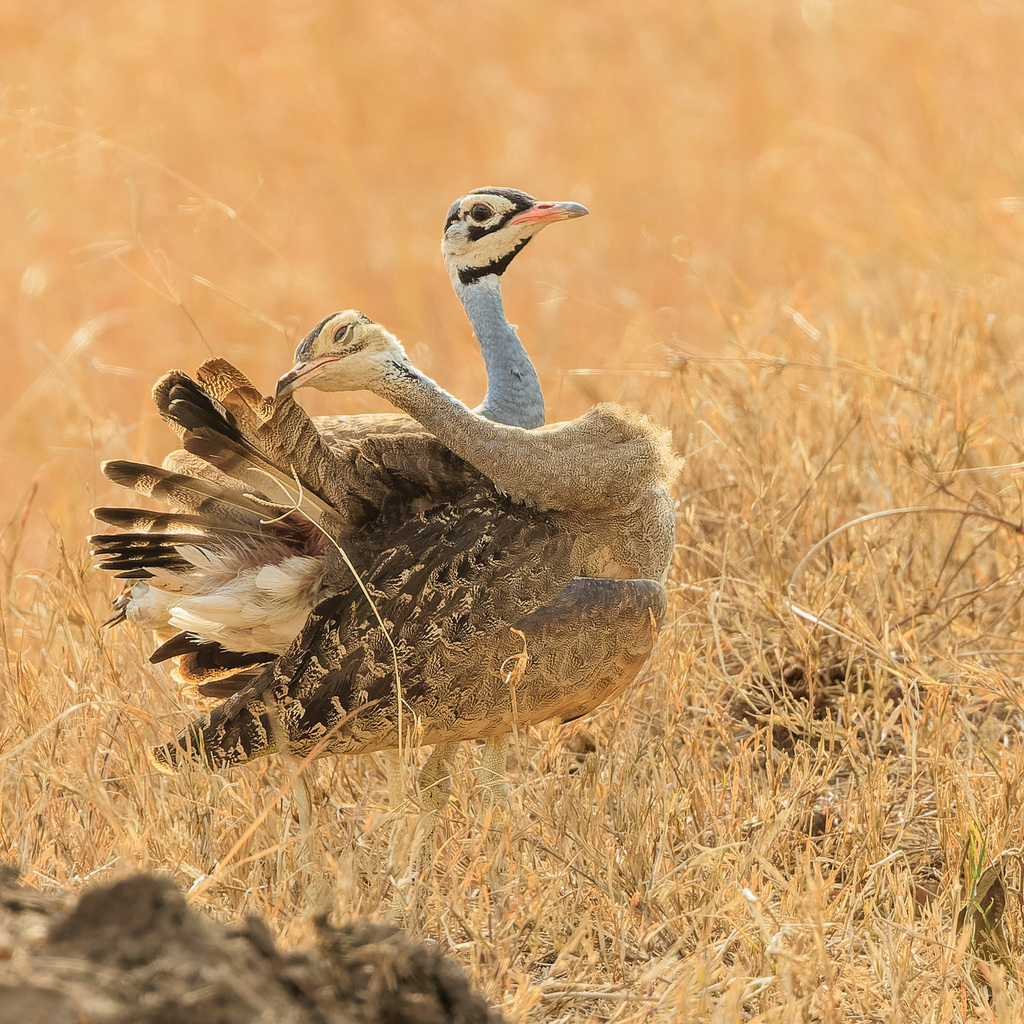
White-bellied Bustard
Photo © Gary T. Leavens
Photo © Gary T. Leavens — CC BY-SA 4.0 — Source: iNaturalist #209089802Identification
The white-bellied bustard is one of Africa's smaller bustards, measuring 48 to 61 centimetres in length. Both sexes are distinctive: tawny brown above and on the breast with a contrasting white belly and cream-coloured legs. Males are noticeably larger than females and display a striking black crown, black lines on white cheeks, a black throat patch, and a pinkish-red bill. Females have a grey crown, a brown and buff line below the eye, and black speckling on the throat. Juveniles are characterized by light brown necks and heads. The species' most recognizable feature is its loud, guttural call—described as "k'whuka WHUKa" or "k'warrak"—which echoes across the savanna, especially at dawn and dusk.
Range & Habitat
White-bellied bustards are widespread across sub-Saharan Africa, with five recognized subspecies distributed across distinct regions: from West Africa (Senegal to Sudan), through East Africa (Ethiopia to Tanzania), and into southern Africa (Botswana, South Africa, and Eswatini). These birds favour tall grasslands and open savannah with scattered dwarf trees, though West African populations are notably more adapted to arid conditions and may venture into deserts during rainy seasons. Other populations prefer greener areas of dense tall grass, river plains, and cultivated areas. Most sightings occur below 1,500 metres elevation, though birds have been recorded at heights up to 2,000 metres in Eastern Africa.
Behaviour & Diet
White-bellied bustards are typically seen in pairs or family groups, with young staying with their parents significantly longer than in other regional bustard species. Both males and females vocalize year-round, particularly at dawn, dusk, and during rainfall, using distinctive croaking calls for territorial defence that can be heard across considerable distances. These omnivorous birds forage by moving close to the ground, feeding primarily on small invertebrates—mainly beetles, but also termites, locusts, caterpillars, and spiders—supplemented by seeds, bulbs, berries, and flowers. They often hunt in recently burnt areas where food is more accessible.
Best Time & Places to See It
Despite their wide distribution across Africa, white-bellied bustards remain poorly studied, and detailed recommendations for specific viewing locations are limited. The species is easiest to locate during early morning and late evening hours when their loud calls are most frequent. Breeding times vary by region and subspecies, ranging from March to June in Northeast Africa to October to February in South Africa, and vocal activity is particularly intense during these periods. Your best chances come from visiting suitable grassland and savannah habitats across the bird's range, particularly in open areas with scattered trees.
Photography Tips
Photographing white-bellied bustards requires patience and early starts, as they are most vocal and active at dawn and dusk. The stark contrast between their tawny upper parts and white belly provides excellent compositional opportunities, while males' distinctive black and white head patterns are particularly photogenic. Their low foraging behaviour means you may need to position yourself low to the ground to capture them naturally. Since these birds are usually seen in pairs or family groups, wait for moments when multiple birds interact, and use their loud calls as an audio cue to locate them in grassland habitat. The open savannah they favour generally provides good lighting conditions for photography.
Serengeti National Park
Tanzania
+558 birds+57 mammals
Across Tanzania's northern plateau, where volcanic soils meet acacia woodland and open grassland, unfolds one of Earth's most dynamic ecosystems. The Serengeti National Park sprawls across…
VIEW NATIONAL PARKArusha National Park
Tanzania
+555 birds+16 mammals
Where the slopes of Mount Mawenzi rise above the Arusha region, a compact yet ecologically rich national park unfolds across montane forest, moorland, and alpine zones.…
VIEW NATIONAL PARKKidepo Valley National Park
Uganda
+478 birds+24 mammals
Where the Narus and Kidepo rivers carve through northeastern Uganda's semi-arid lowlands, a landscape of sparse acacia woodland, grassland, and riverine thickets creates one of East…
VIEW NATIONAL PARKTsavo East National Park
Athi ward, Kenya
+468 birds+50 mammals
Across the semi-arid lowlands of southeastern Kenya, where acacia woodland fragments into scrubland and the landscape rolls toward the Indian Ocean horizon, lies one of Africa's…
VIEW NATIONAL PARKTsavo West National Park
Mwatate, Kenya
+513 birds+49 mammals
Where volcanic ridges and weathered lava flows meet the semi-arid lowlands of south-central Kenya, Tsavo West National Park unfolds across a landscape sculpted by fire and…
VIEW NATIONAL PARKNgorongoro Conservation Area
Tanzania
+626 birds+55 mammals
Volcanic calderas and open grassland dominate this high plateau in northern Tanzania, where the landscape rises above 2,000 metres and ancient geological forces have shaped both…
VIEW WILDLIFE MANAGEMENT AREAKruger National Park
Ba-Phalaborwa Local Municipality, South Africa
+540 birds+91 mammals
Across the low-lying savanna of northeastern South Africa unfolds one of Africa's largest and most ecologically intact protected areas, where acacia woodlands merge into mopane scrub…
VIEW NATIONAL PARKIthala Game Reserve
uPhongolo Local Municipality, South Africa
+328 birds+26 mammals
Rolling thornbush savanna and acacia woodland dominate the landscape of this 494-square-kilometre national park in KwaZulu-Natal's uPhongolo Local Municipality, where granite outcrops punctuate grassland plateaus and…
VIEW NATIONAL PARKOmo National Park
Ethiopia
+61 birds+4 mammals
Where the Omo River carves through southwestern Ethiopia, a landscape of riverine woodland, acacia savanna, and scattered grassland unfolds across one of East Africa's most remote…
VIEW NATIONAL PARKAwash National Park
Didiga, Ethiopia
+473 birds+23 mammals
Where the Ethiopian Rift Valley carves through volcanic plateaus, a ribbon of riverine forest winds through acacia scrubland and grassland, creating a mosaic of habitats that…
VIEW NATURAL PARKYabelo Wildlife Sanctuary
Bedewera, Ethiopia
+359 birds+5 mammals
Where acacia woodlands meet volcanic plateaus in southern Ethiopia, a landscape of austere beauty unfolds across nearly 2,500 square kilometers. Yabelo Wildlife Sanctuary sprawls across semi-arid…
VIEW WILDLIFE SANCTUARYNairobi National Park
Nairobi, Kenya
+515 birds+35 mammals
Just minutes from Kenya's capital, where the Nairobi River winds through acacia woodland and open grassland, lies one of Africa's most paradoxical wildlife sanctuaries. The park's…
VIEW NATIONAL PARKLake Nakuru National Park
Nakuru West, Kenya
+494 birds+32 mammals
Alkaline waters ringed by acacia woodland and grassland create one of East Africa's most distinctive wetland ecosystems, where the interplay of geology and climate sustains a…
VIEW NATIONAL PARKMeru National Park
Igembe Central, Kenya
+408 birds+38 mammals
Granite outcrops and acacia woodland rise across the northern reaches of Meru, where semi-arid savanna transitions into drier scrubland under the fierce equatorial sun. The park's…
VIEW NATIONAL PARKSamburu National Reserve
Samburu, Kenya
+430 birds+42 mammals
Across the arid plains of northern Kenya, where scattered acacia woodland gives way to rocky outcrops and dry riverbeds, Samburu National Park unfolds as one of…
VIEW NATURE RESERVEHell’s Gate National Park
Olkaria ward, Kenya
+388 birds+18 mammals
Volcanic scarps and geothermal vents dominate the floor of Hell's Gate, where the East African Rift has carved a dramatic gorge through crystalline rock formations. The…
VIEW NATIONAL PARKNo community photos yet. Log in to add the first one.
No community observations of this species yet.