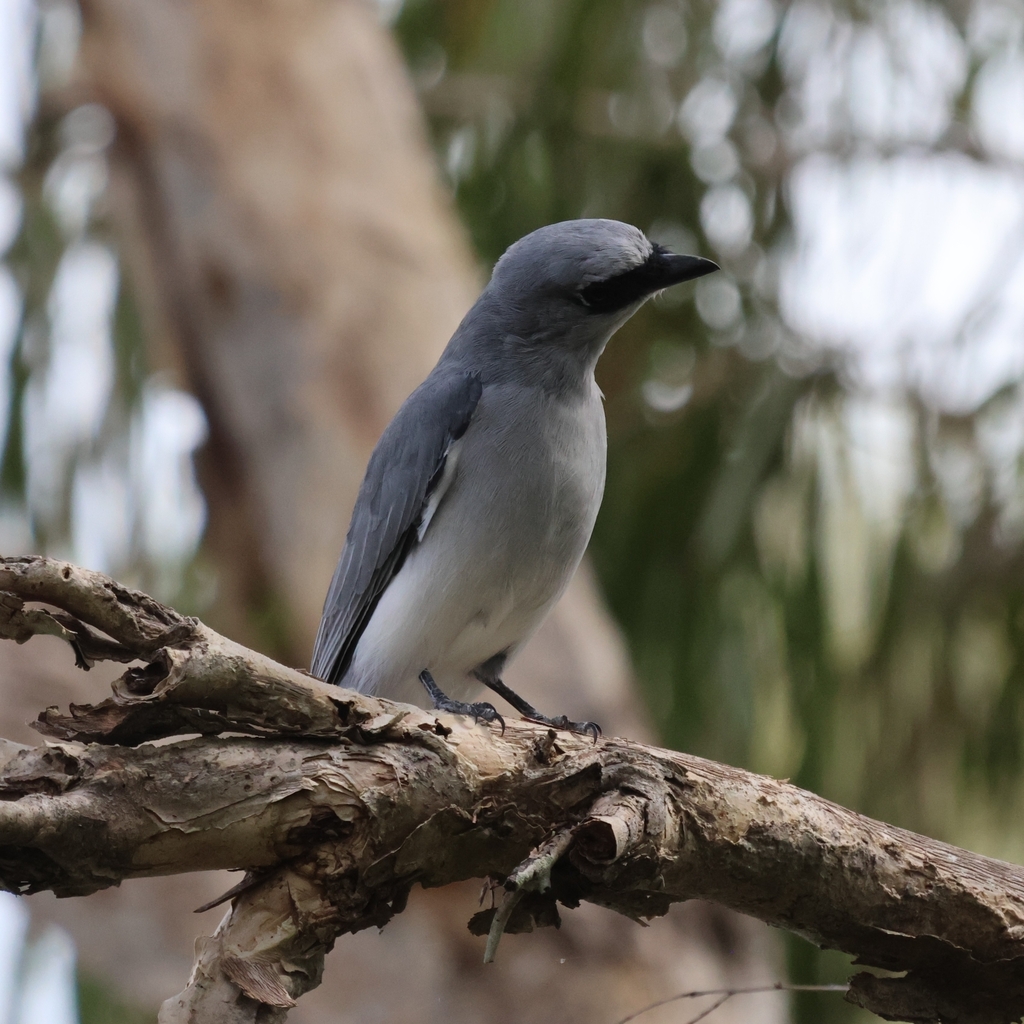
White-bellied Cuckooshrike
Photo © Luke Lythgoe
Photo © Luke Lythgoe — CC BY 4.0 — Source: iNaturalist #270127931Identification
The white-bellied cuckooshrike is a medium-sized passerine measuring 22–29 cm and weighing 55–80 g. Adults display pale blue-grey upperparts and head, with a distinctive short black mask extending from the beak to the eyes but not beyond, complemented by a fine white eye-ring. The tail feathers are darker grey, while the belly ranges from white to grey depending on subspecies and region. There is minimal sexual dimorphism. The subspecies C. p. robusta can show a striking dark morph with extensive black plumage on the neck and chest, sometimes barred at the edges. Immature birds appear duller with lightly barred underparts and a less distinct mask.
The species produces a characteristic peevish call described as 'kissik kissik' or 'quiseek', along with a weak, squealing, slurred 'whee-eeyu' or 'wee-year' reminiscent of parrot calls. Its flight is distinctive, showing an undulating pattern as the bird gains altitude by flapping, then holds its wings stiffly downward to glide. While superficially similar to the black-faced cuckooshrike, the white-bellied is notably smaller and more compact.
Range & Habitat
This species is widespread across Australia, Indonesia, Papua New Guinea, and the Solomon Islands. In Australia, it occupies tropical northern regions and eastern areas, from Western Australia's Kimberley region through the Northern Territory, Queensland, New South Wales, Victoria, and into southeastern South Australia. It is common throughout Papua New Guinea and the Solomon Islands, and less frequently encountered in Indonesia's northern Moluccas and Eastern Wallacea.
The white-bellied cuckooshrike is highly adaptable, thriving in savanna, woodlands, Eucalyptus forests, riparian forest, rainforest, littoral forest, mangroves, open grasslands, coconut plantations, farmlands, and suburban gardens. It shows a strong preference for lower-lying and forested habitats, typically below 800 m elevation. Most populations are sedentary or locally nomadic, though the subspecies C. p. robusta exhibits migratory behavior.
Behaviour & Diet
Breeding seasons vary geographically: in Australia, birds breed from August to March, while in southern New Guinea around Port Moresby, breeding occurs from March to June. Both adults participate in nest construction, typically building a shallow cup from grass, fine twigs, bark, leaves, and vine tendrils bound with spider webs and decorated with lichen. Nests are placed on horizontal forks 7–10 m above ground. Clutch sizes range from 1 to 3 eggs, with coloration varying regionally—pale blue-green with dark markings in Papua New Guinea, while Australian eggs exhibit a broader range of coloration.
Best Time & Places to See It
The white-bellied cuckooshrike is best observed during breeding season in your target region: August to March in Australia, or March to June in southern Papua New Guinea. The species is common throughout its range, making it relatively accessible to patient observers. In Australia, focus on tropical northern regions and eastern coastal areas; in Indonesia, the northern Moluccas offer reliable sightings. Papua New Guinea and the Solomon Islands provide excellent opportunities year-round.
Photography Tips
The species' undulating flight pattern offers dynamic photography opportunities—anticipate the gliding phase for sharp wing-detail shots. Early morning provides optimal light for capturing the pale blue-grey plumage and the distinctive black mask. Suburban gardens and open woodlands often provide closer approach distances than dense forest. The white eye-ring and facial mask are key identification features worth highlighting. Listen for the characteristic 'kissik kissik' or parrot-like 'whee-eeyu' calls to locate birds in foliage, then position yourself for clear sightlines before they take flight.
Annan River (Yuku Baja-Muliku) National Park
Bald Rock National Park
Ben Boyd National Park
Blue Mountains National Park
Boodjamulla National Park
Bunya Mountains National Park
Cania Gorge National Park
Carnarvon National Park
Chiltern-Mt Pilot National Park
Nothing matches these filters.
No community photos yet. Log in to add the first one.
No community observations of this species yet.