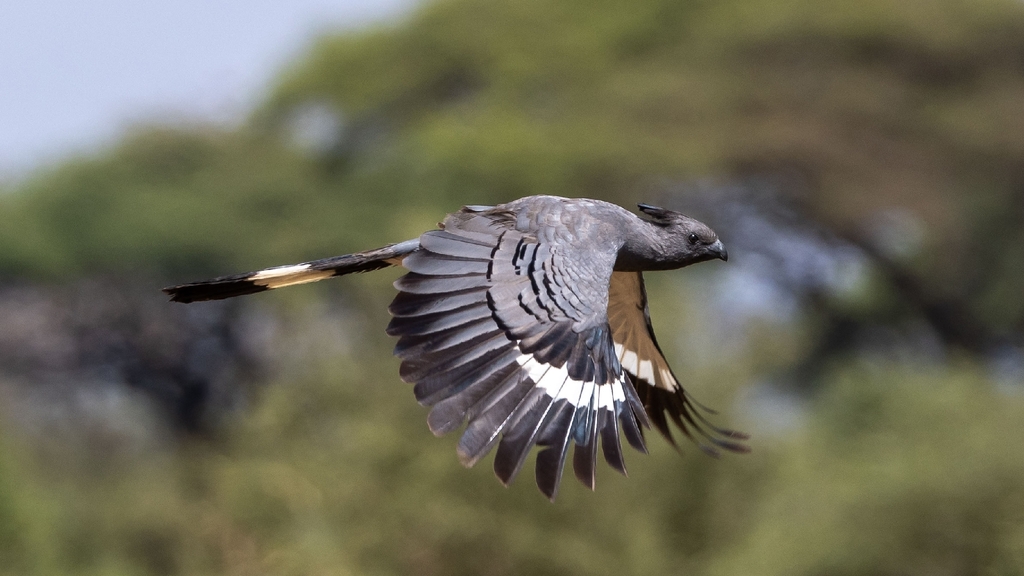
White-bellied Go-away-bird
Photo © Barry Stewart
Photo © Barry Stewart — CC BY 4.0 — Source: iNaturalist photo #661232368Identification
The white-bellied go-away-bird is a distinctive turaco averaging 51 cm in length. Its most characteristic features include a long, pointed grey and black tail with a striking white median band, and a prominent dark grey to blackish pointed crest approximately 6 cm long. The bird's common name derives from two key field marks: a white belly and under-tail coverts, and a distinctive nasal call—a repeated "gwa" or "g'away" that sounds like bleating. In flight, look for a white under-wing patch. Males have black bills, while females sport pea-green bills (becoming yellowish during breeding season). Females are noticeably larger, weighing 225–250g compared to males at 170–225g. Juveniles resemble adults but display more brown plumage, especially on the wing-coverts.
Range & Habitat
This species is endemic to eastern Africa, with a wide distribution across the Horn of Africa and beyond. It is found in Burundi, Djibouti, Eritrea, Ethiopia, northern and eastern Kenya, Rwanda, Somalia, South Sudan, northeastern Uganda, and southwards into the eastern plateau of Tanzania. The white-bellied go-away-bird inhabits hot acacia-steppe, savanna, and woodland areas, avoiding deep forest. The species occurs across a vast range exceeding 3 million square kilometres, at elevations from sea level up to 2000 metres. Birds are sedentary within their local ranges, wandering primarily in response to water and food availability rather than undertaking true migration.
Behaviour & Diet
White-bellied go-away-birds are gregarious and highly vocal, moving in family groups of up to 10 individuals. They are territorial, with breeding pairs likely maintaining year-round territories. These birds feed primarily on plant matter—fruits, flowers, nectar, seeds, and buds of acacias—supplemented by invertebrates such as winged termites. Their exceptional agility as climbers enables them to forage easily in tree tops, though this dietary habit has earned them a reputation as agricultural pests in some regions, where they raid orchards and fruiting plantations. During breeding season, which typically coincides with the rains, birds become considerably more vocal and engage in elaborate courtship displays involving tree-to-tree chases, bowing, and tail-flicking while raising and lowering the crest to showcase the striking black and white patterning.
Best Time & Places to See It
The breeding season, generally timed with local rains, offers the best opportunity to locate this species, as birds become noticeably more vocal and active. The white-bellied go-away-bird's wide distribution across eastern Africa, from the Horn of Africa through Kenya, Uganda, Tanzania, and southwards, provides numerous possibilities for encounters. Look for them in acacia woodlands and savannas within the species' range. Their gregarious nature and loud, distinctive calls make them relatively conspicuous when present, though sighting success depends on local habitat conditions and water availability.
Photography Tips
The bird's striking long tail with its white median band and contrasting dark plumage provides excellent photographic subjects, particularly in flight when the white under-wing patch becomes visible. The prominent crest and black-and-white patterning are enhanced during courtship displays—capturing these moments would showcase the bird's most dramatic features. Early morning is ideal for photography, as the birds are vocal and active. Position yourself near acacia trees where they forage or roost. The birds' tendency to fly in loose straggling groups calling loudly means patient observation of promising habitat should yield opportunities. Their semi-zygodactylous feet (flexible outer toe) and agile climbing behaviour can also provide interesting behavioural shots while foraging in tree canopies.
Serengeti National Park
Tanzania
+558 birds+57 mammals
Across Tanzania's northern plateau, where volcanic soils meet acacia woodland and open grassland, unfolds one of Earth's most dynamic ecosystems. The Serengeti National Park sprawls across…
VIEW NATIONAL PARKArusha National Park
Tanzania
+555 birds+16 mammals
Where the slopes of Mount Mawenzi rise above the Arusha region, a compact yet ecologically rich national park unfolds across montane forest, moorland, and alpine zones.…
VIEW NATIONAL PARKKidepo Valley National Park
Uganda
+478 birds+24 mammals
Where the Narus and Kidepo rivers carve through northeastern Uganda's semi-arid lowlands, a landscape of sparse acacia woodland, grassland, and riverine thickets creates one of East…
VIEW NATIONAL PARKTsavo East National Park
Athi ward, Kenya
+468 birds+50 mammals
Across the semi-arid lowlands of southeastern Kenya, where acacia woodland fragments into scrubland and the landscape rolls toward the Indian Ocean horizon, lies one of Africa's…
VIEW NATIONAL PARKTsavo West National Park
Mwatate, Kenya
+513 birds+49 mammals
Where volcanic ridges and weathered lava flows meet the semi-arid lowlands of south-central Kenya, Tsavo West National Park unfolds across a landscape sculpted by fire and…
VIEW NATIONAL PARKAmboseli National Park
Etonet/Lenkism ward, Kenya
+501 birds+43 mammals
Where the Amboseli basin opens toward the Tanzanian frontier, a shallow alkaline lake mirrors vast skies across one of East Africa's most iconic savanna landscapes. The…
VIEW NATIONAL PARKKilimanjaro National Park
Kenya
+207 birds+16 mammals
Africa's highest mountain rises not in isolation but as the centerpiece of a vast national park that sweeps across the borderlands of northern Tanzania, where savanna…
VIEW NATIONAL PARKTarangire National Park
Tanzania
+527 birds+50 mammals
Acacia woodland and grassland sweep across the Manyara Region where the Tarangire River carves through low hills and volcanic soils, creating one of East Africa's most…
VIEW NATIONAL PARKNgorongoro Conservation Area
Tanzania
+626 birds+55 mammals
Volcanic calderas and open grassland dominate this high plateau in northern Tanzania, where the landscape rises above 2,000 metres and ancient geological forces have shaped both…
VIEW WILDLIFE MANAGEMENT AREAAbijata-Shalla Lakes National Park
Ethiopia
+438 birds+7 mammals
Two crater lakes of contrasting chemistry define this remote corner of Ethiopia's Rift Valley, where soda lakes and freshwater basins create a mosaic of distinct aquatic…
VIEW NATIONAL PARKBale Mountains National Park
Ethiopia
+397 birds+20 mammals
Where the Ethiopian highlands rise above 4,000 metres, the Bale Mountains create a landscape of stunning ecological extremes—from afroalpine grasslands swept by wind and mist to…
VIEW NATIONAL PARKMago National Park
Ethiopia
+128 birds+3 mammals
Where the Omo River cuts through southern Ethiopia's arid borderlands, Mago National Park sprawls across a landscape of dramatic escarpments, riverine forests, and semi-arid savanna that…
VIEW NATIONAL PARKOmo National Park
Ethiopia
+61 birds+4 mammals
Where the Omo River carves through southwestern Ethiopia, a landscape of riverine woodland, acacia savanna, and scattered grassland unfolds across one of East Africa's most remote…
VIEW NATIONAL PARKAwash National Park
Didiga, Ethiopia
+473 birds+23 mammals
Where the Ethiopian Rift Valley carves through volcanic plateaus, a ribbon of riverine forest winds through acacia scrubland and grassland, creating a mosaic of habitats that…
VIEW NATURAL PARKNech Sar National Park
Arba Minch, Ethiopia
+191 birds+10 mammals
Where the East African Rift Valley plateaus drop dramatically toward the shore of Lake Abaya, a mosaic of habitats unfolds across sun-scorched savanna and acacia woodland.…
VIEW NATIONAL PARKYabelo Wildlife Sanctuary
Bedewera, Ethiopia
+359 birds+5 mammals
Where acacia woodlands meet volcanic plateaus in southern Ethiopia, a landscape of austere beauty unfolds across nearly 2,500 square kilometers. Yabelo Wildlife Sanctuary sprawls across semi-arid…
VIEW WILDLIFE SANCTUARYNairobi National Park
Nairobi, Kenya
+515 birds+35 mammals
Just minutes from Kenya's capital, where the Nairobi River winds through acacia woodland and open grassland, lies one of Africa's most paradoxical wildlife sanctuaries. The park's…
VIEW NATIONAL PARKLake Nakuru National Park
Nakuru West, Kenya
+494 birds+32 mammals
Alkaline waters ringed by acacia woodland and grassland create one of East Africa's most distinctive wetland ecosystems, where the interplay of geology and climate sustains a…
VIEW NATIONAL PARKMeru National Park
Igembe Central, Kenya
+408 birds+38 mammals
Granite outcrops and acacia woodland rise across the northern reaches of Meru, where semi-arid savanna transitions into drier scrubland under the fierce equatorial sun. The park's…
VIEW NATIONAL PARKSamburu National Reserve
Samburu, Kenya
+430 birds+42 mammals
Across the arid plains of northern Kenya, where scattered acacia woodland gives way to rocky outcrops and dry riverbeds, Samburu National Park unfolds as one of…
VIEW NATURE RESERVEHell’s Gate National Park
Olkaria ward, Kenya
+388 birds+18 mammals
Volcanic scarps and geothermal vents dominate the floor of Hell's Gate, where the East African Rift has carved a dramatic gorge through crystalline rock formations. The…
VIEW NATIONAL PARKChyulu Hills National Park
Kibwezi East, Kenya
+232 birds+30 mammals
Volcanic cones rise abruptly from the Kenyan savanna floor, their flanks clothed in dense acacia woodland and grassland that transforms the Chyulu Hills into an ecological…
VIEW NATIONAL PARKOl Donyo Sabuk National Park
Matungulu North ward, Kenya
+200 birds
Granite peaks rise abruptly from the highland plateau of Matungulu North, their weathered slopes clothed in scattered woodland and montane grassland that shifts between verdant and…
VIEW NATIONAL PARKSibiloi National Park
Kenya
+118 birds
Where the northern deserts of Kenya meet the volcanic Chalbi Plain, Sibiloi National Park sprawls across a landscape shaped by millennia of tectonic upheaval and semi-arid…
VIEW NATIONAL PARKArabuko Sokoke Forest Reserve
Kilifi, Kenya
+383 birds+29 mammals
Coastal forest rises from the Indian Ocean plains of Kilifi County, where sandy soils and seasonal rainfall have sculpted a woodland ecosystem unlike anywhere else on…
VIEW NATURE RESERVEWatamu Marine National Park
Dabaso ward, Kenya
+328 birds+12 mammals
Where mangrove channels meet coral gardens and sandy shallows blend into the warm waters of the Indian Ocean, Watamu Marine National Park unfolds across the Kilifi…
VIEW NATIONAL PARKNo community photos yet. Log in to add the first one.
No community observations of this species yet.