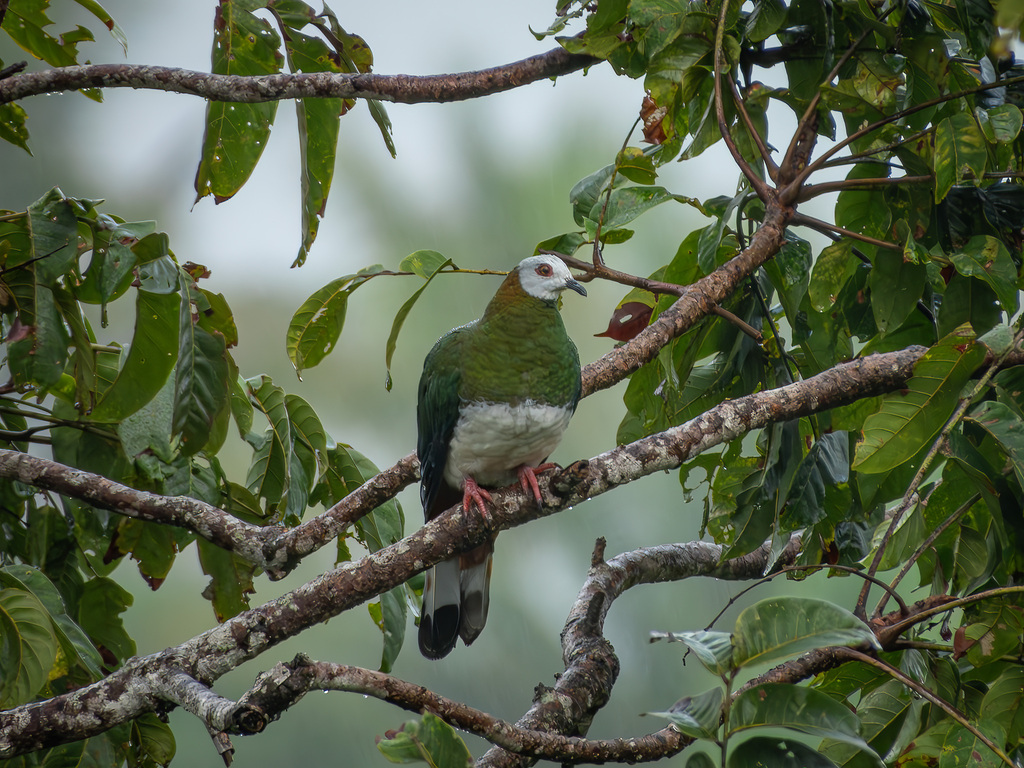
White-bellied Imperial Pigeon
Photo © Jason Alexander
Photo © Jason Alexander — CC BY 4.0 — Source: iNaturalist #292319897The white-bellied imperial pigeon (Ducula forsteni) is a species of bird in the pigeon family Columbidae. First described by the French ornithologist Charles Lucien Bonaparte in 1854, it is endemic to Indonesia, where it is found on Sulawesi, Buton, Taliabu, Togian, and Peleng. It inhabits primary forest, dense secondary forest, and isolated areas of hill forest. A large pigeon with a long tail, it measures 42.5–51.5 cm (16.7–20.3 in) long and weighs 510 g (18 oz) on average. Males are mainly green, with pale-grey heads and bellies, chestnut vents, and a pale grey tail band, along with a red orbital ring. Females are nearly identical, but have darker grey areas in their plumage. The white-bellied imperial pigeon feeds on fruit. It is listed as being of least concern by the International Union for Conservation of Nature (IUCN) on the IUCN Red List due to its sufficiently large range and lack of significant population decline. However, its population is declining due to habitat destruction. == Taxonomy and systematics == The first specimens of the white-bellied imperial pigeon were collected in May 1840 by the Dutch naturalist Eltio Alegondas Forsten from near Lake Tondano in northern Sulawesi. He recognised these specimens are…
Bogani Nani Wartabone National Park
Bolaang Mongondow, Indonesia
+154 birds+4 mammals
Across North Sulawesi's rugged interior, where tectonic uplift has carved steep ridges and deep valleys through ancient volcanic terrain, Bogani Nani Wartabone National Park sprawls across…
VIEW NATIONAL PARKLore Lindu National Park
Indonesia
+177 birds+4 mammals
Across the mountainous spine of Central Sulawesi spreads a wilderness of montane forest, rolling ridges, and deep valleys that rises from the island's volcanic bedrock to…
VIEW NATIONAL PARKNo community photos yet. Log in to add the first one.
No community observations of this species yet.