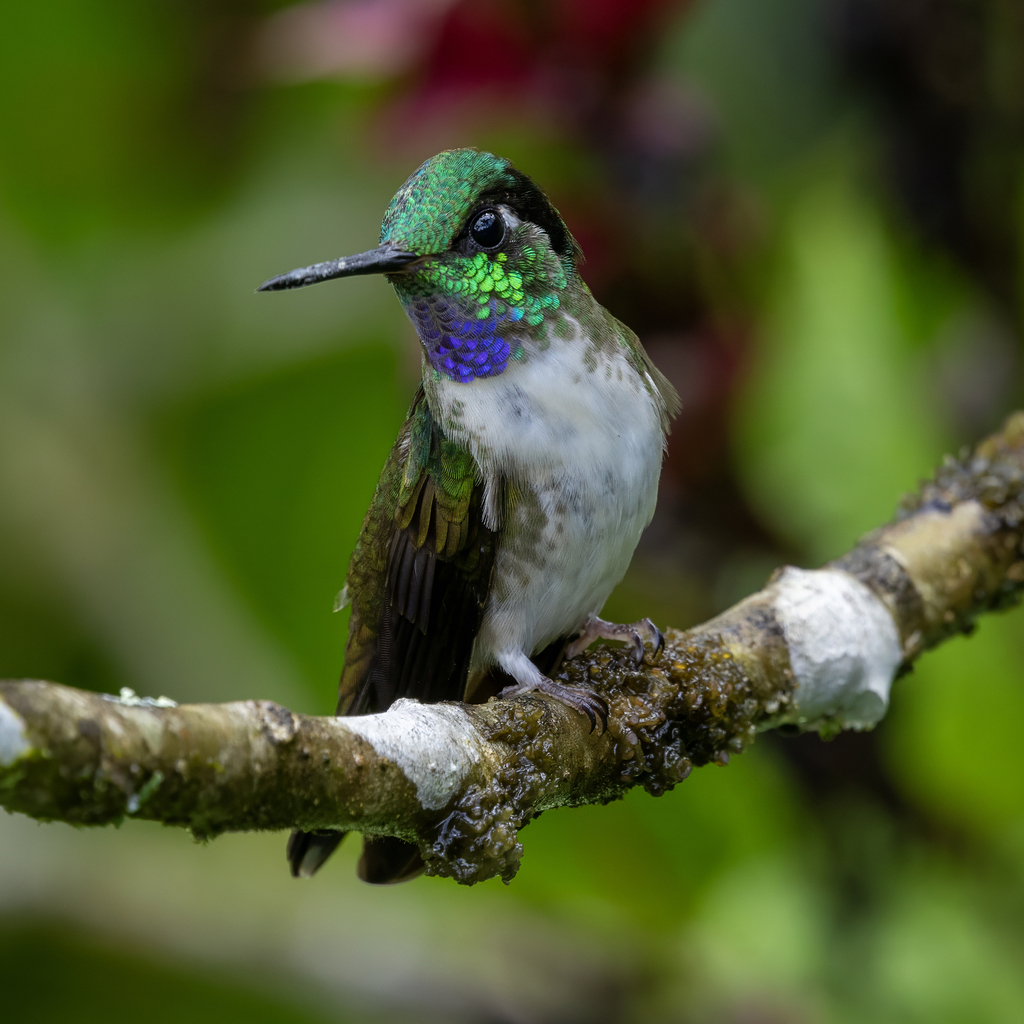
White-bellied Mountaingem
Photo © Dan Vickers
Photo © Dan Vickers — CC BY 4.0 — Source: iNaturalist #256005697Identification
The white-bellied mountaingem is a small hummingbird measuring 10 to 11 cm in length, with males weighing approximately 6.2 g and females 5.1 g. Both sexes are immediately recognizable by a striking long white stripe behind the eye, a medium-length black bill, and pinkish feet. Adult males display a glittering green face and crown, bronzy-green upperparts, and a distinctive blue-violet gorget contrasting sharply with white underparts speckled with green along the sides. Females are similar but with less glittering facial plumage and a white throat with green speckles rather than a colored gorget. Juveniles of both sexes show rusty fringes on their green feathers, while young males display a dull bronze gorget.
Range & Habitat
This species is endemic to Central America, found on the Caribbean slope from north-central Costa Rica south and east into western Panama as far as Veraguas Province, with a secondary presence on the Pacific slope in Panama. The white-bellied mountaingem inhabits the canopy of cool, very wet subtropical forests, particularly between 700 and 1,400 m elevation during breeding season, descending to 400–600 m afterward. It also frequents shrub-level vegetation at forest edges, gaps, and clearings, but generally avoids secondary forest and semi-open landscapes.
Behaviour & Diet
This species is an aggressive and dominant forager, with males establishing authority over larger hummingbird species at flowering epiphytes, particularly those in the Ericaceae family and genus Columnea. Beyond nectar, it supplements its diet with insects captured through hawking, while females also glean small arthropods directly from foliage. The white-bellied mountaingem produces a remarkable variety of vocalizations: its song comprises a medley of squeaks, dry or liquid trills, and sputtering notes, while chasing birds emit squeaky sputtering trills. Other calls include repeated nasal notes and rattling sequences. Breeding occurs between August and March in Costa Rica, though specific nest structure and full breeding details remain undocumented.
Best Time & Places to See It
The breeding season from August through March offers the best opportunity to locate this species, particularly at elevations between 700 and 1,400 m in cloud forest habitat. After breeding, birds move to lower elevations of 400–600 m, making them accessible across a broader vertical range. Three Costa Rican national parks protect much of this hummingbird's preferred habitat and represent excellent locations for encounters. The species is considered locally common throughout its range, making it a rewarding subject for patient observers in appropriate elevation zones.
Photography Tips
The white-bellied mountaingem's small size and preference for the forest canopy present challenges, but its tendency to visit flowering epiphytes and shrubs at forest edges provides opportunities for observation and photography. The striking white eye-stripe and male's blue-violet gorget are distinctive field marks worth capturing. Early morning light often reveals the iridescent quality of male plumage most effectively. Fast shutter speeds are essential for freezing the rapid wing beats typical of hummingbirds. Patience near flowering plants, especially ericads and Columnea species, increases the likelihood of prolonged views and quality photographs of this aggressive yet beautiful species.
Arenal Volcano National Park
Baru Volcano National Park
Braulio Carrillo National Park
Parque Internacional la Amistad
Tapantí Macizo de la Muerte National Park
Volcán Poás National Park
Volcán Tenorio National Park
Nothing matches these filters.
No community photos yet. Log in to add the first one.
No community observations of this species yet.