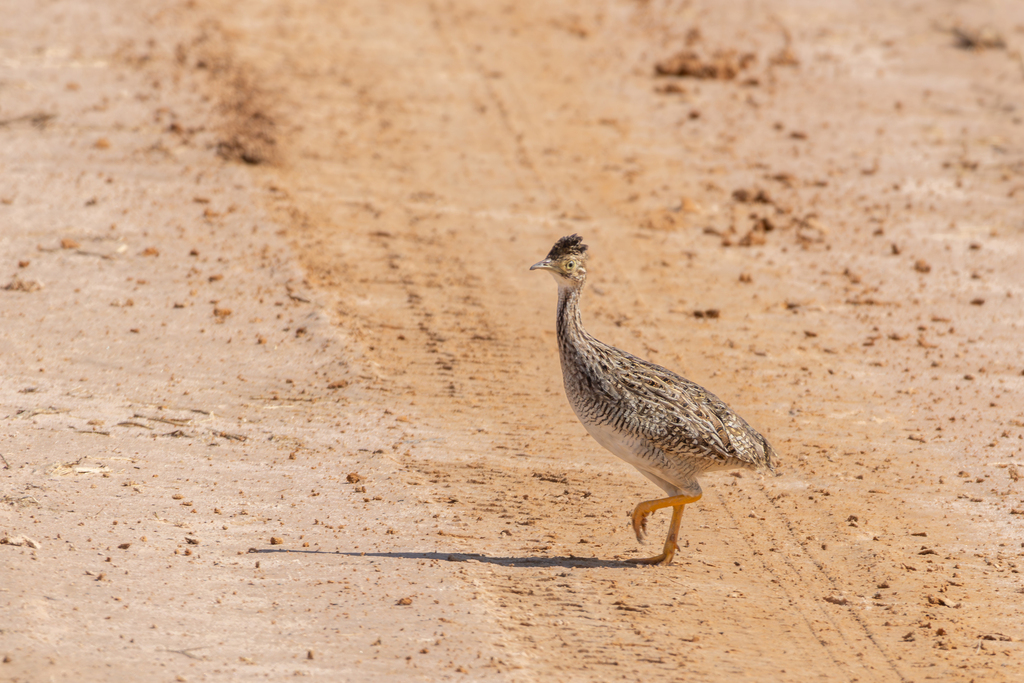
White-bellied Nothura
Photo © Francisco V. Bezerra Neto
Photo © Francisco V. Bezerra Neto — CC BY-SA 4.0 — Source: iNaturalist photo #675488697Identification
The white-bellied nothura is a small tinamou, measuring approximately 27 cm (11 inches) in length. Despite their small size, these birds are members of the ratite family and can fly, though they are not particularly strong fliers—a characteristic that distinguishes tinamous from all other ratites. The species is named for its distinctive white belly, which contrasts sharply with its buff breast. The upper parts are light brown and barred with black and white streaks, while the crown is dark brown. The sides of the head are buff-colored, and the throat is white with black streaking on the foreneck. A useful field mark for identification is the bird's bright yellow legs. If you observe the wing structure closely, the inner webs of the primaries are uniformly dark, which helps distinguish this species from the closely related spotted nothura.
Range & habitat
The white-bellied nothura is endemic to South America, with a range spanning northeastern Bolivia, western Paraguay, and northeastern and central Brazil. This species has a substantial occurrence range of 1,400,000 square kilometers. The bird is highly specialized for arid environments, preferring dry shrubland regions at altitudes up to 500 meters (1,600 feet). Beyond shrublands, it can also be found in dry grassland, savanna, caatinga (a semi-arid scrubland ecosystem), and occasionally in pastures, making it adaptable to various open and semi-open dry habitats across its range.
Behaviour & diet
Like other tinamous, the white-bellied nothura is primarily a ground feeder, foraging for fruit fallen from or growing on low-lying bushes. Its diet is supplemented with small amounts of invertebrates, flower buds, tender leaves, seeds, and roots. The species has an unusual breeding system: males are responsible for incubating eggs and raising chicks, and a single male may incubate eggs from as many as four different females. This polyandrous arrangement is remarkable in the bird world. The nest is located on the ground in dense brush or between raised root buttresses, providing shelter for the clutch. After hatching, the male tends the chicks until they are independent, typically after 2–3 weeks.
Best time & places to see it
The white-bellied nothura is classified by the IUCN as Least Concern, indicating stable populations across its range. For the best chances of encountering this species, focus your efforts in the dry shrubland and caatinga regions of northeastern Brazil, eastern Bolivia, and western Paraguay. The bird's preference for open and semi-open habitats makes it more accessible to observers than some forest-dwelling tinamous, though it remains elusive due to its cryptic coloration and ground-dwelling habits. Early morning is typically the best time to search, when the birds are most active.
Photography tips
Photographing the white-bellied nothura presents challenges typical of ground-dwelling birds. The species' cryptic plumage and preference for dense brush and grassland mean patience and a keen eye are essential. Use a telephoto lens to maintain distance and avoid flushing the bird from cover. The bright yellow legs are a distinctive feature worth capturing, as are the contrasting white belly and buff breast. Be prepared for quick flights if the bird becomes alarmed; while not strong fliers, tinamous will flush explosively when threatened. Early light conditions will help showcase the subtle barring and streaking on the bird's upper parts.
Serra do Cipó National Park
Brazil
+379 birds+5 mammals
Where granite escarpments rise above the Atlantic Forest transition zone in southeastern Brazil, Serra do Cipó National Park unfolds across a landscape of dramatic ridges, cascading…
VIEW NATIONAL PARKSerra do Teixeira National Park
Brazil
+160 birds+5 mammals
Rugged plateaus and deep escarpments define this 3,112-square-kilometre sweep of the Brazilian Northeast, where the crystalline bedrock of the Borborema Plateau rises abruptly from the surrounding…
VIEW NATIONAL PARKSerra da Capivara National Park
Brazil
+156 birds+6 mammals
Across the semi-arid plateaus and deeply incised canyons of northeastern Brazil, where Piauí's ancient sandstone formations rise and fall in weathered waves, Serra da Capivara National…
VIEW NATIONAL PARKChapada Diamantina National Park
Brazil
+346 birds+5 mammals
Where granite peaks and sandstone cliffs rise abruptly from the Brazilian interior, Chapada Diamantina National Park sprawls across 4,215 square kilometers of some of Brazil's most…
VIEW NATIONAL PARKCatimbau National Park
Brazil
+118 birds+6 mammals
Where sandstone plateaus rise from the semi-arid scrublands of northeastern Brazil, Catimbau National Park unfolds across more than 1,000 square kilometres of geological drama and surprising…
VIEW NATIONAL PARKNo community photos yet. Log in to add the first one.
No community observations of this species yet.