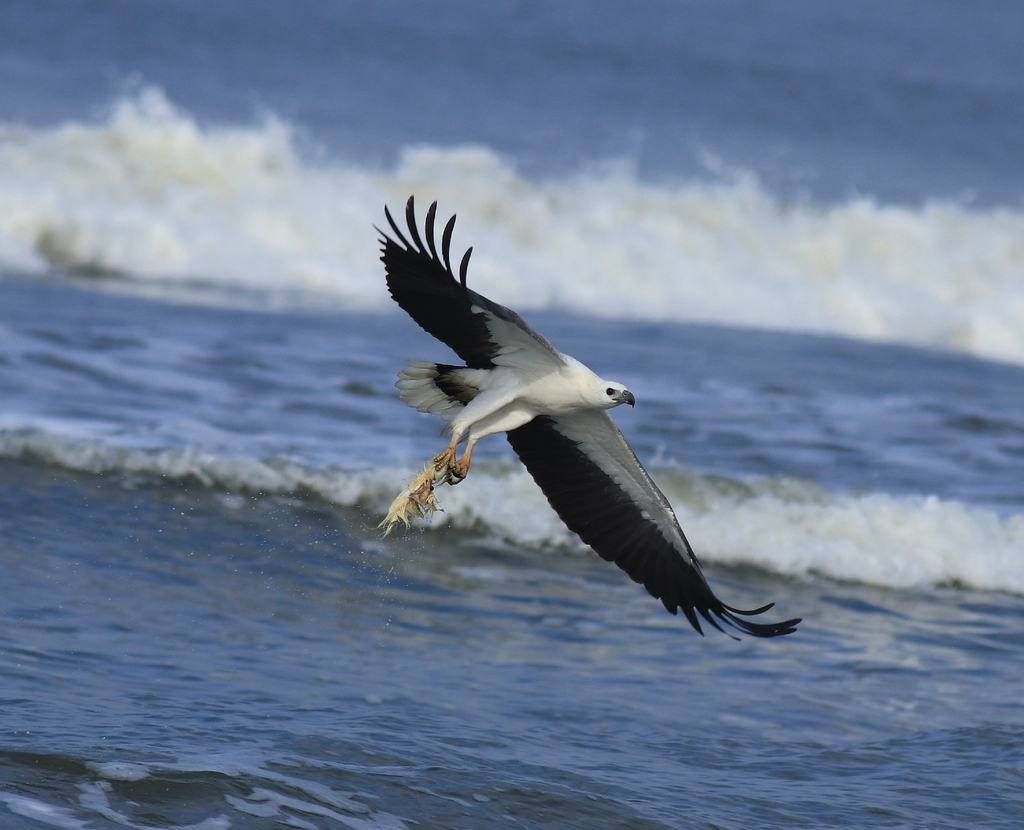
White-bellied Sea Eagle
Photo © Afsar Nayakkan
Photo © Afsar Nayakkan — CC BY 4.0 — Source: iNaturalist photo #606673267Identification
The white-bellied sea eagle is a large, unmistakable raptor with striking plumage. Adults display a white head, breast, underparts and tail, contrasting sharply with a dark slate-grey back and wings. In flight, the black flight feathers are easily visible against white wing coverts when viewed from below. The bird has a large, hooked leaden blue-grey bill with a darker tip, dark brown eyes, and yellow or grey legs with long black talons. The tail is short and wedge-shaped, characteristic of all sea eagles in the Haliaeetinae subfamily. In silhouette, the comparatively long neck, head and beak extend almost as far forward as the tail extends backward.
Females are noticeably larger than males, measuring up to 90 cm in length with a wingspan up to 2.2 metres and weighing up to 4.5 kg. Immature birds are predominantly brown and gradually acquire white plumage, not reaching full adult colouration until around five or six years of age. The bird's distinctive loud, goose-like honking call is often heard before it is seen.
Range & Habitat
The white-bellied sea eagle is resident across a vast range extending from India and Sri Lanka through Southeast Asia to Australia, always remaining close to coasts and major waterways. This waterway dependency reflects its hunting and breeding ecology, as the species relies on proximity to suitable fishing grounds and tall trees for nesting. Although globally rated as Least Concern, populations have declined significantly in parts of its range, particularly in Thailand and southeastern Australia, where it is ranked as Threatened in Victoria and Vulnerable in South Australia and Tasmania.
Human disturbance poses the greatest threat to the species throughout its range. Direct human activity near nesting sites impacts breeding success, while removal of suitable large trees for nesting further reduces available habitat. Despite these pressures, the species remains widespread and is deeply revered by indigenous peoples across Australia, featuring prominently in various folk tales and cultural traditions.
Behaviour & Diet
The white-bellied sea eagle hunts from a distinctive flying style, alternating strong, deep wing-beats with short periods of gliding. When gliding, the wings rise from the body at an angle before becoming more horizontal along the wingspan. Fish comprise around half of the bird's diet, reflecting its waterside hunting specialisation. However, the species is highly opportunistic and will consume carrion and a wide variety of other animals to supplement its diet.
Best Time & Places to See It
Look for white-bellied sea eagles along coasts and major waterways throughout their range from India and Sri Lanka through Southeast Asia to Australia. The bird's large size, distinctive white and dark plumage, and characteristic loud honking calls make it relatively conspicuous when present. Search open water and areas with tall trees suitable for nesting and hunting perches.
Photography Tips
The white-bellied sea eagle's striking contrast between white underparts and dark upperparts makes it highly photogenic. When photographing from below, aim to capture the distinctive black flight feathers against the white wing coverts in flight. The bird's large size and waterside habitat provide opportunities for dynamic action shots of hunting dives or water takeoffs. The long neck and prominent head profile visible in silhouette are distinctive features worth emphasizing in your composition.
Minneriya National Park
Angamedilla National Park
Annan River (Yuku Baja-Muliku) National Park
Bako National Park
Bandipur National Park
Bogani Nani Wartabone National Park
Budj Bim National Park
Cania Gorge National Park
Carnarvon National Park
Nothing matches these filters.
No community photos yet. Log in to add the first one.
No community observations of this species yet.