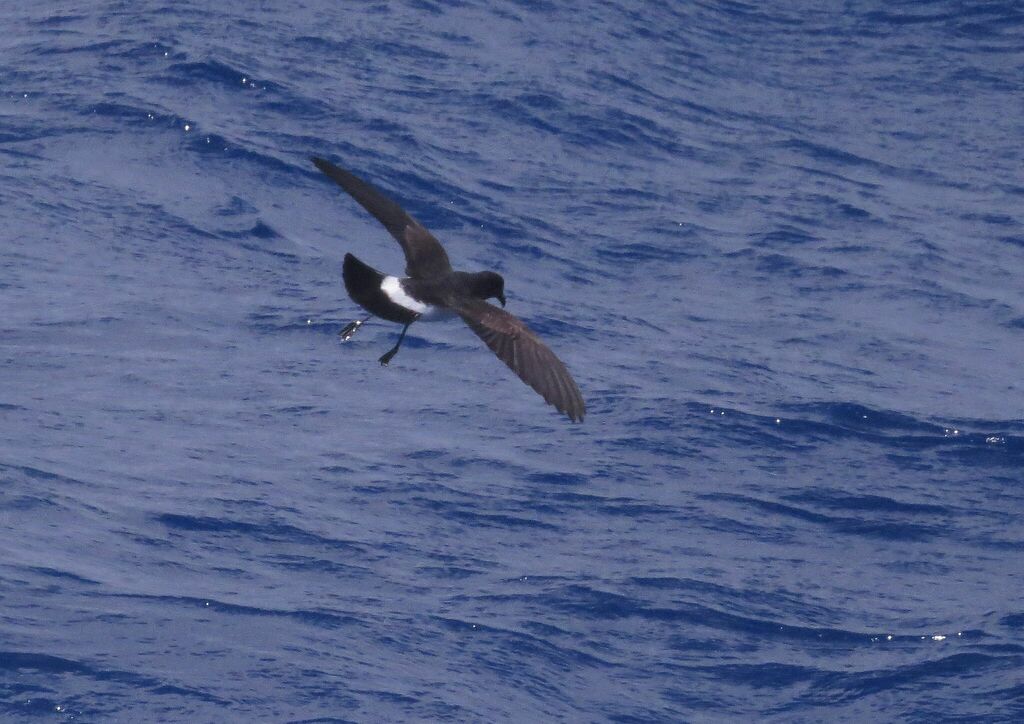
White-bellied Storm Petrel
Photo © ian_mcallan
Photo © ian_mcallan — CC BY 4.0 — Source: iNaturalist photo #363600070Identification
The white-bellied storm petrel is a small seabird, measuring 18–20 centimetres in length with a wingspan of 46–48 cm. It is characterized by dark upper parts and light-coloured underparts, with distinctive white upper tail coverts. The species displays polymorphic plumage patterns in black, grey, and white, including a largely dark variant, though plumage variation between sexes and ages has not been documented. Its fine black bill, square tail, and notably long legs are distinguishing features—the toes do not usually project beyond the tail. As a tubenose (member of the Procellariiformes order), it possesses the characteristic tubular nostrils typical of petrels. The white-bellied storm petrel can be easily confused with similar species of black and white storm petrels, making identification challenging.
Range & Habitat
The white-bellied storm petrel is found across the Southern Hemisphere, with a widespread range throughout the Pacific, Atlantic, and Indian Oceans. Its distribution includes breeding colonies on remote offshore islands such as Lord Howe Island and the Kermadec Islands (south-west Pacific), the Juan Fernández and Desventuradas Islands (southeast Pacific), Easter Island (south Pacific), Tristan da Cunha and Gough Island (Atlantic), and Île Saint-Paul (Indian Ocean). The species is highly pelagic, spending most of its time on open seas. Its movements at sea remain poorly understood, though it is thought to migrate some distance northward, with maximum dispersal estimated at several thousand kilometres.
Behaviour & Diet
This elusive seabird is highly pelagic and rarely observed. It is nocturnal when ashore and visits land infrequently, primarily near breeding colonies. In flight, it exhibits a characteristic low gliding pattern with pattering and dipping to feed, stepping off the water's surface with its legs in an asymmetrical gait. The species has been observed feeding alongside other seabirds and following ships. Its diet consists of small crustaceans, small squid, and sea skaters, obtained by skimming across the water and dipping to catch prey near the surface.
Best Time & Places to See It
The white-bellied storm petrel is highly pelagic and rare, making it uncommonly observed even by experienced birders. The best opportunities to encounter this species involve visiting known breeding islands during the breeding season, which occurs in late summer and early autumn. Egg-laying takes place between January and March, with fledgling chicks visible from mid-April to May. Notable breeding locations include Lord Howe Island, the Kermadec Islands, the Juan Fernández Islands, and Gough Island. However, sightings at sea remain unpredictable given the species' elusive nature and poorly understood pelagic distribution.
Photography Tips
Photographing the white-bellied storm petrel presents significant challenges due to its pelagic habits and rarity. The species' dark plumage above and light underparts require careful exposure management, particularly when birds are skimming low over water in variable light conditions. Patient seabird photography from boats near breeding islands during the breeding season offers the most realistic opportunity for images. The bird's characteristic low, gliding flight and dipping feeding behaviour provide dynamic photographic moments, though the small size and speed of movement demand a fast shutter speed and good autofocus capability.
No community photos yet. Log in to add the first one.
No community observations of this species yet.